Thursday, 18 June 2015

30 Days Wild - Day 15 and 16 - Zooming in on familiar places

Days 15 and most of 16 were about revisiting familiar places and zooming in. In my own garden and on my Uckfield to Birmingham run, I am getting to know the best places to find wildlife. Sometimes experience tells me where to look but often I've been able to see something special because someone was generous with their knowledge.


Monday, June 15

Monday was a working at home day and, as I had another phone conference, I took my note book and a pen and tiptoed outside hoping that the loudly buzzing bees on the flowers wouldn't give me away. One of the others commented on the birdsong, and our client confessed that he'd taken the call in the garden. Emboldened I 'fessed up to being outside too. While I was outside, I saw white-tailed and early bumble bees, a carder bee and a pair of speckled wood butterflies.

Tuesday, June 16

Heading to Birmingham again. In a previous post, I said that a fellow commuter had showed me where to see some grey wagtails. So I looked over the River Uck, where it flows under the platform.
The River Uck from the station platform.

There were swifts screaming overhead and then ... there they were. I was delighted to see a pair of grey wagtails courting on the ledge, partly hidden by the leaves of the tree on the right of the photo.
Grey wagtails
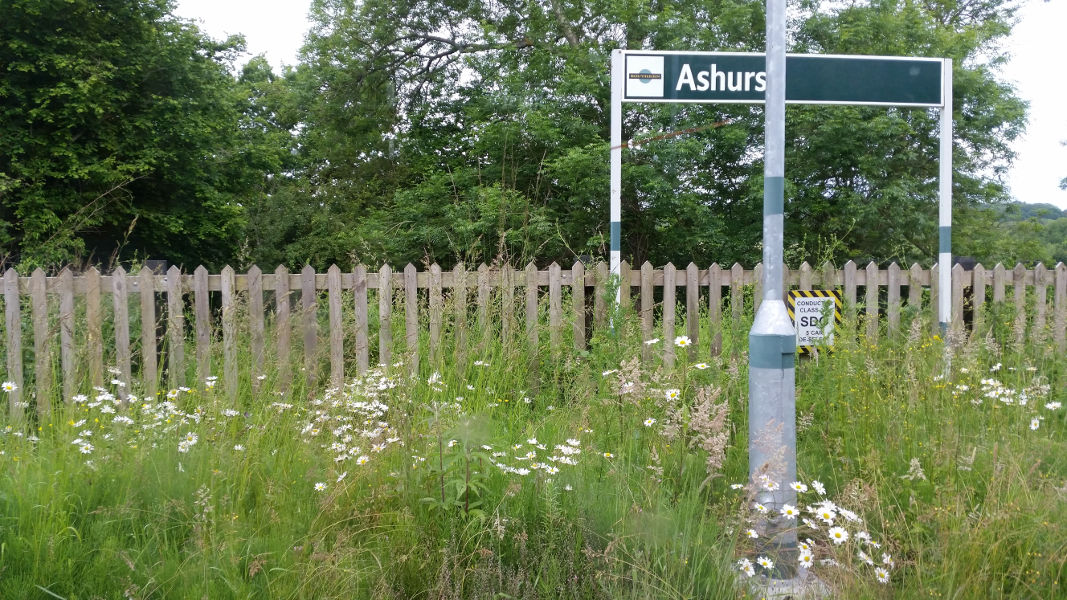
Just before Buxted, where I had previously seen some fallow deer, I saw a fallow doe and her fawn. Then, at Ashurst, a joyous romp of moon daisies.

Moon daisies at Ashurst.
One I got to Birmingham, I took a few moments to check out the wayside flowers, on my way into the office. There are quite a few roses, including both cultivated and wild varieties.

Wild roses between the road and main-line railway.
I paused for a moment by the white roses and noticed an iridescent green beetle.

Fat thighed beetle.
Then straight in to the office. I wanted to get into work as quickly as possible - I had a plan ...

Sunday, 14 June 2015

30 days wild - Days 13 and 14 - the Weekend!


It's the weekend and the first time I went on a #30DaysWild outing. So far all my encounters with nature have been opportunistic - squeezed in, sometimes while travelling. Saturday was still like that but on Sunday, I visited Ashdown Forest.


Saturday, June 13

On the way back from the shops, I was happy to see that East Sussex council had managed the mowing of local grass verges so that the wild flowers including orchids could flower.

Spotted orchid.
My Saturday lunchtime treat was to open up my trail camera and see what has been visiting our garden. To my surprise, a fox had appeared in daylight so we have some colour pictures rather than the usual infra red. The badger continues to be a total diva, rushing by so we don't get a decent photo.


Fox, visited in the afternoon on the 11th of June.
I did a little tidying and watering outside and was filling the pond when I heard calls. To my delight there was a family of pied wagtails on our roof.

Sunday, June 14 - Old Lodge Nature Reserve

The day was dry but rather overcast. I decided to head out to Sussex Wildlife Trust's Old Lodge Nature Reserve on Ashdown Forest. Even before I left the Uckfield bypass, I saw young rabbits feeding at the side of the road. Once I got to the reserve, I decided to concentrate on details because the light was too dull for landscape shots.

Lichen on birch trunk.
The first thing I spotted was lichens and mosses on a craggy old birch tree.  As I walked along the top edge of the reserve, I was fascinated by the colourful and rather weird pine flowers and amazed to find bluebells still out.

Pine flower.
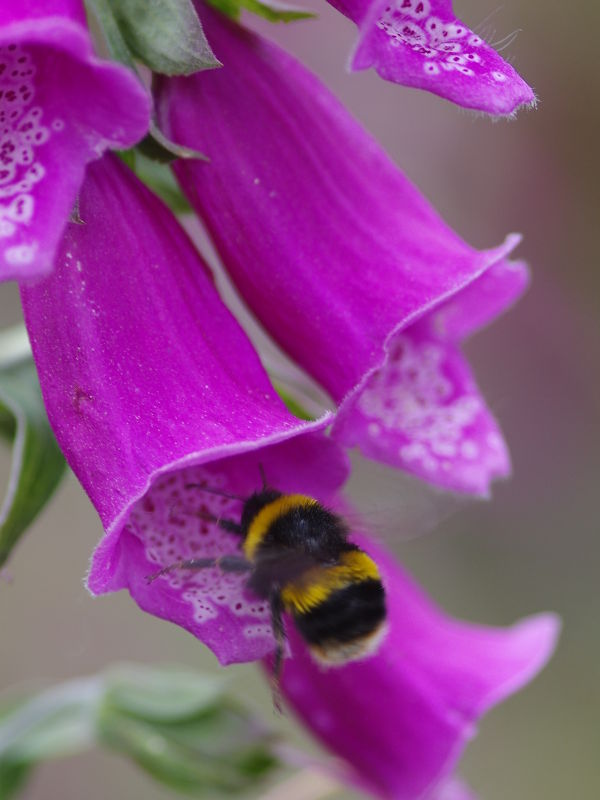
I was glad to see a cluster of foxgloves had sprung up again on the old bank and even more pleased to see a bumble bee scrambling in and out of the flowers.

Buff-tailed bumble bee on foxgloves.
Pink and purple flushes here and there show that the heaths and heathers are already beginning to bloom.

Cross-leaved heath.

Bell heather.
On the path down to the dragonfly ponds I noticed many other plants including the tiny, startlingly beautiful flowers of a sedge.

Heath sedge, just a few inches high.
Along the way I met a couple. The man was clutching binoculars and was pleased because he has seen a greater spotted woodpecker and heard the calls of its mate. The woman wanted to know about the white tufts she could see from the path. I explained they are cotton grass and told them about the green woodpecker I had seen on the higher ground.

Cotton grass.
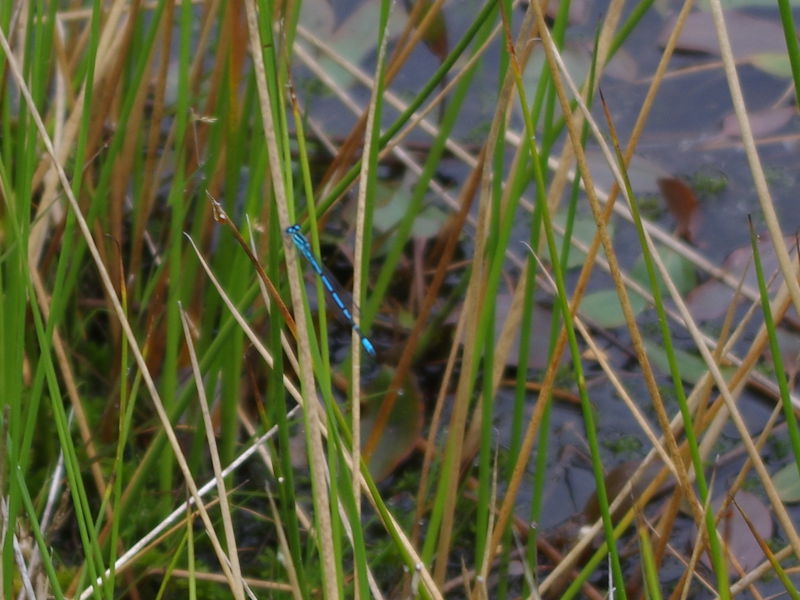
I think it is too early and certainly to dull for dragonflies but I did see a damselfly.

Damselfly - Common blue, I think.
I was far to slow to catch up with the many ochre coloured moths that I disturbed while walking but I did manage to photograph a brown china-mark moth, which is unusual in that its larvae are aquatic.
Brown china mark moth.
Across the path from the ponds, three ancient and magnificent beeches cast a deep shade.

Three huge, ancient beeches.
For me, the sight of these lovely and rather mysterious trees is always the high point of a visit to Old Lodge. After spending some time with them, I returned to the car, pausing to enjoy something on an altogether different scale.

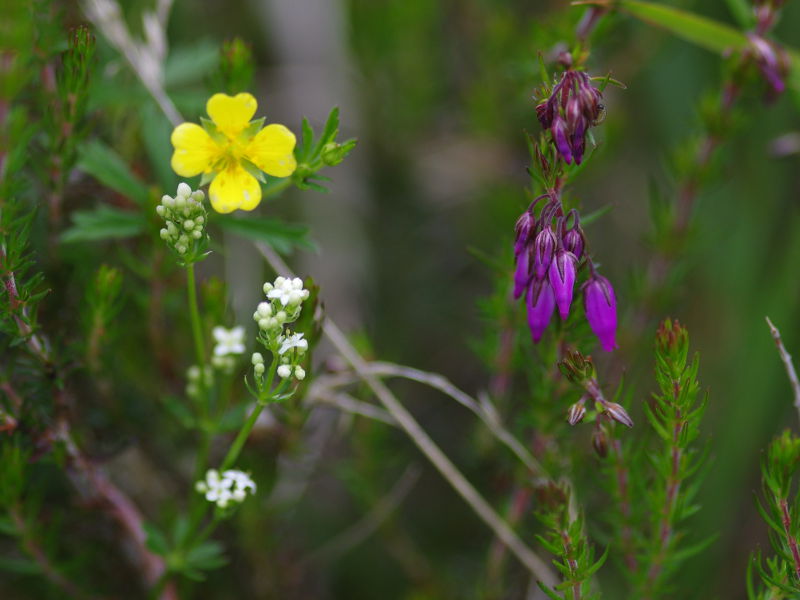
Tormentil, heath bedstraw and bell heather.
Three colourful little flowers had mixed to give the effect of a tiny garden.

Our own garden

After being out on the forest, our own garden seems so much more confined but is full of colour and interest. After lunch, I grazed my way through our alpine strawberries. Then I watched some bees feeding from our own foxgloves and borage. The borage had at least three different sorts of bee. White-tailed and early bumbles as well as a leaf cutter.

Patchwork leafcutter bee.
Just after 10pm, to round things off, I saw bats swooping past my window.

Saturday, 13 June 2015

30 Days Wild - Days 7 to 12 - Travelling

I'm continuing with 30 days wild. My first post was about me squeezing time out of a very busy week to see wildlife that had squeezed itself into our lives.  I'm juggling my time between Uckfield and Birmingham but my journey is nothing compared to that of some creatures, which travel enormous distances.


Sunday, June 7th

A week into 30 days wild, I finally some quality time in our garden. As I was trimming back the foliage threatening to overwhelm our windows I loved hearing the bees buzzing and the church bells ringing.

Tree bumblebee on ceanothus.
Many of the bees were tree bumblebees. BWARS tells us that these bees were first recorded in Britain in 2001. Since them they have travelled throughout Britain.

Monday, June 8th

I found a nest and attentive woodpigeon well camouflaged by the shadows of our robinia tree.

A homely woodpigeon with its nest hidden amongst exotic robinia flowers.
Tuesday, June 9th

The river Uck runs alongside our little station. Just before I got on the train, I enjoyed a serene moment watching the ducks.  I had a chat with a fellow commuter who had just been watching a pair of grey wagtails working their way along a ledge near the edge of the platform. We discussed the lack of insects this year and how some exotic ducks have joined forces with our local mallards.

Ducks on the Uck.
Most of the time, I was busy reading documents on my laptop but I was able to glance out of the window and enjoy nature as I travelled. As we pulled into Buxted, I spotted a herd of fallow deer. A carpet of wild flowers was an unexpected treat at Milton Keynes.

Carpet of wild flowers seen from train window at Milton Keynes.
Later, when I looked out of the window of my Birmingham hotel room, I was astounded to see house martins darting around almost at eye level. These little birds will have travelled from Africa and are nesting under the eves of the hotel.

Wednesday, June 10th

On Wednesday morning I got up early and dropped my laptop off in the office and settled down by a nearby pond to watch this little slice of nature wake up.

Just a few steps but a world away from the office.
The first birds I saw were a moorhen and two chicks. Then a coot, dabbling under the surface for its waterweed breakfast.

Rushes provide perfect cover for coots and other birds.
As a female tufted duck ventured across the pond a furious coot appeared out of nowhere. Maybe it was defending a nest?  As I returned to the office, a rabbit lolloped into the bushes.

Thursday, June 11th

On the way out of the Arden, I spotted one of the house martins zoom into a nest made from a thousand beakfulls of mud. I stacked my baggage by the kerb and watched them for a while. As passenger jets roared into the air behind them, about half a dozen of these African visitors seemed to dance in the air by the hotel.

Arrivals.


Departures.
 
Friday, June 12th

Today's wildlife moment was sad but gave me a chance to get close to something lovely. A blackbird had hit one of our windows and died. I was able to examine his subtly coloured plumage and vivid yellow beak. There was a perfect graduation from the tiny soft feathers on his back to the long flight feathers on the tips of his wings.

Blackbird wing.
Of course, my drawing doesn't do the blackbird justice but spending time trying to copy the shapes of the feathers gave me time to appreciate just how lovely this fallen angel was and how perfectly birds have evolved for flying.

So the last few days have been about appreciating how good wild creatures are at travelling. They may be tiny compared to our trains and jets but they are never stopped by a signal failure or lost baggage.

Saturday, 6 June 2015

30 Days Wild - Days 1 to 6 - Squeezing in

When I first heard about 30 Days Wild, a challenge in which you do something wildlife related, my heart leapt. Then it sank. I knew it was starting on the 1st of June, the Monday of what was going to be an exceptionally busy week. Surely I would never be able to fit it in.  I decided it would do no harm to try and squeeze in some nature observations while I went about my working week.

Monday, June 1st

I took my phone meeting in the garden. Buzzing bees and chattering sparrows are nicer than a screeching printer! I saw white-tailed bumble bees like the one shown, a tree bumblebee and a marmalade hoverfly on the weigela next to the bench I perched on for the call.
White-tailed bumblebee on the weigela next to our garden bench.

Tuesday, June 2nd

Just before leaving for Birmingham I tweeted that I was feeling and hearing the awesome power of the wind as I watch it toss oak branches. When it became apparent that - in the words of Southern "Tree on the line in the area which has caused damage to a Train as well as some damage to a rail." and that London Bridge was partly closed causing significant delays - I was less impressed.

Wednesday, June 3rd

I enjoyed watching house martins under the eves of my Birmingham hotel.
House martins' nests under the eves of The Arden.
This seemed a particularly miraculous "spot" as the hotel is adrift in a business park bounded by a dual carriageway, a mainline railway and the airport. As I walked to work, I noticed that one of the office buildings had house martins darting under a ledge. I met a fellow hotel guest, who was watching these birds and told him about the hotel nests. In return he showed me photos he had taken in his home country and told me about the birds he had seen in pond at the back of our building.
 
Thursday, June the 4th

Thursday was always going to be tough. I didn't have time during the day and I got home about 8:30pm.  After watching Springwatch and the continuing saga of Spineless Si the stickleback (this clip shows Si before he got his colouring from about 0:15), it was lovely listening to the birds singing their twilight songs while looking at Jupiter in the West.

Friday, June the 5th

I enjoyed running my hands over the craggy textures of a birch tree too big to get my arms round.
 
Birch bark
Saturday, June the 6th
 
I needed to go down the town anyway so decided to make a detour so I could walk through Lime Tree Avenue where I enjoyed the play of light through the leaves of ancient Limes.
Lime leaves.

I also swung through the Hempstead Meadow nature reserve. I remembered being told there were sticklebacks in the stream and decided to look for them. I found one drab-looking fish and a tiny baby in a rather muddy pool populated with skeeters, whirligig beetles and tadpoles.  Then I saw Uckfield's very own Stickleback Si near some flag irises. I could see his red tummy and I was delighted to see him duck into his tunnel nest for a moment. I also found myself explaining about the sticklebacks to a couple of walkers who were wondering why a middle-aged woman was sprawled over the bridge with her head through the bars.
 
Flag Irises near the stickleback stream.
So the first six days was about grabbing bits of time and having a fellow feeling for the wildlife that has squeezed itself into our lives by finding a niche in our built environment or occupying the slivers of land left when the estates grew up around avenues of trees and water meadows.

Sunday, 31 May 2015

Garden Bio Blitz 2015

It's the end of May and it's time to record as many wild species I can find for the Garden BioBlitz.

Marmalade hoverfly on a garden poppy.
I did my first BioBlitz last year and was surprised by the number of different wild species I found in our garden and how little I knew about them.  I have often seen hoverflies, like the one shown on the poppy, around the garden but had never particularly looked at them or realised that there were many different species.  I set myself three objectives for this year's BioBlitz:

1. To spot more species last year's score of 105.
2. To do a better job of identifying them - I was OK on flowering plants but otherwise my 105 species included too many that I was very unsure about. This included taking more photos for reference.
3. To identify more minibeasts - insects, crustaceans etc.

Early bumblebee with 'bed hair'.
The day started cold (it went down to 3 degrees C overnight) but bright. Having worked late on the Friday evening, I could relate to the early bumblebee in the photo, which slowly and unwillingly clambered out of the allium flower it had slept in overnight.

I started by checking off the wild flowers I had listed last year. I was indignant when I realised that many of them had been browsed off by two fallow deer who had visited a couple of days previously. Fortunately the deer had done the decent thing and left enough for me to identify the plants and, judging from fresh droppings, popping back on the night before/early morning of BioBlitz day.

Caught in the act.
Throughout the day, I was able to see how others were doing by following the #gbb15 hashtag on Twitter. Although I was working on my own, I felt like I was part of a team working on a joint project because we kept tweeting photos and commenting on each other's progress.

I was particularly pleased to see @DaveyManMcG tweet "Loads of honey bees & a few tree bees on my cotoneaster". This unregarded little shrub with its tiny flowers seems to be great for bees. Ours was covered in honeybees, tree and early bumble bees.

Tree bumblebee on cotoneaster
He has posted about his Garden BioBlitz on his Lancashire and Lakeland Outback Wildlife Safaris blog. I was amazed that he still had bluebells looking good at the end of May. In Sussex, ours peaked at the start of the month. It sounds like they had pretty challenging weather. Ours was OK but colder and windier than you would expect at this time of year so I didn't see many of the hoverflies that have been buzzing round our garden lately.
 
I am finding that social media is transforming my ability to observe and understand wildlife. I am learning so much from others. When I found out how many species of bees and hoverflies there are, I was fairly daunted by how difficult it would be to identify the creature that was in front of me. However there are loads of helpful resources online. Recently, I have found following Facebook groups very friendly and helpful:
So instead of being stranded by myself with books full of similar looking creatures, I can put a photo in the group and people, including experts, will help me identify them.
 
Back in the garden, I decided to try something I saw on Springwatch a few days previously. One of the presenters explained how many creatures could be found in an oak tree and shook a branch over a tray. He got several caterpillars and I got ... a disappointing rain of tiny bugs that I couldn't hope to identify and a fallen bit of leaf. Then I looked closer ...
 
Light emerald moth.
The leaf was a beautiful moth. It's light green colour and white 'veins' looked just like the back of an oak leaf. Then I looked some more and found a jaunty little yellow and black bug.
 
Dryophilocoris flavoquadrimaculatus bug from our oak tree.
I carried on poking around in the garden until the clouds rolled over and all sensible creatures including myself headed for shelter. I spent the evening processing photos and figuring out what I had found.  I entered my results on Sunday and was pleased that I had met my objectives, having:
  • identified 127 species
  • improved the accuracy of my identifications and added photos to enable verification
  • increased the number of 'minibeasts' identified - I have actually doubled the number of insect species in my count.
Breakdown of my BioBlitz Results.
When I finished at about 2:30pm, I was delighted to find that I was 3rd on the league table for the results overview. Of course, others will soon overtake me but it'll be nice while it lasts!
 
Overview of BioBlitz results at 2:30pm on Sunday.
I was intrigued to see that other results were building up for East Sussex. My 127 had contributed to a total of 141 species at that point.  I went into iRecord proper to find out what was going on. 
BioBlitz records in iRecord.
It seems that people have been doing a National Trust BioBlitz at Birling Gap.  Obviously their results are going to be very different - Birling Gap is right on the coast, is chalky and is a much more natural environment.  However, as their list has built up, it has been intriguing to see some similarities with mine.

Red tailed bumble bee was found in both Birling Gap and my BioBlitz.
Back to my own garden, I was pleased that some our garden minibeasts have become familiar enough to name on sight and I can identify some of the more distinctive creatures without too much trouble. However, I'm still struggling with many of them and have a lot to learn.  Also, after one little shake of an oak branch revealed two such pretty creatures, I really want to know what is going on in the canopies of our trees and who lives there.

Saturday, 23 May 2015

Casulty 152461 - An injured pigeon in our garden

A while after I got home from Birmingham on Thursday, I glanced into the garden and saw a woodpigeon. There's nothing unusual in that but this one was lying on its back with its legs in the air. I checked it and it was still breathing. I decided to give it about 20 minutes to see if it would come round by itself.

The rescue
20 minutes spent watching for cats between mouthfuls of my microwaved meal and I was out again. The pigeon was still on its back, but clearly conscious and alive - it was blinking now and then.  The situation was clearly not going to resolve itself. Fortunately our area is well served by the East Sussex Wildlife Rescue & Ambulance Service (WRAS).
WRAS to the rescue.
I phoned up and was instructed to put the pigeon in a box, making sure that it was the right way up. I got a box from the loft, put on a pair of soft gardening gloves and squatted down by the pigeon. It looked at me with bright black eyes as I noted the lovely shading from pink on its side to almost white on its belly. As I cupped my hands around it rather plump body, it stretched out a protesting wing. It had a rather nasty wound on its back. I put it in the box the right way up but pigeon had other ideas and promptly rolled over again. I decided to leave it be and carried the box into the conservatory. I dropped an old towel over the whole thing, vaguely remembering that excluding light would calm a stressed, caged bird.

As I waited, I wondered what had happened. I think the most likely explanation is a sparrow hawk. We've seen some clusters of feathers on the ground recently and I glimpsed one in the garden carrying a rodent just a few weeks ago.  Some feathers from our pigeon, scattered over the grass, seemed to confirm this.

The ambulance arrived with two gentle but efficient rescuers. They asked me some questions and examined the bird while completing a form. Admin and examination over, they put the pigeon in a carrier. It snuggled into the soft pink lining, tucking its head into its wings as if it knew it was in good hands. They gave me a casualty number (152461) and information about the organisation including how to donate. I have already donated a few times. I remember giving when I heard about the cascade of baby hedgehogs they got over one winter then to the related Sussex Badger Vaccination Project. However, I've done the decent thing and texted a another donation.

Woodies in our garden

Woodpigeons are regular visitors to our garden. They are rather amusing with their self-important walk and are surprisingly agile when dangling from oak twigs to reach for acorns.  They sometimes build their untidy raft-like nests in our trees and I have occasionally found a discarded eggshell.

Woodpigeon in our garden - 21st May.
Back on the 21st of March, I was surprised to see a juvenile bird. It must have been born at the start of that month. I understand that pigeons make a sort of milk that enables them to start breeding early in the year.  I was able to identify it as a juvenile using the information on the Pigeon and Dove Rescue site.

The post script

On Friday (23 May), WRAS put a post on Facebook outlining the tremendous number of rescues they had done on the day they collected my pigeon. They kindly told me that "He is still with us, doing ok but early days, he was trying to push himself up on the side of the towels we are using to support him earlier."

On Saturday (30 May), WRAS responded to a question on Facebook by saying "Was he the adult one falling on his back with the wounds? ... doing well. Early days for the adult as he has a lot of healing to do, but he is standing and more balanced and eating. It is woodie central at the moment"

Monday, 11 May 2015

Boothland Wood

It's the early part of May, which means it's time to go and see some bluebells.  We have a bluebell wood, Views (Williams) Wood, just a few hundred yards from where I live. I looked round my old friends: the bluebells, the strange stumps and the kingcups on the May Day bank holiday weekend. Today, I visited Boothland Wood, owned by Uckfield Town Council.

Tall trees in Boothland wood.
Although I had never visited this wood before, it has been much in my thoughts recently. Within the next few years it will be engulfed by vast new housing estates.  There is also a Facebook group discussing the situation here. At a Neighbourhood Planning event that we held on the 7th of March, several people mentioned the lovely bluebells in Boothland Wood and their concerns that the wood would be spoilt by too many pairs of feet or the addition of inappropriate pathways.

The wood itself is charming. Although, like Views (Williams) Wood it is an ancient woodland carpeted with bluebells, the atmosphere is very different.  The wood is much smaller but it has a light, airy feel. Partly this is because the trees are different. Views (Williams) Wood is full coppiced sweet chestnut with some sturdy oaks.  Because it was once part of a grand house's park and adjoins a housing estate, a mixture of odd species such as sycamores and rhododendrons have been planted or have found their own way in. To my inexpert eye, Boothland seems to be full of hornbeam and elegant beeches soaring skywards.  It appears to have far fewer 'interlopers'.

Light slanting into the wood.
Because Boothland is surrounded by fields, light seems to bounce in from the slides, playing beautifully with the textures of bark and greenery.

Looking outside of the wood, you can see a farm. Seeing wool caught on the wire seems especially poignant, knowing that the sheep that once grazed there will soon be replaced by houses.

Wool caught on a fence and farm equipment in the background.
On a brighter note, the plans suggest that the farm and oast houses will be kept.

Farm and oast house.
At the moment, the woodland floor is thick with bluebells. A myriad of small paths thread through allowing a curious animal or photographer to get right into the flowers without doing any damage.  As I found my way through the wood a small group of great tits squabbled amongst themselves with little concern about the lumbering human watching them.  Butterflies flitted between the sunlit fields and flower rich woods.

Female holly blue butterfly.
The spring succession of flowers is well under way. I came too late for the wood anemones but there are bluebells, cow parsley, red camion, lesser celandine, herb robert and so many more. The delightfully named, goldilocks buttercup was a particular treat.

Goldilocks buttercup and lesser celandine with the bluebells.
I fear that the paths and the flowers surrounding them will be trampled into dust and the birds will find nesting much harder once the wood is surrounded by thousands of people and their cats and dogs. So it was a lovely but rather troubling visit. The wood seems quite delicate and will need considerable care if it is to survive the new estates.

Note: The outline planning application is here - you need to scroll down the page and hit accept to see it.  It is too late to make comments on this stage of the application.