Showing posts with label BioBlitz. Show all posts

Saturday, 17 June 2017

Garden BioBlitz 2017

It was the first weekend of June, which meant it was time for the Garden Bioblitz giving me 24 hours to find as many wild species in my garden as possible. I have been doing the Bioblitz every year since 2014.
 
3rd June 2017 - 9am - let the Bioblitz commence
This year I wanted to:
  • beat last year's total of 144 wild species identified
  • successfully identify some tiny bugs that the iRecord verifier had been forced to reject because of my inadequate photographs
  • make more precise identification of plants in my garden especially grasses.
Hoverfly (Eupeodes) - a useful pollinator.
I started at about 9am on Saturday to try and find insects.  I was able to photograph some hoverflies and bees before they really warmed up and got too fast for me.  While I was exploring for insects, I could hear the birds calling in the trees. Thanks to what I have learnt on birdsong walks (guided by David of the Uckfield Local Nature Reserves Supporters Group) I found it easier to figure out where the calls come from and identify the bird. This means I got a couple of extra bird species compared to last year.

Leaf hopper - Iassus lanio
Our visiting birds are forever searching our oak and birch trees for insects to eat. I used a hook, hastily improvised from a packaging tube and a coat hanger to shake some branches. My catch included a number of tiny bugs and spiders. This time my replacement macro lens gave me a good enough photo to identify the Leaf Hopper shown above.

Corizus hyoscyami - Cinnamon Bug
I was a little disappointed not to find any Shield Bugs but I did find a colourful Cinnamon Bug amongst our flowers.

White-tailed Bumble Bee on ceanothus.
One of our star plants for bees is Mum's ceanothus. This was covered in different types of bees, such as the White Tailed Bumblebee shown, all day. After photographing the bees it was time to start checking the wildflowers. This is easier and quicker because, over the years, I have developed a list of what I expect to find. This year, because I have had some useful advice from the Sussex Botanical Recording Society I have been able add a few extras. For example, I have used the guides on the bottom left hand corner of BSBI Identification page to identify grasses more precisely.  Species new to my list included Fox Tail Grass and Perennial Rye Grass, both of which must have been in the garden for years without me noticing them.

Common Liverwort
Unexpectedly, I found a large colony of liverworts amongst the grasses on a sloping grass bank.


Frog tadpole
Doing a pond dip really brings out the big kid in me. I was delighted to find 15 fat tadpoles in one scoop.


Arion Rufus - Large Red Slug from underside
Mum called me over because she had found some slugs under her pots.  I photographed them from 3 angles as advised by Chris De Feu in February's Biological Recorders' Seminar. The bigger of the two was from one of those groups that are difficult to sort out but is probably Arion Rufus. Although they are big and very obvious in the garden, they do relatively little damage because they live on rotting vegetation. It's the little brown ones you need to look out for. After taking portraits of my slimy little sitters, I set up my beetle traps and went inside for tea.

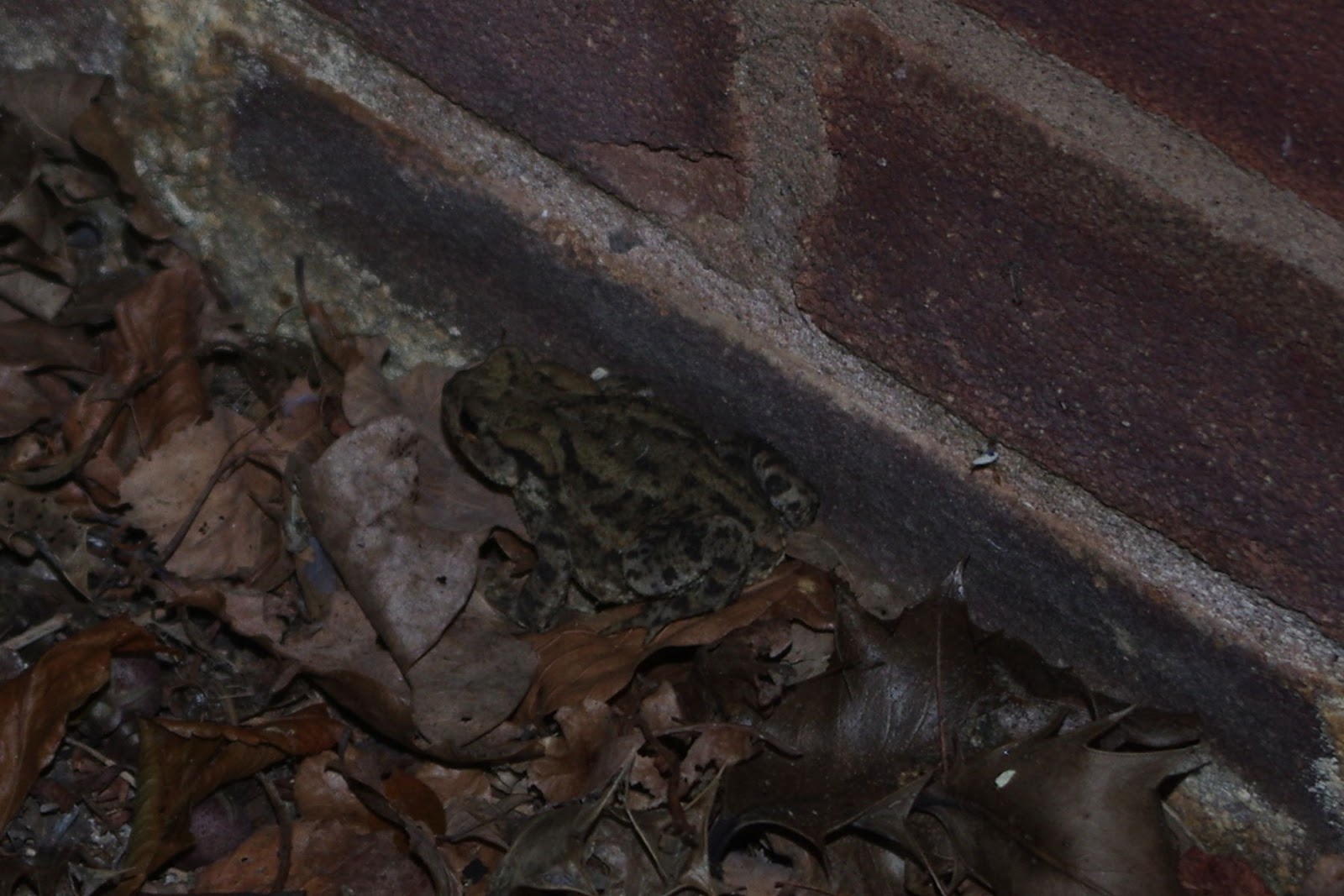
Toad, creeping through the leaves after dark.
As night was falling I went outside with my bat detector and detected a Common Pipistrelle. I heard some rustling behind me. Because there was no wind, this was seriously creepy. I slowly turned round, fearing that I would find a rat. Instead there was a toad moving through some dried-up leaves at the side of the house.  Toads eat insects, spiders, slugs and worms. Hopefully it is helping to keep our slug population down.


Millipede (Polydesmus)
The next morning, I got up early to check my beetle traps. I didn't find any beetles but I did find a millipede.  One last round of the garden yielded a few more insects and a forgotten wildflower and then it was time to enter my results.  So how did I do?

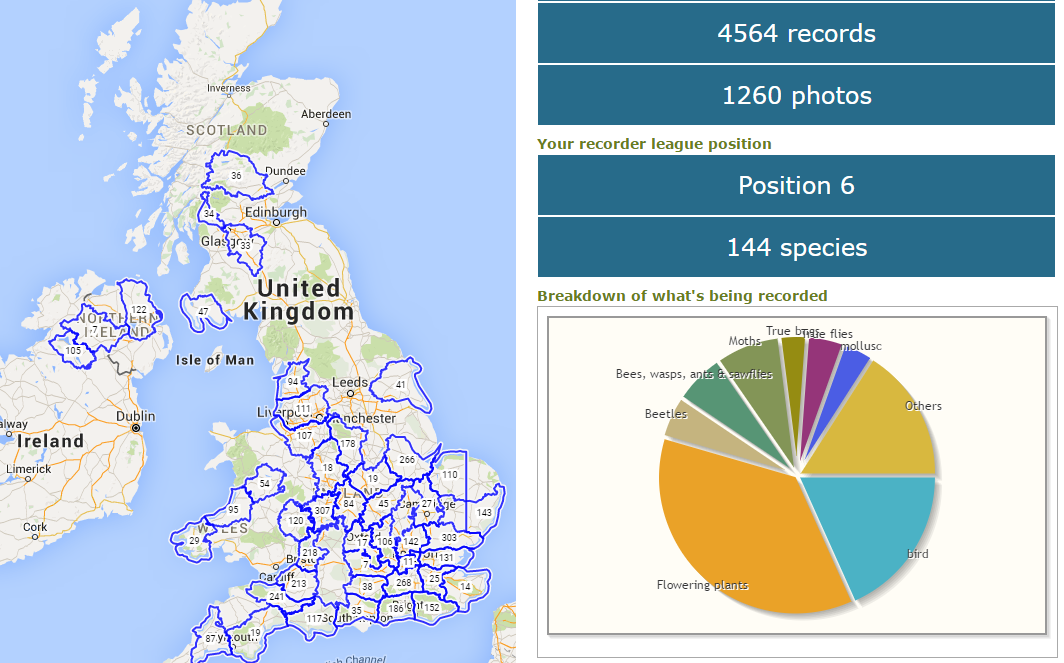
The National Results - I found 153 species in the garden.
I had just about beaten last year's record and, due to having replaced my 20-year old macro lens, had taken much better photos of the tiny bugs, enabling successful verification.  Thanks to other people, such as members of recording societies and Uckfield's own Nature Reserves group, I have been able to increase the number of species that I have recorded and share my own knowledge with others.

The 153 species I found broke down as follows.


My results broken down by group.

Before I close, I would like to give a big shout out to all the people who diligently sift through the records pushed into the system by people like me and verify or correct as required.

Monday, 13 June 2016

Garden BioBlitz 2016 - What did I find out?

Earlier, I wrote about doing my Garden BioBlitz in which I found as many wild plants and creatures in my garden as possible. This was Day 4 and 5 of #30DaysWild. Now, I have identified as much as I can and logged them in iRecord.

To start with, my records were not included with the BioBlitz totals. This was because I hadn't set up the Garden BioBlitz 2016 activity in iRecord. The kind person running the GardenBioBlitz Twitter account untangled my error and my results appeared with the rest.  This is how the national summary looked when I finished putting in my results on June the 10th.


National Results on June the 10th - 152 species for East Sussex.
The pie diagram shows what sort of wild things people were finding. The big orange sector represents flowering plants, aqua is birds etc.  So how does mine compare?
Breakdown of my 144 Species.

Moths and Birds - Must Try Harder!

Compared to the National breakdown, my bird and moth counts are low. My bird list seemed reasonable for our garden but I can probably do better. However I haven't been paying attention to moths, so maybe that's something to look at over the coming year.

Diamondback moth (Plutella xylostella)
One moth I did see - and in some numbers - was the tiny Diamondback moth. You are likely to have seen them but without magnification they look like white lines about 1cm long. Every time I walked through the long grass in our garden, they sprang out from under my feet.


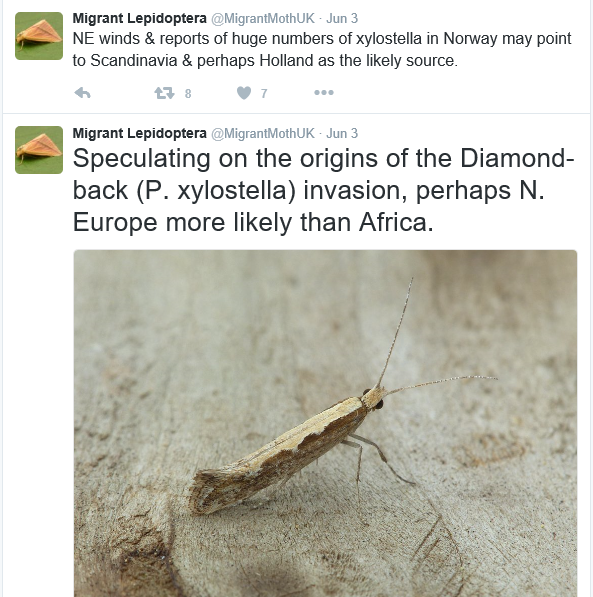
Since the beginning of June, the @MigrantMothUK Twitter account has been retweeting reports of thousands being found all over the country. They suggest that they may have been come from Scandinavia. Maybe they were carried on the cold North winds we experienced at the end of May. This is bad news for vegetable growers as their caterpillars eat brassicas (cabbage family).

While I am talking about moths, I must mention the Moths UK & Europe Facebook group who have kindly helped to identify a small, brown but intricately patterned Common Marble (Celypha lacunana) moth.

Common Marble (Celypha lacunana)
Bees, Wasps, Ants and Sawflies - Finding out more

My pie chart shows that I am doing quite well in terms of numbers for Bees, Wasps, Ants and Sawflies and I am gaining a better understanding of the differences between the main groups.  Every now and again I make really idiotic errors but I am quite pleased with my progress.  This is really down to the kindness and patience of the iRecord verifiers and members of the UK Bees, Wasps and Ants Facebook group who have been patiently verifying my results and tactfully correcting my errors.

Small Garden Bumblebee on foxglove (sorry - a bit blurred).
Facebook groups like this also help me understand the behaviour of the creatures in my garden. While doing the BioBlitz, I realised that bees pollinating Foxgloves were making a loud high-pitched buzz, In a UK Bees, Wasps and Ants Facebook group post, David Norton explained "Buzz Foraging" as follows:

It's called "buzz foraging" in flowers with abundant pollen like this poppy the bee vibrates its wing muscles without moving the wings, this creates an intense vibration, the pollen flies off the flower onto the bee which then grooms it off and onto the pollen basket. 

Matt Smith then confirmed that they also did it in Foxgloves.

I am beginning to get my head round the main groups of solitary bees, thanks to Ryan Clark's Guide to Solitary Bees in Britain.

If you are scared of spiders, look away now!

Another fascinating if rather gross insight came from the British Spider Identification Facebook group (I think).  Unfortunately, I can't find the post now but it showed a black Spider Eating (Auplopus) wasp removing the legs from a Sac Spider (Clubiona).  Once this is done, the wasp would fly off, carrying the spider to feed its young.  I found both in my BioBlitz and am pleased to find out how they fit into the garden food web.

Predator - Spider Eating Wasp (Auplopus)

Prey - Sac Spider (Clubiona)
2016 vs 2015

I found more species (144) this year than last (129). There was a fair amount of 'churn'. I 'lost' 26 species but gained 35:
  • I lost some birds, which regularly visit the garden, by missing the 'early shift'.
  • I lost some flowering plants - due to our own tidying and browsing by a Fallow buck.  I am quite indignant that the deer, having eaten some of my total, didn't do the decent thing and turn up on BioBlitz day.
  • A notable absence was spangle galls on the oak - last year there were thousands.
  • We've lost the liverwort from a damp area.
Green Shield Bugs.
However, I have added many new species. Maybe some, such as the Shield Bugs and Butterflies appeared due to the lovely sunshine that appeared halfway through my count.  Others such as ground beetles and centipedes were included because I focussed more effort at ground level.

Looking forward

Things will consider focussing on next year include:
  • A better organised set up - due to being in Birmingham the previous week, I didn't prepare very well.
  • More Moths - maybe I'll try a simple trap to catch some night flyers.
  • More ground level creatures - I had some success with my beetle traps especially those by the wall, so I will try these again next year.
  • An early shift to catch our garden birds.
  • Maybe moss and lichen.
And ... of course ... I will keep on learning about the web of life in our garden.

Wednesday, 8 June 2016

#30DaysWild - Stolen Moments with Nature

While I was in Birmingham, I visited a buttercup field and found Ragged Robin on a ragged verge.

However, once I am home, it can be hard to find time during the working week to do anything other than meet work and other commitments. It is fortunately that others doing the Wildlife Trusts' #30DaysWild challenge are teaching me how to steal moments from my day and give them to nature.

I'm also going to confess to a blogging sin - my posts are out of order. I wrote up my Day 4/5 BioBlitz before this post about Day 2 and 3.

Day 2 - Beetles at the Watford Junction

Sitting next to wildflowers while waiting for the train.
On Day 2, I travelled home from Birmingham to Uckfield. At Watford Junction, while I was waiting for the train, I sat on a low wall next to some wildflowers.

Oedemera Lurida at Watford Junction.
A couple of long, narrow Oedemera Lurida beetles jumped onto my bag and I had to carefully return them to their flowers.  I love the way nature finds its way into the unlikeliest places.

Day 3 - Taking a moment from the laptop

Foxgloves, Uckfield Sussex
Friday was exceptionally busy. I took a moment away from the laptop to admire self-sown foxgloves in our garden.

Looking forward to the Garden BioBlitz

Due to dull weather we haven't had many bees but during the next day's Garden BioBlitz, I would see nine different species including a number going in-and-out of the Foxglove bells.

 
Red Mason Bee (Osmia bicornis) - from the next weekend's BioBlitz
I used Ryan Clark's-easy-to understand guide to solitary bees on the Wildlfe Trusts website to help me understand the different types including the Mason bees, who store their pollen on the underside of their abdomen as shown in the photo and large Wool carder bee (Anthidium maculatum), which lead me a merry dance on BioBlitz day. So a big thank you to Ryan for his wonderful guide and also to the patient and hard working verifiers on iRecord, who verified my sightings and tactfully corrected my errors.

Monday, 6 June 2016

Garden Bio Blitz 2016

It's the first weekend of June and it's time to record as many species as I can for the Garden BioBlitz.  I really needed to go into town on Saturday morning and fine weather was forecast for Sunday, so my 24 hours ran from 2:15pm on Saturday to the same time on Sunday. 

Because I have just started doing the WildLifeTrust's #30DaysWild, this has been a very wild-life intensive few days.  Although I had a pleasant visit to a buttercup field in Birmingham, I was disappointed that the bluetits that nested in the box on the side of the house had gone before I came back to Uckfield.

BioBlitzing our garden - A lovely Sunday morning.
Before I started, I set myself some objectives:
  • To record more species than I saw last year (127)
  • To pay more attention to ground-level minibeasts and get a centipede onto my list.
  • To detect a bat with the detector I got for Christmas.
Blackbird sunbathing.
My first BioBlitz sighting for 2016 was a pair of blackbirds sunning themselves. The female was on the grass and the male had spread himself out along one of the branches of our conifer.

Germander Speedwell in an uncultivated corner.
I did a quick round of the whole garden, ticking off flowers from my 2015 list. I hadn't particularly noticed during the year but we have had some casualties, probably due to our own tidying, which is 'assisted' by a visiting fallow deer.  On the other hand, I have recorded two self-sown trees, beech and rowen, for the first time.

Common Carder Bee feeding on Iris Sibirica
After this, I started looking at the minibeasts, particularly pollinators, that land on the flowers and leaves in the garden. I found myself fascinated by a Common Carder Bee feeding on an Iris Sibirica, its weight opening and closing the flower as it climbed in and out of its petals.

Western Yellow Centipede (Stigmatogaster subterranean)
It was only about 5pm when the light started dropping. It was time to find a centipede. I dug around in the "ready-to-use" compost from our heap and found a wriggling orange ribbon. I flicked it into a little pot, figured out which end was the head, took a photo and returned it to its home. 

After setting up beetle traps,  it was time to go indoors and start processing results.  by the end of the evening, I had identified 102 species had about 15 photos of unidentified creatures.

The Bushnell 'traps' a fox while I sleep off the day's efforts.
At 9:45pm I was outside again, bat detector in hand. I always get stupidly excited when detecting - waiting for those click-slap-click noises that herald the arrival of a bat. I waited and waited. Then just before 10pm, few weak squelchy clicks. My excitement mounted as I tried to pinpoint the direction. The clicks got stronger and louder and - there it was! A Common Pipistrelle, fluttering in the gloom - the perfect end to the first few hours of my Garden BioBlitz. It was time to leave the garden to the creatures of the night.

Beetle trap with Nebria Brevicallis in pot.
Sunday morning was bright and, having slept like a log, started a little later than I intended so I missed the early shift. I focussed my efforts at ground level and found black beetles in my beetle traps, slugs under paving slabs, and woodlice under garden ornaments.

Swollen-Thighed Beetle
Some beetles live a sunnier life. Amongst our flowers, I found several shiny green Swollen-Thighed Beetles. Whilst searching, I could hear the "dee-dee-dee" of bluetits calling each other. I kept looking up but, frustratingly, didn't see anything in our thick trees.

Hawthorn Shieldbug rocking 80's-style shoulder pads.
As I searched round shrubs and trees in the garden, I found three different species of shield bugs. The Hawthorn Shieldbug's block colours and pointed shoulders always remind me of the daft fashions we wore in the eighties. I tried shaking the trees but only the tiniest of insects came down.

Baby blue tit well disguised in the dappled light and birch leaves.
I was in the last stages, just mopping up the last few wild plants, when I heard "dee-dee-dee" and saw a flicker of movement in our birch trees. There was an adult bird finding insects where the clumsy human had failed and then ... two little balls of fluff emerged to be fed. I'm assuming that this is our bird box family and I was delighted to see them.

I've managed to meet my objectives having:
  • identified 131 species with more to come - however finding them took more effort this year
  • used beetle traps and dug around in the compost heap to find ground-level creatures including an implausibly long centipede
  • detected and watched a bat.
There are more details about the results in Garden BioBlitz 2016 - What did I find out?

I've also enjoyed a day "playing in the garden" - making beetle traps and dipping ponds. I exchanged photos and IDs with others across the country who were BioBlitzing their own gardens or taking part in #30DaysWild. I've learnt to identify some more of the creatures with whom I share the garden and greeted some who I thought had left without saying goodbye.  Quite simply, a lovely way to spend 24 hours in June.

There are plenty more #30DaysWild blogs at MyWildLife.

Saturday, 26 December 2015

My 2015 in Uckfield nature photos

As the year draws to a close it's time to look back on the wildlife I have seen in and around Uckfield during 2015.

January

January started with the BSBI New Year Plant hunt, in which I spent an hour looking for wild flowers that were out in bloom. I found a total of 21 different types - surprising considering that we had a few days of hard frost. 
Campanula on old wall at the top Uckfield's High Street.
Towards the end of the month, I took part in Lime Aid's volunteer session - trimming back unwanted growth at the feet of the amazing old Lime trees that once led to Uckfield House.
Before and After - Lime Tree Avenue.
As usual, the month ended with the RSPB's Big Garden Birdwatch.

February

On the 8th, four tiny Goldcrests were fluttering round the lower branches of our laurels and nearby bushes. One was displaying to the others with his normally inconspicuous crest feathers fluffed up in a bright orange "quiff".  One sunny day brought out a tattered but still lovely Red Admiral.

Red Admiral, Manor Park garden.

March

When Hazel catkins are shaken by the wind, you can see how they get the name "lambs tails". This year has been exceptionally windy.
Hazel, Manor Park garden.

April

Two Fallow Deer bucks, who are regular visitors to the Manor Park estate, came into the garden for a couple of hours. I and others were concerned that the darker one was limping. However it showed a fair turn of speed when escaping would-be rescuers.

 
Fallow deer, Manor Park garden.

May

May is, of course, bluebell time. This year I visited Boothland Wood, which in the next few years will be surrounded by the Ridgewood Farm development.  The woodland has a light, airy feel because it is surrounded by open farmland and has many elegant, slender beech trees.
Bluebells, Boothland wood.
Later in the month, the splendid WRAS rescued an injured woodpigeon from our back garden.
WRAS to the rescue, Manor Park.
The month ended with the Garden Biobliz in which I tried to find as many wild flowers and creatures in the garden as possible.  In the end, I identified 129 species compared to 104 last year.
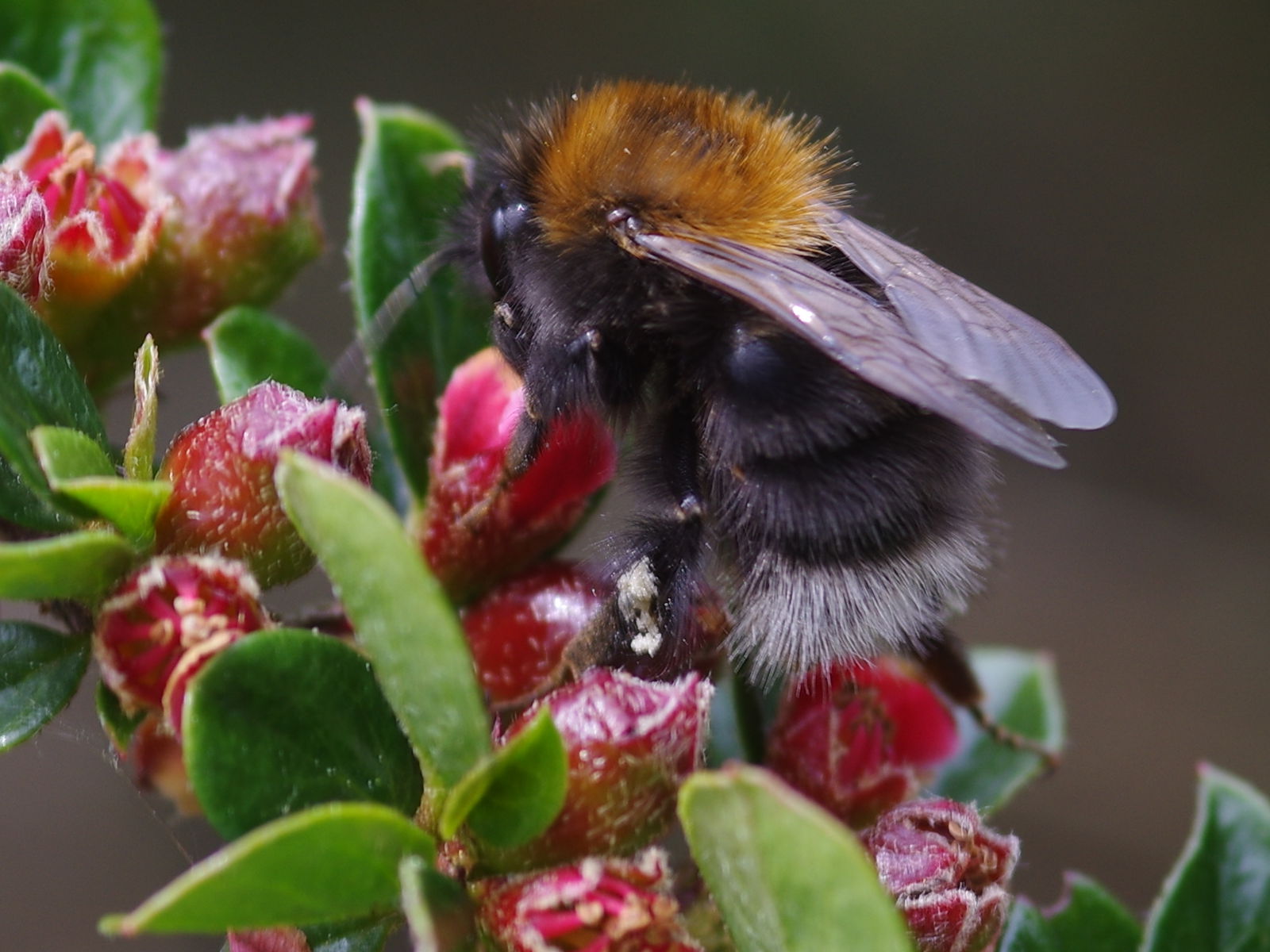
Tree bumble bee spotted during Garden Bioblitz, Manor Park garden.

June

June was dominated by 30 days wild. This project meant having one wildlife moment a day.  To me it meant pausing and really taking notice of what was around me. My most memorable Uckfield discovery was a pair of Grey Wagtails that live on the part of the River Uck that flows under our station. I saw them courting and mating and was able to follow their progress up to the point when I saw a fluffy youngster.

Grey Wagtails on riverbank, seen from Uckfield station platform.

Another highlight was spotting Uckfield's very own Stickleback Si (named after one featured on BBC's Spring Watch) in the Hempstead Meadow Nature Reserve. I could see his red tummy and I was delighted to see him duck into his tunnel nest for a moment. 

July

Towards the end of July, I spent time pulling invasive Himalayan Balsam in the Hempstead Meadow Nature Reserve.  It was very pleasant to spend time in the reserve like that and getting to see special trees like rare Black Poplars and all manner of tiny creatures.
Black Poplar (left) and Himalyan Balsam (right). Hempstead Meadow
July was also marked the start of the Big Butterfly Count.  This year I saw more butterflies (108 in 12 counts) than last.  Our most regular visitor were bright orange and brown Gatekeepers. 

Gatekeeper butterfly, Manor Park garden.

August

The 8th of August was flying ant day. Suddenly they erupted from our lawn and were flying skywards like so many golden angels. It wasn't just us - all over the country, people were commenting, via social media, on the ants.  
Black ants, Manor Park garden.
On the 22nd of August 2015, I spent a lovely hour in our garden experiencing the light fading away and the creatures of the day finding their way home.  I counted about 400 Rooks as they flew past our house to their roost - probably Lime Tree Avenue.

On a wet bank holiday, I finally found the little remnant of heathland habitat on Manor Park, which is home to hundreds of dainty Autumn Ladies Tresses flowers.
Autumn Ladies Tresses, Manor Park estate.

September

September mornings found our garden full of spider webs sprinkled with jewel-like drops of dew. I was pleased to see that they seemed to be catching plenty of crane flies.
Garden Spider (Araneus diadematus) in Manor Park garden.
At the end of the month, I cut through Hempstead Meadow Nature Reserve and found plenty of flowers still out including a blue, Meadow Crane's-bill.
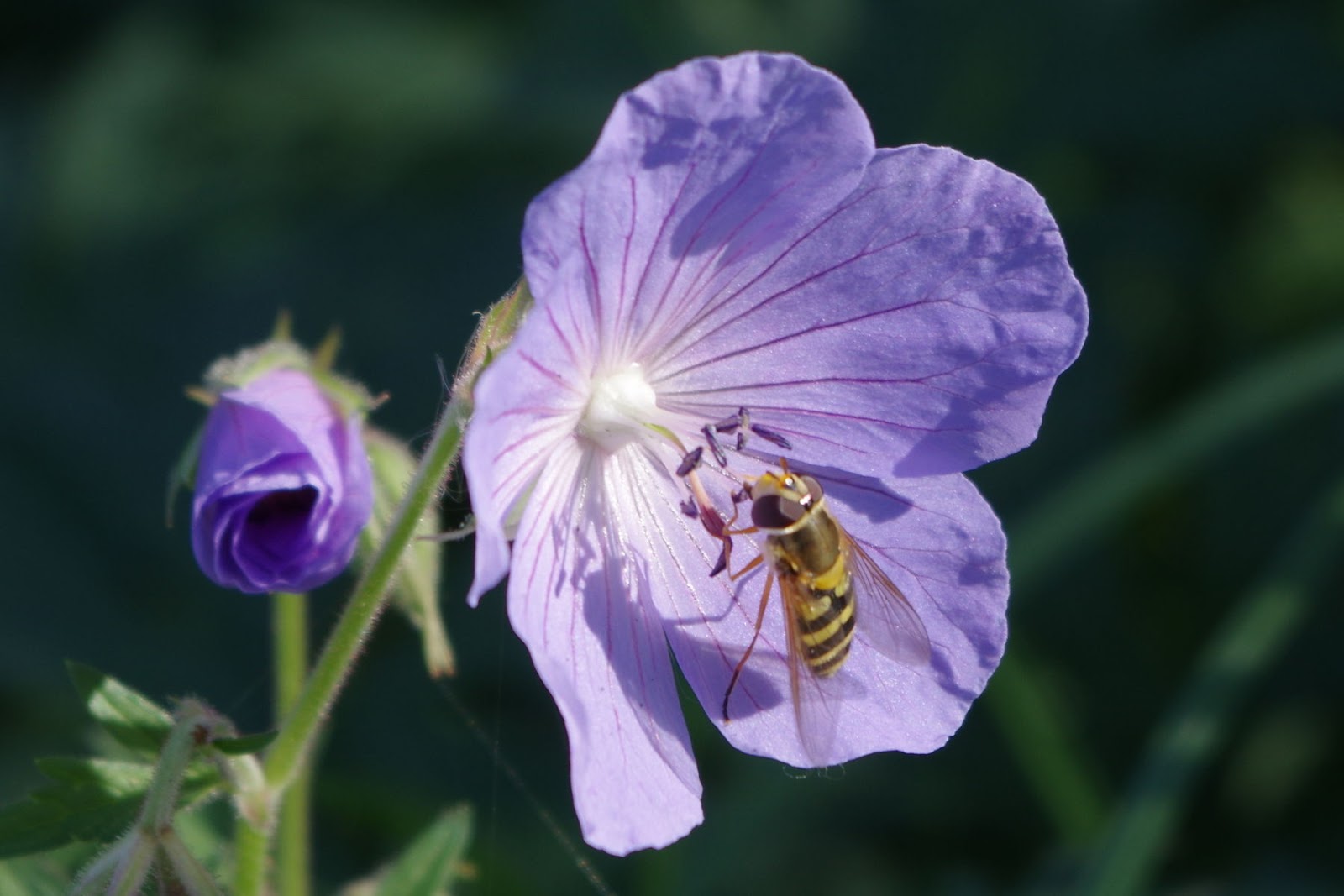
Hoverfly (Syrphus ribesii) on Meadow Crane's-bill. Hempstead Meadow.

October

In the run up to Halloween I expect to hear much talk about bats and other spooky things but I don't expect to see real ones. However the long, late summer brought us two surprise visits. One on October the 18th at about 6:15pm when we saw three dancing in the fading light and another at about 5pm on October the 30th.
Autumn leaves and Halloween decorations.

November

A grim month in all sorts of ways. At the start of the month fog swept in closing both Gatwick and Heathrow and on the 21st there were snowflakes in the rain.  Even the foxes that regularly visit our garden stayed away for most of the month.
One of the few fox visits in November. Manor Park garden.

December

In the run up to Christmas we had a few visits from a fallow deer with fine antlers. This is probably the lighter of the two bucks that we saw earlier in the year. Sadly the darker one wasn't with him.
Fallow buck, Manor Park garden.
Christmas is a time when we traditionally bring greenery inside. I'll leave you with the lovely Nordman tree that I bought from Vulcan Farm.