Showing posts with label fox. Show all posts

Sunday, 1 January 2017

2016's Garden Visitors

While I've been running round the country for work, my trail camera has been keeping an eye on our garden visitors.  First - a confession - the battery was low for January and most of February so I didn't get night-time shots for those months.


24 June - Badger family
How many visits in 2016?

Mammals recorded on the Bushnell Trail Camera in 2016

This year, the badgers were very much the stars of the show. They visited every month from February to October and the number of visits was approximately double that of 2015.  I was delighted to see a group of three appearing on camera together. They appeared twice:
  • on 24 June, two of the badgers were smaller than the third
  • on 23 July, they were all about the same size - the youngsters were clearly growing fast.
On 25 July, I found that they had dug up a wasps nest.  So they are providing a free pest control service as well as photos!

Fallow buck, 17 May 2016
Sadly, we saw much less of the Fallow Deer. Last year, I noted that the darker, older buck stopped visiting in August. It appears that the magnificent light-coloured buck was less inclind to visit without his companion. We had just a few visits in the middle of the year.  In this shot, he has recently shed his antlers.

Fox - 27 December 2016, 1:40 pm
The number of fox visits (190 between March and December) is significantly down since last year (284 over the same period). We had spikes in March and August.  We usually expect increased visits in August as this is when the youngsters are active.  This August was very dry and, for the first time, I put a dish of water out for our wild visitors.  

Fox and cat - 11 August 2016
The camera occasionally captured a fox and cat together. In this photo, they look a little suspicious of each other. In others they didn't appear worried.

Monday, 6 June 2016

Garden Bio Blitz 2016

It's the first weekend of June and it's time to record as many species as I can for the Garden BioBlitz.  I really needed to go into town on Saturday morning and fine weather was forecast for Sunday, so my 24 hours ran from 2:15pm on Saturday to the same time on Sunday. 

Because I have just started doing the WildLifeTrust's #30DaysWild, this has been a very wild-life intensive few days.  Although I had a pleasant visit to a buttercup field in Birmingham, I was disappointed that the bluetits that nested in the box on the side of the house had gone before I came back to Uckfield.

BioBlitzing our garden - A lovely Sunday morning.
Before I started, I set myself some objectives:
  • To record more species than I saw last year (127)
  • To pay more attention to ground-level minibeasts and get a centipede onto my list.
  • To detect a bat with the detector I got for Christmas.
Blackbird sunbathing.
My first BioBlitz sighting for 2016 was a pair of blackbirds sunning themselves. The female was on the grass and the male had spread himself out along one of the branches of our conifer.

Germander Speedwell in an uncultivated corner.
I did a quick round of the whole garden, ticking off flowers from my 2015 list. I hadn't particularly noticed during the year but we have had some casualties, probably due to our own tidying, which is 'assisted' by a visiting fallow deer.  On the other hand, I have recorded two self-sown trees, beech and rowen, for the first time.

Common Carder Bee feeding on Iris Sibirica
After this, I started looking at the minibeasts, particularly pollinators, that land on the flowers and leaves in the garden. I found myself fascinated by a Common Carder Bee feeding on an Iris Sibirica, its weight opening and closing the flower as it climbed in and out of its petals.

Western Yellow Centipede (Stigmatogaster subterranean)
It was only about 5pm when the light started dropping. It was time to find a centipede. I dug around in the "ready-to-use" compost from our heap and found a wriggling orange ribbon. I flicked it into a little pot, figured out which end was the head, took a photo and returned it to its home. 

After setting up beetle traps,  it was time to go indoors and start processing results.  by the end of the evening, I had identified 102 species had about 15 photos of unidentified creatures.

The Bushnell 'traps' a fox while I sleep off the day's efforts.
At 9:45pm I was outside again, bat detector in hand. I always get stupidly excited when detecting - waiting for those click-slap-click noises that herald the arrival of a bat. I waited and waited. Then just before 10pm, few weak squelchy clicks. My excitement mounted as I tried to pinpoint the direction. The clicks got stronger and louder and - there it was! A Common Pipistrelle, fluttering in the gloom - the perfect end to the first few hours of my Garden BioBlitz. It was time to leave the garden to the creatures of the night.

Beetle trap with Nebria Brevicallis in pot.
Sunday morning was bright and, having slept like a log, started a little later than I intended so I missed the early shift. I focussed my efforts at ground level and found black beetles in my beetle traps, slugs under paving slabs, and woodlice under garden ornaments.

Swollen-Thighed Beetle
Some beetles live a sunnier life. Amongst our flowers, I found several shiny green Swollen-Thighed Beetles. Whilst searching, I could hear the "dee-dee-dee" of bluetits calling each other. I kept looking up but, frustratingly, didn't see anything in our thick trees.

Hawthorn Shieldbug rocking 80's-style shoulder pads.
As I searched round shrubs and trees in the garden, I found three different species of shield bugs. The Hawthorn Shieldbug's block colours and pointed shoulders always remind me of the daft fashions we wore in the eighties. I tried shaking the trees but only the tiniest of insects came down.

Baby blue tit well disguised in the dappled light and birch leaves.
I was in the last stages, just mopping up the last few wild plants, when I heard "dee-dee-dee" and saw a flicker of movement in our birch trees. There was an adult bird finding insects where the clumsy human had failed and then ... two little balls of fluff emerged to be fed. I'm assuming that this is our bird box family and I was delighted to see them.

I've managed to meet my objectives having:
  • identified 131 species with more to come - however finding them took more effort this year
  • used beetle traps and dug around in the compost heap to find ground-level creatures including an implausibly long centipede
  • detected and watched a bat.
There are more details about the results in Garden BioBlitz 2016 - What did I find out?

I've also enjoyed a day "playing in the garden" - making beetle traps and dipping ponds. I exchanged photos and IDs with others across the country who were BioBlitzing their own gardens or taking part in #30DaysWild. I've learnt to identify some more of the creatures with whom I share the garden and greeted some who I thought had left without saying goodbye.  Quite simply, a lovely way to spend 24 hours in June.

There are plenty more #30DaysWild blogs at MyWildLife.

Saturday, 2 January 2016

2015's Garden Visitors

Once again, I've been using my Bushnell Trail camera to record wildlife that visits our garden. I missed a little bit of January because I needed to repaint the box. For most of the year I kept the camera in the same position. Average number of visits was well up on 2014, which had fewer visits per night than 2013.
Two regular visitors - sadly the dark buck hasn't  visited since 6th August 2015.

How many visits in 2015?

In 2015:

  • Fox visits peaked in March/April - there were regular encounters between two individuals, maybe the youngsters we saw last year.
  • We had badger visits through late spring, summer and autumn
  • The fallow deer came in Spring, August and December.

How does this compare to previous years?


For the year as a whole:

  • Fox visits are up by about half c.f. 2014 although we had far fewer visits in the latter part of the year. We are seeing more occasions when there are two foxes in the garden.
  • Badger visits are up by about a quarter.
  • Deer visits are down. This may be due to us removing a tree at the end of May 2014 and/or the possible loss of one of the regular visiting males.
I have spotted a few patterns over the 3 years I have been recording:

  • In all three years that I have been recording, there is a dip in the number of fox visits in May - perhaps due to the birth of cubs.
  • Badgers are always absent for a period in winter, when they are dormant:
    • 2013 - November to January (2014)
    • 2014 - October to April (2015)
    • 2015 - November to ?
  • Fallow deer are:
    • absent at the beginning of the year first appearing in March (2015) and April (2013/4)
    • appear at various times during the late spring and summer months
    • absent for part of the autumn around October, presumably for the rut
    • often return in December enabling me to make predictable Rudolf jokes.

Sunday, 28 June 2015

30 Days Wild - Days 27 and 28 - Keeping it Local

30 Days Wild is drawing to a close. I wondered about trying to do something special for this weekend but, in the end, I had too much stuff that just had to be dealt with so I just kept it local.

Saturday, 27th June

For some reason I decided it would be a really good idea to go butterfly hunting before I was properly up, so apologies to early bird neighbours 'treated' to the sight of me chasing butterflies round garden while still in my dressing gown.

Um. Sorry.
All I can say in my defence is that it is from the excellent Carvills in our town, so I'm supporting local independent shops. Also I managed to get my first sighting of a meadow brown this year, 2 weeks later than in 2014.

Meadow Brown.
Once I was properly up (and dressed) I went across the road for a newspaper and enjoyed the sight of the Brighter Uckfield/The Uckfield Singers Community Choir planter in full bloom. Even better, there were two white-tailed bumble bees feasting on the flowers.

Planter outside Tesco Express on Manor Park, Uckfield.
White-tailed bumble bee on begonia.
One of the big treats of the weekend was opening up my Trail Camera to find out who has been visiting.
Another day-time visit - this time in good light.
Two young foxes have visited 3 times in the last 2 weeks.
It was particularly nice to see the young foxes visiting as, on Saturday afternoon, I found some soft, almost downy, brown fur. My guess is that the young foxes are beginning to shed their baby fluff.

Sunday, 28th June

Since we replaced the back window, we've had some birds hit it, including the unfortunate blackbird that I mentioned in 30 Days Wild - Days 7 to 12 - Travelling. I've added some stickers (from Allsorts in Uckfield) to try and prevent collisions.

Butterfly stickers on our back window.
After arranging my stickers, I did a little potting up and was amazed and delighted to see the tail-end of a bee disappearing into a small volcano-like hole in the earth between some paving slabs. I've seen various mining and leafcutter bees around the garden so it is good to see them making nests.

I spent most of the day editing the wild-life friendly part of the garden at the front. There is a fine line between a fairly natural-looking space and a mess. Part of that is keeping paths passable. The red-valerian is now more-or-less upright rather than sprawled over the paving, the forsythia will no longer whack tall people when they walk to our door and the lilac is now tree-shaped. While I was doing all this, I found an assortment of insects - so I'll leave you with some love bugs.

Mating Hawthorn Sheildbugs.
 

Friday, 26 June 2015

30 Days Wild - Days 22 to 26 - Bee Orchids and Fledging House Martins

For this run of days through the working week, I expected a quiet run of everyday nature spotting. It started that way, but after dutifully noting snails and foxes, all I can say is "That escalated quickly."

Monday, 22nd June

Who knew that common garden snails were this colourful in the rain?

Deep colours and intricate patterns on snail shells.
Tuesday, 23rd June

Looking out of the train window on the way to Birmingham, I noticed that haymaking has started. Just a couple of days after the solstice it feels like the year is turning. As I was gazing at ripening wheat, there was a roe deer up to it's chestnut coloured back in the crop. A few miles on, just before Hever, a fox nimbly scaled a steep bank. On the other side of the track, as the train was pulling into South Croydon, I saw another nosing round the trackside brambles.

Once in Trinity Park business park, I momentarily startled a bunny, which soon went back to the important business of eating the local greenery.

After, I checked into the Arden hotel I was pleased to get a room with a good view of the house martins nest I photographed a couple of weeks ago. I was happy to see that they were still visiting the nest. Before I headed down to dinner, I was treated to a fabulous flying display by these incredible little birds.

Wednesday, 24th June

I left the hotel early, intending to walk round the area for a bit and glanced rather casually at a piece of waste ground in the business park where I work. I was stunned by what I saw. 

Bee orchids in Trinity Business Park, in sight of Birmingham NEC.
There were 14 lovely flower spikes. I may spend much of my life in Sussex, looking at the local nature reserves and other beauty spots but I have never seen bee orchids before. At lunch time, I took some colleagues out to see them.

In the evening, I went exploring. The footpath I had intended to follow was trapped between high security fences and rather too intimidating to tackle by myself. Instead, I meandered along some of the cycle/walkways by the main roads. As I was coming back I surprised an adorable family of young bunnies and just managed to get a photo on my phone as they hid under a privet bush. 

Family of rabbits hiding in bushes, just below flyover.
As I passed the tunnel that leads to the NEC's Genting arena, a colourful pair of bullfinches caught my eye. Approaching the disused ground in Trinity Park, I alarmed a green woodpecker, which shot into the trees between the empty area and the Arden Hotel. When I say empty, I really mean full of wild plants and inhabited by a family of rabbits.  I looked across hoping to see them. There were a couple of good-sized bunnies but, even better, there were dozens more orchids, taking the number of flower spikes up to 50.
Detail of a bee orchid.
After the important business of dinner, I flopped back into my room and watched the house martins flying in the fading evening light.

Clouds in fading, evening light.
Thursday, 25 June

It was before seven when I checked what 'my' house martins were doing. There seemed to be a small group of birds going between the nest and the main group, which was now about 10 birds strong. My house martins had fledged! I breakfasted and checked out as quickly as I could and spent some time watching and photographing the birds.

3 house martins close to the nest.
I was a bit puzzled about what was happening. There was clearly a bird still in the nest - you could just see a head looking out. But who were the other birds? Were they prospective mates? Birds wanting to take over the nearly empty nest? 

A "House Martin Diary" BTO newsletter from 2011 explained what was going on. "First group ... has fledged today, taking short flights in and out of nests ... [A few days later, after bad weather] the recent fledglings have remained secure in their nests relying on parents to continue feeding them."

So that was the answer, the young birds had fledged but were still using the nest as a base.

Friday, 26 June

First thing in the morning after getting home, I had to get a young magpie out of the conservatory. Third time in a couple of weeks. This is getting silly

Finally, to round off the working week, a sunny display of birds-foot-trefoil from a no mow area of our - ahem - lawn.

Birds-foot-trefoil.


Sunday, 14 June 2015

30 days wild - Days 13 and 14 - the Weekend!


It's the weekend and the first time I went on a #30DaysWild outing. So far all my encounters with nature have been opportunistic - squeezed in, sometimes while travelling. Saturday was still like that but on Sunday, I visited Ashdown Forest.


Saturday, June 13

On the way back from the shops, I was happy to see that East Sussex council had managed the mowing of local grass verges so that the wild flowers including orchids could flower.

Spotted orchid.
My Saturday lunchtime treat was to open up my trail camera and see what has been visiting our garden. To my surprise, a fox had appeared in daylight so we have some colour pictures rather than the usual infra red. The badger continues to be a total diva, rushing by so we don't get a decent photo.


Fox, visited in the afternoon on the 11th of June.
I did a little tidying and watering outside and was filling the pond when I heard calls. To my delight there was a family of pied wagtails on our roof.

Sunday, June 14 - Old Lodge Nature Reserve

The day was dry but rather overcast. I decided to head out to Sussex Wildlife Trust's Old Lodge Nature Reserve on Ashdown Forest. Even before I left the Uckfield bypass, I saw young rabbits feeding at the side of the road. Once I got to the reserve, I decided to concentrate on details because the light was too dull for landscape shots.

Lichen on birch trunk.
The first thing I spotted was lichens and mosses on a craggy old birch tree.  As I walked along the top edge of the reserve, I was fascinated by the colourful and rather weird pine flowers and amazed to find bluebells still out.

Pine flower.
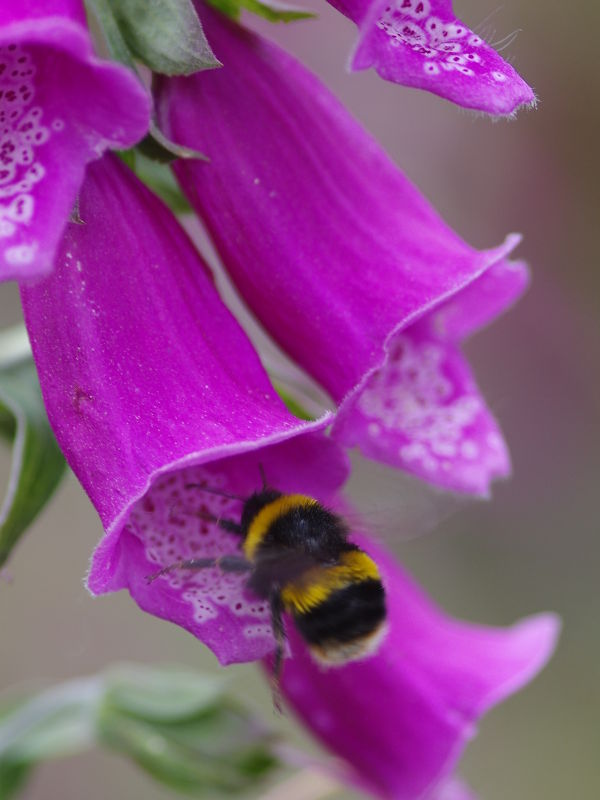
I was glad to see a cluster of foxgloves had sprung up again on the old bank and even more pleased to see a bumble bee scrambling in and out of the flowers.

Buff-tailed bumble bee on foxgloves.
Pink and purple flushes here and there show that the heaths and heathers are already beginning to bloom.

Cross-leaved heath.

Bell heather.
On the path down to the dragonfly ponds I noticed many other plants including the tiny, startlingly beautiful flowers of a sedge.

Heath sedge, just a few inches high.
Along the way I met a couple. The man was clutching binoculars and was pleased because he has seen a greater spotted woodpecker and heard the calls of its mate. The woman wanted to know about the white tufts she could see from the path. I explained they are cotton grass and told them about the green woodpecker I had seen on the higher ground.

Cotton grass.
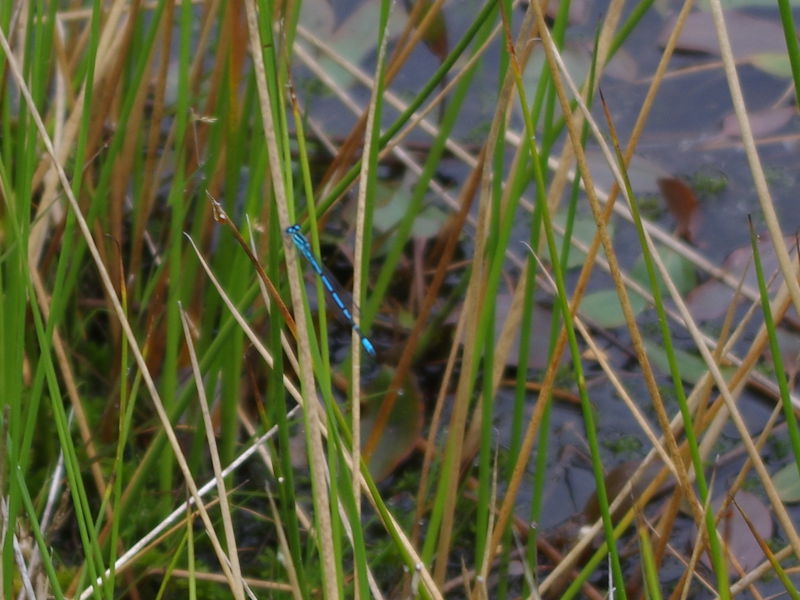
I think it is too early and certainly to dull for dragonflies but I did see a damselfly.

Damselfly - Common blue, I think.
I was far to slow to catch up with the many ochre coloured moths that I disturbed while walking but I did manage to photograph a brown china-mark moth, which is unusual in that its larvae are aquatic.
Brown china mark moth.
Across the path from the ponds, three ancient and magnificent beeches cast a deep shade.

Three huge, ancient beeches.
For me, the sight of these lovely and rather mysterious trees is always the high point of a visit to Old Lodge. After spending some time with them, I returned to the car, pausing to enjoy something on an altogether different scale.

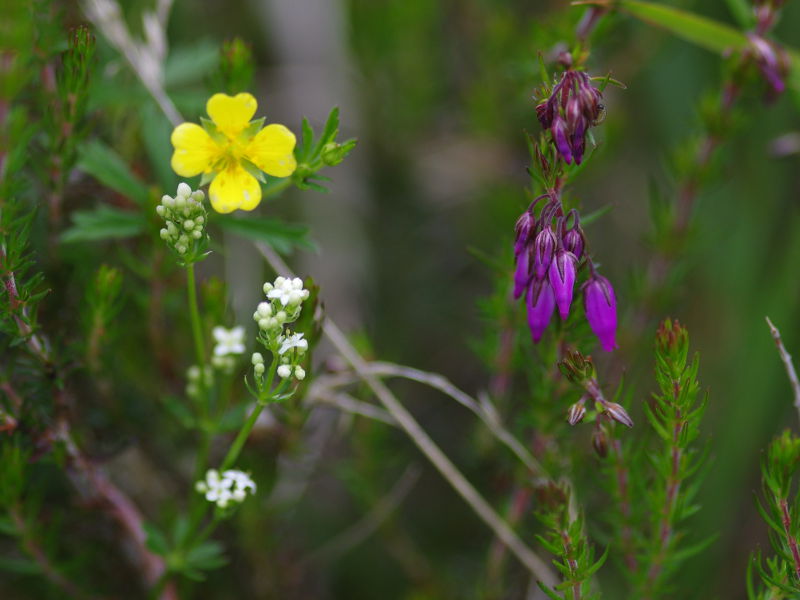
Tormentil, heath bedstraw and bell heather.
Three colourful little flowers had mixed to give the effect of a tiny garden.

Our own garden

After being out on the forest, our own garden seems so much more confined but is full of colour and interest. After lunch, I grazed my way through our alpine strawberries. Then I watched some bees feeding from our own foxgloves and borage. The borage had at least three different sorts of bee. White-tailed and early bumbles as well as a leaf cutter.

Patchwork leafcutter bee.
Just after 10pm, to round things off, I saw bats swooping past my window.