Showing posts with label uckfield. Show all posts

Saturday, 28 January 2023

Big Garden Birdwatch 2023

I did this year's Big Garden Birdwatch from 8:20 to 9:20 am. The weather was cold (about 1-2 C) and dull.  The big difference this year is that I've been using feeders much more.  Previously we had one feeder for fatballs, a bird table and scattered some food on the paving or grass.  However due to increasing numbers of Pigeons monopolizing the supplies, I've more-or-less stopped using the bird table and ground and now have a total of four feeders:

  • The original, with fat balls, in the Magnolia
  • Mealworms in the Lilac at the front
  • Sunflower hearts in the Crab Apple at the back
  • Suet pellets in the Cornus Mass.

I imagined that this would encourage more birds into the garden and make them easier to spot.  However, during the count, I observed that most species come and go to the feeders quite quickly whereas before they would spend more time looking for morsels in our unruly garden.  

During the count, I recorded a total of 31 individuals from 11 species.

My Big Garden Bird Count scores.
Some results stood out. For example, the were two Goldfinches and one Coal tit.  Although these species have occasionally graced my count, their visits have be very irregular and fleeting, with the Goldfinches usually flying high above the garden and not landing (which means I can't include them in the count). Over the last few weeks these have become reliable visitors, coming to our feeders every day. 

Big Garden Bird Watch - How counts have changed since 2011

I did get more individuals than the last couple of years. It doesn't necessarily mean much because numbers have gone up and down so much over since I started doing the count.  However, the main boost was a group 12 of House Sparrows that spent a little time squabbling over the sunflower hearts and suet. 

Hopefully as we enter the hungry period when the birds have eaten most of the naturally occurring berries and seeds, the feeders will help keep our feathered friends going until Spring. 

Saturday, 31 December 2022

2022 - Adding New Species to my List

As it is the last day of 2022, I'm looking over my wildlife observations fot the yearand seeing what is new.  Most of my sightings were within walking or running distance of my home - i.e. in and around Uckfield.  Numbers of new species were significantly up from last year.  I think this has been driven by some serious plant hunting in Hempstead Lane, which turned out to be very species rich. Some of my new species are described in my previous post, Botanical Survey - Hempstead Lane. 

At the end of the year the number of new species found were:

  • 60 Species new to my records
  • of which, 30 were new to me.
Here is a selection of species that are new to me or my records.

Fools Parsley, New Year Plant Hunt

Once again, my recording year started with the BSBI New Year Plant hunt.  There was just one new species for my lists - Fools Parsley (Aethusa cynapium) found on Bellbrook Industrial Estate. Probably the most miserable-looking specimen that I have ever tried to photograph.

Goat's Rue, 26 June, Bellbrook Industrial Estate
The industrial estate also yielded one of my showiest new plants - Goat's Rue (Galega officinalis). The officinalis part of the scientific name suggests that it had medicinal uses and indeed, the RHS Encyclopaedia of herbs says that it was used in the treatment of fevers and to help milk production.  

Slender St. John's Wort, 18 June
One of the big changes in recording this year is that the Sussex Botanical Recording Society have asked us to submit records using iRecord. This makes it much easier to add casual records while I am out and about. While I was running along Etchingwood Lane, I noticed a St. John's Wort that looked a bit "off". On closer inspection and much looking up in books, it turned out to be a Slender St. John's Wort (Hypericum pulchrum), which is one that I have not encountered before. The downside  of being able to record on-the-fly is that my running times are even worse than they used to be!

Snowy Inkcap, 3 Sept, near Gatehouse Green Farm
While I was running through a field  - carefully to avoid stepping in cow poo - I found a gleaming white Snowy Inkcap (Coprinopsis nivea) growing out a pile of the mucky stuff.  Looking at the scientific name, Copros is latin for dung and Niveus means snow-white.

Fig Gall on Elm Leaf, 8 May, Hempstead Lane
One of the weirdest things that I found this year was a Fig Gall (Tetraneura ulmi).  This little black sac contains the offspring of a type of aphid. 

Early Thorn, 19 March, Uckfield garden
This Early Thorn (Selenia dentaria) took me by surprise when I was cutting back the old Epimedium leaves. Its wings still floppy so it must have just emerged.

Small Phoenix, 14 May, Uckfield garden
Another garden find was this striking little Small Phoenix, which likes woodland habitats and whose foodplants include Willowherbs. Its presence may owe something to my failure to keep up with the weeding!

Small Blood-vein, 27 Aug, in the house
During the heatwave, we got a lot of moths inside the house including this Small Blood-vein (Scopula imitaria).

So, if all goes according to plan, on the New Year bank holiday, I will start with another New Year Plant Hunt.

Wednesday, 28 December 2022

Botanical Survey - Hempstead Lane

 For my 2022 botanical survey, I decided to explore Hempstead Lane, Uckfield. 

  • The lane is about 2km (1 and a quarter miles) runs from the town centre, over the river and flood plain, over the railway, through ancient woodland and between fields over a relatively short distance.
  • It runs through two "tetrads" - i.e. squares on the map:
    • TQ42Q for the first two sections, nearest the town centre
    • TQ42V for the rest.
  • I wanted to get a snapshot of what's in these different habitats and I've been rewarded by finding a wonderful range of plants including some I have never encountered before and a few that don't seem to have been recorded for the relevant tetrad. 
  • I was aware that the part of the lane furthest from the town was old and runs alongside ancient woodland but I've been surprised at how close the ancient woodland species indicators come to the town. There are areas with these plants scattered along this old lane as far as Lime Tree Avenue. 
  • The Flora, referred to below, is the Sussex Botanical Recording Society's The Flora of Sussex.

I divided the lane into a number of sections and recorded what I found in each on iRecord.  A huge thank you to the people who verified my records and to those in the SBRS Facebook group who helped me with identifications.

Section 1 - Near Town Centre

From the start of Hempstead Road to Lime Tree Ave.

Common Millet - 9 Jul 2022

In this section I found 47 species, most of which were opportunistic weeds and plants/grasses on a couple of small verges.  Common Millet (Panicum miliaceum), presumably from a bird feeder, was a new species for my records and, in the Flora, had not been recorded for TQ42Q up to 2015.

Section 2 - School Boundary

From Lime Tree Avenue to the start of the shaded path.

Creeping Yellow Cress - 12 June 2022

In this section I found 73 species. On the school side of the lane, there is a wooded verge with Bluebells (Hyacinthoides non-scripta) and other ancient woodland indicators. On the other side, there are grass verges. A couple of these had "weeds" that I had not noticed before. These included Slender Trefoil (Trifolium micranthum), American Willowherb (Epilobium ciliatum), Nipplewort (Lapsana communis) and Creeping Yellow Cress (Rorippa sylvestris). According to the Flora, the latter had not been found in TQ42V between 2000 and 2015 although it was present previously.

Section 3 - Shaded Path

This part of the lane is not open to motor vehicles and is very shady. 

Wood Anemones - 26 March 2022

I found 34 species, many of which would look at home in an ancient woodland, including a Common Cow-wheat (Melampyrum pratense), Bluebells (Hyacinthoides non-scripta), Ramsons (Allium ursinum) Wood Anemone (Anemone nemorosa), and Hart's-tongue fern (Asplenium scolopendrium)

Section 4 - Between the Estates

Footpath skirting the bottom of a green area and running past the substation to Hempstead Mill.
Turkey Oak - 7 July 2022

I found 43 species - Many typical of hedgerows and I think some of these are old hedges with traditional planting such as Hawthorn (Crataegus monogyna), Blackthorn (Prunus spinosa) and even a Cherry Plum (Prunus cerasifera). The main surprise was a couple of  good-sized Turkey Oaks (Quercus cerris), one each side of the lane, near the new houses. Their history is a mystery to be solved!.

Section 5 - River and Flood Plain

From Hempstead Mill to just before the track separating the enclosed area with a big pond from the open field.

Alder - 27 February 2022

I found 40 species in this section.  The River Uck runs through the Mill's property and is associated with some wetland species such as Alder (Alnus glutinosa). The grassland, newly planted with hedge plants, is not that special but I did find Meadow Barley (Hordeum secalinum), which is a species that I have not noticed before.

Section 6 - Hedgerow

Between the hedges alongside the enclosed area with the big pond and old Horse Rescue buildings.

Upright Hedge Parsley - 31 July 2022

I found 56 species - mostly those associated with hedgerows. These included Upright Hedge Parsley (Torilis japonica), which I was particularly pleased to find because my previous favourite spot for it, right next to the railway, had spoil from railway work dumped on it, eliminating the more delicate wildflowers.

Section 7 - Railway

The trackbed and the little pieces of land immediately outside the level-crossing gates influenced by dumped "spoil" etc.
Tall Melliot - 10 Aug 2022

I found 37 species in this tiny area including some unusual weeds on the railway trackbed.  These included a new find (not in the Flora) for tetrad TQ42V - Tall Melliot (Melilotus altissimus),

Section 8 - Between Fields

From the railway to the beginning of Hempstead Wood.

Giant Horsetail - 2 June 2022
I found 41 species in this shaded and damp area. Oddly, there were more damp-loving species here than near the river. Species that I had not encountered before included Spiked Sedge (Carex spicata), Great Horsetail (Equisetum telmateia) and Square-Stalked Saint John's wort (Hypericum tetrapterum). According to the Flora, the latter has not been found in TQ42V between 2000 and 2015 although it was present previously. 

Section 9 - Alongside Hempstead Wood

Pendulous Sedge - 17 April 2022

I found 38 species along the part of the lane that borders ancient woodland. These included  plenty of ancient woodland indicators - Enchanters Nightshade (Circaea lutetiana), Field Maple, Holly (Ilex aquifolium), Red Currant (Ribes rubrum), Wild Cherry (Prunus avium), Wood Spurge (Euphorbia amygdaloides), Yellow Archangel (Lamiastrum galeobdolon )  and Pendulous Sedge (Carex pendula). The latter dominates the path area and trickles back towards the town.

Section 10 - Holloway

Between the ancient woodland and the end of the lane.

Primroses - 17 April 2022

I found 27 species in this ancient, deep trackway. Some of the species are the same as the ancient woodland with the welcome addition of Primroses (Primula vulgaris) and Broad Buckler ferns (Dryopteris dilatata).


Sunday, 30 January 2022

Big Garden Birdwatch - 2022

I did this morning's #BigGardenBirdwatch from 8:20 to 9:20am. It was bright but cold. I melted the ice in the bird bath, put some seed on the bird table and got going.  I didn't even wait to get inside, I heard the 'teacher, teacher' cry of the Great Tit and spotted a bunch of fat Woodpigeons dozing in the Oak and got recording.

Woodpigeons dozing and preening.

Then some small brown jobs are tumbling through our hedge - 3 cheeky House Sparrows. Scanning carefully with my binoculars I found a Dunnock. Far above, at the top of one of our birches, a Magpie. Then, for a long time, it seemed to go quiet.

Where are all the birds?

I prowled round the house, straining to see movement outside. Nothing around except the pigeons.  A movement in our birches caught my eye. Three little balls of yellow fluff - Bluetits - had appeared amongst the stunning black and white branches and trunks. They were soon joined by the Great Tit that I had already counted. Even so, I took a moment to admire its smart plumage against the white trunks and blue sky.

I moved to the back of the house to see if there was anything there.  A few starlings on the phone wires - but I can't count those. Then one drifted down into the Magnolia tree. The rest stayed stubbornly on the wire. A charm of Goldfinches flew straight past our garden into our neighbour's. A strong throbbing song from the top of our conifer drew my attention to a Robin. One of our usually reliably greedy Blackbirds had finally appeared to claim one of the grapes we had scattered outside earlier.

With the end of the hour coming into view, a shape appears in the Robinia and promptly disappeared behind a thick branch. Another pigeon? Then a pointed beak appeared followed by a bright blue eye. I added the Jackdaw to my list.

I give the Oak tree one more look - and found a Jay perching close to the group of Woodpigeons.  It has been visiting the garden for sometime.  In the Autumn, I spotted it caching acorns, so maybe it is back for a snack.

The final score.
I saw 20 birds from 11 species - very slightly more than last year.


Friday, 31 December 2021

2021 - Adding New Species to my List

 As we reach the end of 2021, I'm looking over my wildlife observations and seeing what is new. I went a little further afield this year than last year. Even so, most of my sightings were within walking or running distance of my home.  Numbers of new species were a little down from last year but I was busier with work and other things, so that's not surprising.  At the end of the year the numbers of new species found were:

  • 37 species new to my records
  • of which, 23 were new to me. 

Hawkweed (1 Jan 2021)

As usual, my wildlife recording year started with the BSBI's New Year Plant Hunt. As well as the usual daisies and other opportunistic weeds I saw a Hawkweed (Hieracium), which has large, showy dandelion like flowers on tall stems.

Pyramidal Orchid, 4 July 2021

Another, and more exciting, botanical find was a Pyramidal Orchid (Anacamptis pyramidalis). It is supposed to prefer an alkali soil like the chalk downs but had not read the book!

Barn Owl, 2 April, 2021

One of my most exciting records was a Barn Owl (Tyto alba) that I disturbed while running through Buxted Park. The bird flew up from ground level and then settled on a post for a few precious seconds while I looked at it. Then it flew over my head towards the copse in the middle of the wild flower meadow. I have seen a Barn Owl before but not since I started my wildlife records.

Long-winged Conehead (14 Aug 2021)
As part of a Sussex Botanical Recorders Society Project, I surveyed the the recreation area at Harlands, home to Uckfield's famous toads. In the grassy area near the pond, I found Bulbous Buttercups (Ranunculus bulbosus) and many different sorts of insects including striking Long-winged Conehead (Conocephalus fuscus).

Opposite-Leaved Saxifrage (3 July 2021)

In the strip of alder trees and bluebells, I found an Opposite-Leaved Saxifrage (Chrysosplenium oppositifolium).  It wasn't in flower but the leaves are a pretty shape and it was a nice little find.

Hornbeam seedheads, 17 Oct 2021

Another plant that I found in this area was Hornbeam (Carpinus betulus).  Although it is a common plant round here, I have had failed to notice and record it.  Hempstead Wood is full of Hornbeams. The one photographed is in the strip of trees between the Meads and the bypass. These trees are much more tolerant of our heavy, clay soil than many other species.

Field Rose, 27 June 2021

On the way to Hempstead Wood, I pass some rather lovely hedgerows. Recently, I have taken the time to look at the wild roses more closely and found there are two types.  As well as the usual, pink, Dog Roses (Rosa canina), there are dainty, cream-coloured Field Roses (Field Rose). 

Lesser Broad-bordered Yellow Underwing, 10 Aug 2021

I love the subtle colours of the Lesser Broad-bordered Yellow Underwing (Noctua janthe) moth. which was hiding in our ivy. I've often found its larger, brasher cousin the Large Yellow Underwing (Noctua pronuba) everywhere from nooks and crannies in our own garden to a bar in Birmingham!

Golden Argent, 24 July 2021

Other garden moths included the tiny Gold Argent moth (Argyresthia brockeella) shown above and the much less welcome Box Moth.

Acorn Weevil, 5 June 2021

Our English Oak supports a great deal of life including the Acorn Weevil (Curculio glandium) shown. 

Stinkhorn, 20 June 2021

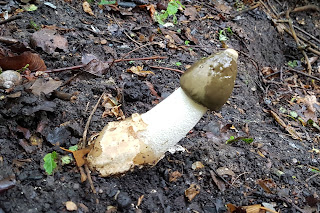
As I ran down Hempstead Lane, I noticed a Stinkhorn (Phallus impudicus). They are pretty unmissable. I'm told that it really lives up to its name so I'm glad that I didn't sniff it!

Four-barred Knapweed Gall Fly, 24 July 2021

I saw this Four-barred Knapweed Gall Fly (Urophora quadrifasciata) in July. There are two generations, one of which overwinters in Knapweed seed heads.

Long Hoverfly, 29 Aug 2021

Hoverflies are useful pollinators and I was delighted to find three species that I had not noticed before including the Long Hoverfly (Sphaerophoria scripta).

So, if all goes according to plan, on New Year's day, I will start all over again. I wonder what I will find in 2022?

Saturday, 1 February 2020

Revving up a Buff-tailed Bumblebee

Late this afternoon, the temperature was dropping and the washing clearly wasn't going to dry any more. So I went out, started gathering getting stuff off the lines and ... spotted a little black body in the grass.  I looked closer and saw that it was a Buff-tailed Bumblebee. I feared that (1) it had died and (2) it was 'our' big queen who has been visiting the garden since Christmas Day.

Buff-tailed Bumblebee Queen - 25 Dec 2019
As I carefully parted the grass to take a closer look, I realised that this Queen was smaller and a leg raised to warn off the annoying human told me that she was very much alive.

A different Buff-tailed Bumblebee Queen - 01 Feb 2020
I didn't like the idea of leaving her in the clammy grass where she could be trodden on so I picked a hellebore flower and scooped her up. As I raised her into the the warmer air, her wings started quivering.

Bumblebee after transfer to a warmer spot - 1 Feb 2020.
I carried her and her flower to a warmer, safer spot and put them down. She started feeding and I left them to it.  I was intrigued by the way in which she vibrated her wings and did a little Googling. According to a clip from the BBC's life in the Undergrowth, it is normal for bumblebees to cool right down in the night but, when they need to warm up, they can vibrate their wings until they are warm enough to fly.

Sunday, 26 January 2020

Big Garden Birdwatch - 2020

It appears that normal service has been resumed for the RSPB's Big Garden Birdwatch. The feeders are topped up, I've prepared my recording sheet, binoculars are to hand and the birds have vanished like snow in summer.  I can only suppose that the damp, mildish weather has allowed the birds to feed up in the countryside and they don't need to visit our gardens so much.

Female Blackbird with grapes.

Finally, I managed to entice our first visitor, a male Blackbird, with some grapes.  Naturally, he hid behind a garden ornament to eat them so here is a photo of the missus.  A little later, a Carrion Crow perched in our Oak.

Robin - one of a pair
I was charmed to see a pair of Robins dancing in and out of the twigs of our Acer and Buddleia trees. This pair have been around for a while now, and I hope they will nest somewhere nearby.

Blue Tit on Winter Sweet
My favourites were the three Blue Tits searching for insects amongst our yellow Winter Sweet and Witchhazel flowers.  A pair have already been checking out our old nest box - maybe they will decide it's still good enough to use.

Male House Sparrow on Crab Apple tree.
The RSPB results (at the time of writing - evening of 26 Jan) shows that the House Sparrow is the most widely spotted bird. I only got one male, which perched briefly in our wonky crab apple tree. My most common bird, with six individuals, was Woodpigeon.


We usually get about eight or nine Starlings fighting over the food on the bird table but only two appeared during my bird count, along with one rather nervous Magpie.

Here is my results list.

Results for 2020
This graph shows the ups and downs of my bird watches since 2011.  This year I got fewer birds (18 from 8 species) than last year (35 from 12).

This year's results were a little below average.

Wednesday, 1 January 2020

New Year Plant Hunt 2020 - Uckfield (2020)

This is my sixth year doing the Botanical Society of the British and Ireland's New Year Plant Hunt. After last year's high score, the number of wild or naturalised plants in flower has settled down to a more usual level. The scores for the last few years are:

  • 2015 - 21 species of which 2 were naturalised garden plants that had 'jumped the fence'
  • 2016 - 34 species of which 4 were naturalised
  • 2017 - 23 species of which 2 were naturalised
  • 2018 - 28 species of which 3 were naturalised
  • 2019 - 45 species of which 4 were naturalised
  • 2020 - 36 species of which 4 were naturalised

The first flowering plants I found were the simple weeds of grass and gardens: Petty Spurge, Daisies, Dandelions etc.

Winter Heliotrope - Just South of the Ringles
A few days previously, I had driven along the London Road and was really excited to find a strip filled with pinkish, fluffy flowers. It is Winter Heliotrope.


Sweet Violet
I visited the little courtyard in front of what used to be Parade Radio. I've often found Sweet Violets (Viola odorata) and several were blooming.  I made my way through the churchyard and along Belmont Lane. Towards the end of the lane, I found a hazel whose catkins had lengthened and could therefore be added to my list.

Gorse, Bellbrook Industrial Estate
In the Industrial Estate I found the ever reliable Gorse (Ulex europaeus) in bloom.

Common Chickweed, Bellbrook Industrial Estate
I was amused by a cheeky Common Chickweed (Stellaria media) growing in artificial turf. Nature always finds a way.

Wild carrot, Bellbrook Industrial Estate
There were some unexpected and rather nice wild flowers outside Barney's Play. I hope the visiting children enjoy seeing them. The "Nervous Botanist" kindly identified the first as Wild Carrot with pretty, lacy flowers. I have always associated Wild Carrot with the more alkali soils around Leatherhead so I was surprised to find it there.

Field Penny-cress, Bellbrook Industrial Estate
The other was a Field Penny-cress (Thlaspi arvense), with strange "penny" seed heads. When I held a piece up to the light, I could see four seeds inside each "penny". Joshua Styles kindly confirmed. Looking at the map in The Flora of Sussex, this appears to be a new species for our "Square".

A quick break in the Station pub!
After a quick break in the Station pub, I checked the Hawthorn hedge alongside the allotments. There was none blooming.

Scentless Mayweed, Manor Park
I made my way back home through Lime Tree Avenue and Manor Park.  The most unexpected find was a Scentless Mayweed (Tripleurospermum inodorum).  My last find was a Dog Violet (Viola riviniana) alongside our garden path.

The Science Bit

Location: Uckfield (North), East Sussex.  Start point: TQ478219

41 Wild Plants Flowering on 1 January 2020

Scientific name Common name
Achillea millefolium Yarrow
Bellis perennis Daisy
Capsella bursa-pastoris Shepherd's Purse
Cardamine hirsuta Hairy Bittercress
Cerastium fontanum Common Mouseear
Conyza sumatrensis Guernsey fleabane
Corylus avellana Hazel
Crepis capillaris Smooth Hawk's-beard
Daucus carota Wild Carrot
Erigeron canadensis Canadian Fleabane
Euphorbia peplus Petty Spurge
Fumaria bastardii Tall Ramping Fumitory
Hedera helix  Ivy
Lamium album White Dead-nettle
Lamium purpureum Red Dead-nettle
Parietaria judaica Pellitory-of-the-wall
Petasites pyrenaicus  Winter Heliotrope
Poa annua  Annual Meadow Grass
Polypogon viridis Water Bent
Ranunculus acris Meadow buttercup
Senecio jacobaea Common Ragwort
Senecio vulgaris  Groundsel
Sonchus oleraceus Smooth Sow-thistle
Stellaria media Common Chickweed
Taraxacum officinale Dandelion
Thlaspi arvense Field Penny-cress
Tripleurospermum inodorum Scentless Mayweed
Ulex europaeus Gorse
Urtica dioica Common nettle
Veronica persica Common Field Speedwell
Viola odorata Sweet Violet
Viola riviniana Dog Violet

4 Naturalised Plants flowering on 1 January 2020

Scientific name Common name
Bergenia cordifolia  Elephants ears
Campanula poscharskyana Trailing Bellflower
Centranthus ruber  Red Valerian
Corydalis lutea Yellow Corydalis