Showing posts with label fallow deer. Show all posts

Sunday, 1 January 2017

2016's Garden Visitors

While I've been running round the country for work, my trail camera has been keeping an eye on our garden visitors.  First - a confession - the battery was low for January and most of February so I didn't get night-time shots for those months.


24 June - Badger family
How many visits in 2016?

Mammals recorded on the Bushnell Trail Camera in 2016

This year, the badgers were very much the stars of the show. They visited every month from February to October and the number of visits was approximately double that of 2015.  I was delighted to see a group of three appearing on camera together. They appeared twice:
  • on 24 June, two of the badgers were smaller than the third
  • on 23 July, they were all about the same size - the youngsters were clearly growing fast.
On 25 July, I found that they had dug up a wasps nest.  So they are providing a free pest control service as well as photos!

Fallow buck, 17 May 2016
Sadly, we saw much less of the Fallow Deer. Last year, I noted that the darker, older buck stopped visiting in August. It appears that the magnificent light-coloured buck was less inclind to visit without his companion. We had just a few visits in the middle of the year.  In this shot, he has recently shed his antlers.

Fox - 27 December 2016, 1:40 pm
The number of fox visits (190 between March and December) is significantly down since last year (284 over the same period). We had spikes in March and August.  We usually expect increased visits in August as this is when the youngsters are active.  This August was very dry and, for the first time, I put a dish of water out for our wild visitors.  

Fox and cat - 11 August 2016
The camera occasionally captured a fox and cat together. In this photo, they look a little suspicious of each other. In others they didn't appear worried.

Tuesday, 21 June 2016

#30DayWild Do you know how fast antlers grow?

On June the 20th I started the day with all the enthusiasm that a wet Monday morning deserves. Heading out to get my daily newspaper I saw a pile of deer poo on our path. As excited as a kid on Christmas Eve, I glanced across at our Bushnell Trail camera, hoping it had caught something in spite of the constant rain.  After the day's work and meetings were done, I grabbed my the camera from the tree and downloaded the photos. 

My favourite visitor is a Fallow buck. He shed his antlers a few weeks ago and on his recent visits it's been interesting to see how quickly they regrow.  The photos here cover the period from April the 12th to June the 20th.  Times on the photos are in GMT. Add one hour to get BST.
April 12th - Antlers present and correct!
May 17th - Antlers gone.
Just 2 weeks later - his new antlers are nearly as long as his ears.
20 more days - the antlers are just over twice the length of his ears.
I don't know exactly when the Fallow buck lost his antlers but, in just over a month, they grew from nothing to twice as long as his ears.

I am currently doing the Wildlife Trusts' #30DaysWild challenge. For other blogs see MyWildLife.

Saturday, 28 May 2016

Spring Creeping Unwillingly into the Garden

It's a while since I've written here. This is because I've been travelling up and down to Birmingham for work.  Coincidently, I found myself in the same area that Edith Holden, who wrote the Diary of an Edwardian Country lady in 1906. I've been making my own notes in The Birmingham Country Diary of a 21st Century Lady.

The early part of the year was unseasonably warm and all the plants and animals seemed to be racing into spring. Then the temperature dropped and the brakes went on. On the 26th of April, it snowed. Finally, in May the sun came out again. It seems that spring is creeping unwillingly into the garden.

Green-veined white, 8th May.
Butterflies have started appearing - speckled wood, holly blues, green-veined and small whites.

Fallow deer, 17th May.
Our visiting fallow deer buck, visited on May the 9th. Since his previous visit on April the 12th, he had lost his antlers. On May 17th, when he visited us to give our flowers their 'Chelsea chop', he stayed in the garden for most of the morning. 

From mid-April, I have been enjoying using my Christmas present, a bat detector to find the common pipistrelle bats that regularly fly through our garden.


Tawny mining bee - 10th April
The garden has seem strangely silent without the buzz of bees. Hairy-footed flower bees have been visiting regularly and we had a little glut of brightly coloured tawny mining bees but it's only in the last few days that I have started seeing honey and bumble bees.

Hover fly (Syritta pipiens) - 27th May
Blue tits have nested in our box again. I was amused to see one of the adults bringing long strands of grass to the box, making the little bird look like it had an enormous moustache. Just a few days ago, I could hear the faint cheeping of the tiny birds only by standing under the box. Now I can hear them loud and clear from the bottom of the garden.

30 days wild - 2015
I am just about to start the Wildlife Trusts' 30 days wild, a challenge in which people do something wild every day for a month. Last year's 30 days wild motivated me to find new places to explore such as Chailey Common in Sussex and Elmsdon Park near one of the hotels we use in Birmingham. More to the point, it got me into the habit of being more opportunistic about engineering encounters with the wildlife that tucks itself into the spaces around us. My most memorable encounters were watching grey wagtails and house martins raise their families. They weren't in a nature reserve or even the countryside but in sight of Uckfield station and under the eves of a Birmingham hotel respectively.

Saturday, 2 January 2016

2015's Garden Visitors

Once again, I've been using my Bushnell Trail camera to record wildlife that visits our garden. I missed a little bit of January because I needed to repaint the box. For most of the year I kept the camera in the same position. Average number of visits was well up on 2014, which had fewer visits per night than 2013.
Two regular visitors - sadly the dark buck hasn't  visited since 6th August 2015.

How many visits in 2015?

In 2015:

  • Fox visits peaked in March/April - there were regular encounters between two individuals, maybe the youngsters we saw last year.
  • We had badger visits through late spring, summer and autumn
  • The fallow deer came in Spring, August and December.

How does this compare to previous years?


For the year as a whole:

  • Fox visits are up by about half c.f. 2014 although we had far fewer visits in the latter part of the year. We are seeing more occasions when there are two foxes in the garden.
  • Badger visits are up by about a quarter.
  • Deer visits are down. This may be due to us removing a tree at the end of May 2014 and/or the possible loss of one of the regular visiting males.
I have spotted a few patterns over the 3 years I have been recording:

  • In all three years that I have been recording, there is a dip in the number of fox visits in May - perhaps due to the birth of cubs.
  • Badgers are always absent for a period in winter, when they are dormant:
    • 2013 - November to January (2014)
    • 2014 - October to April (2015)
    • 2015 - November to ?
  • Fallow deer are:
    • absent at the beginning of the year first appearing in March (2015) and April (2013/4)
    • appear at various times during the late spring and summer months
    • absent for part of the autumn around October, presumably for the rut
    • often return in December enabling me to make predictable Rudolf jokes.

Saturday, 26 December 2015

My 2015 in Uckfield nature photos

As the year draws to a close it's time to look back on the wildlife I have seen in and around Uckfield during 2015.

January

January started with the BSBI New Year Plant hunt, in which I spent an hour looking for wild flowers that were out in bloom. I found a total of 21 different types - surprising considering that we had a few days of hard frost. 
Campanula on old wall at the top Uckfield's High Street.
Towards the end of the month, I took part in Lime Aid's volunteer session - trimming back unwanted growth at the feet of the amazing old Lime trees that once led to Uckfield House.
Before and After - Lime Tree Avenue.
As usual, the month ended with the RSPB's Big Garden Birdwatch.

February

On the 8th, four tiny Goldcrests were fluttering round the lower branches of our laurels and nearby bushes. One was displaying to the others with his normally inconspicuous crest feathers fluffed up in a bright orange "quiff".  One sunny day brought out a tattered but still lovely Red Admiral.

Red Admiral, Manor Park garden.

March

When Hazel catkins are shaken by the wind, you can see how they get the name "lambs tails". This year has been exceptionally windy.
Hazel, Manor Park garden.

April

Two Fallow Deer bucks, who are regular visitors to the Manor Park estate, came into the garden for a couple of hours. I and others were concerned that the darker one was limping. However it showed a fair turn of speed when escaping would-be rescuers.

 
Fallow deer, Manor Park garden.

May

May is, of course, bluebell time. This year I visited Boothland Wood, which in the next few years will be surrounded by the Ridgewood Farm development.  The woodland has a light, airy feel because it is surrounded by open farmland and has many elegant, slender beech trees.
Bluebells, Boothland wood.
Later in the month, the splendid WRAS rescued an injured woodpigeon from our back garden.
WRAS to the rescue, Manor Park.
The month ended with the Garden Biobliz in which I tried to find as many wild flowers and creatures in the garden as possible.  In the end, I identified 129 species compared to 104 last year.
Tree bumble bee spotted during Garden Bioblitz, Manor Park garden.

June

June was dominated by 30 days wild. This project meant having one wildlife moment a day.  To me it meant pausing and really taking notice of what was around me. My most memorable Uckfield discovery was a pair of Grey Wagtails that live on the part of the River Uck that flows under our station. I saw them courting and mating and was able to follow their progress up to the point when I saw a fluffy youngster.

Grey Wagtails on riverbank, seen from Uckfield station platform.

Another highlight was spotting Uckfield's very own Stickleback Si (named after one featured on BBC's Spring Watch) in the Hempstead Meadow Nature Reserve. I could see his red tummy and I was delighted to see him duck into his tunnel nest for a moment. 

July

Towards the end of July, I spent time pulling invasive Himalayan Balsam in the Hempstead Meadow Nature Reserve.  It was very pleasant to spend time in the reserve like that and getting to see special trees like rare Black Poplars and all manner of tiny creatures.
Black Poplar (left) and Himalyan Balsam (right). Hempstead Meadow
July was also marked the start of the Big Butterfly Count.  This year I saw more butterflies (108 in 12 counts) than last.  Our most regular visitor were bright orange and brown Gatekeepers. 

Gatekeeper butterfly, Manor Park garden.

August

The 8th of August was flying ant day. Suddenly they erupted from our lawn and were flying skywards like so many golden angels. It wasn't just us - all over the country, people were commenting, via social media, on the ants.  
Black ants, Manor Park garden.
On the 22nd of August 2015, I spent a lovely hour in our garden experiencing the light fading away and the creatures of the day finding their way home.  I counted about 400 Rooks as they flew past our house to their roost - probably Lime Tree Avenue.

On a wet bank holiday, I finally found the little remnant of heathland habitat on Manor Park, which is home to hundreds of dainty Autumn Ladies Tresses flowers.
Autumn Ladies Tresses, Manor Park estate.

September

September mornings found our garden full of spider webs sprinkled with jewel-like drops of dew. I was pleased to see that they seemed to be catching plenty of crane flies.
Garden Spider (Araneus diadematus) in Manor Park garden.
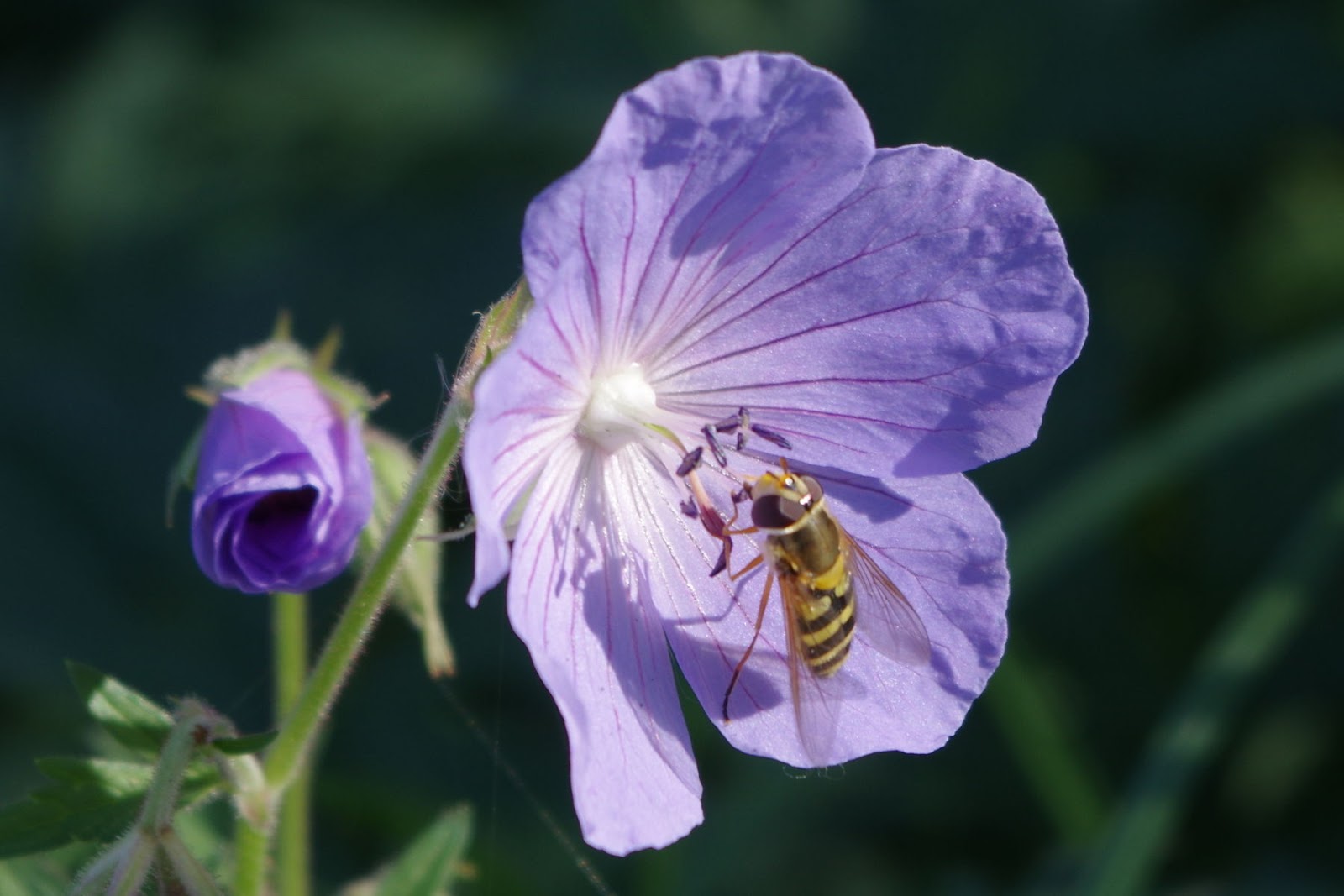
At the end of the month, I cut through Hempstead Meadow Nature Reserve and found plenty of flowers still out including a blue, Meadow Crane's-bill.
Hoverfly (Syrphus ribesii) on Meadow Crane's-bill. Hempstead Meadow.

October

In the run up to Halloween I expect to hear much talk about bats and other spooky things but I don't expect to see real ones. However the long, late summer brought us two surprise visits. One on October the 18th at about 6:15pm when we saw three dancing in the fading light and another at about 5pm on October the 30th.
Autumn leaves and Halloween decorations.

November

A grim month in all sorts of ways. At the start of the month fog swept in closing both Gatwick and Heathrow and on the 21st there were snowflakes in the rain.  Even the foxes that regularly visit our garden stayed away for most of the month.
One of the few fox visits in November. Manor Park garden.

December

In the run up to Christmas we had a few visits from a fallow deer with fine antlers. This is probably the lighter of the two bucks that we saw earlier in the year. Sadly the darker one wasn't with him.
Fallow buck, Manor Park garden.
Christmas is a time when we traditionally bring greenery inside. I'll leave you with the lovely Nordman tree that I bought from Vulcan Farm. 


Sunday, 31 May 2015

Garden Bio Blitz 2015

It's the end of May and it's time to record as many wild species I can find for the Garden BioBlitz.

Marmalade hoverfly on a garden poppy.
I did my first BioBlitz last year and was surprised by the number of different wild species I found in our garden and how little I knew about them.  I have often seen hoverflies, like the one shown on the poppy, around the garden but had never particularly looked at them or realised that there were many different species.  I set myself three objectives for this year's BioBlitz:

1. To spot more species last year's score of 105.
2. To do a better job of identifying them - I was OK on flowering plants but otherwise my 105 species included too many that I was very unsure about. This included taking more photos for reference.
3. To identify more minibeasts - insects, crustaceans etc.

Early bumblebee with 'bed hair'.
The day started cold (it went down to 3 degrees C overnight) but bright. Having worked late on the Friday evening, I could relate to the early bumblebee in the photo, which slowly and unwillingly clambered out of the allium flower it had slept in overnight.

I started by checking off the wild flowers I had listed last year. I was indignant when I realised that many of them had been browsed off by two fallow deer who had visited a couple of days previously. Fortunately the deer had done the decent thing and left enough for me to identify the plants and, judging from fresh droppings, popping back on the night before/early morning of BioBlitz day.

Caught in the act.
Throughout the day, I was able to see how others were doing by following the #gbb15 hashtag on Twitter. Although I was working on my own, I felt like I was part of a team working on a joint project because we kept tweeting photos and commenting on each other's progress.

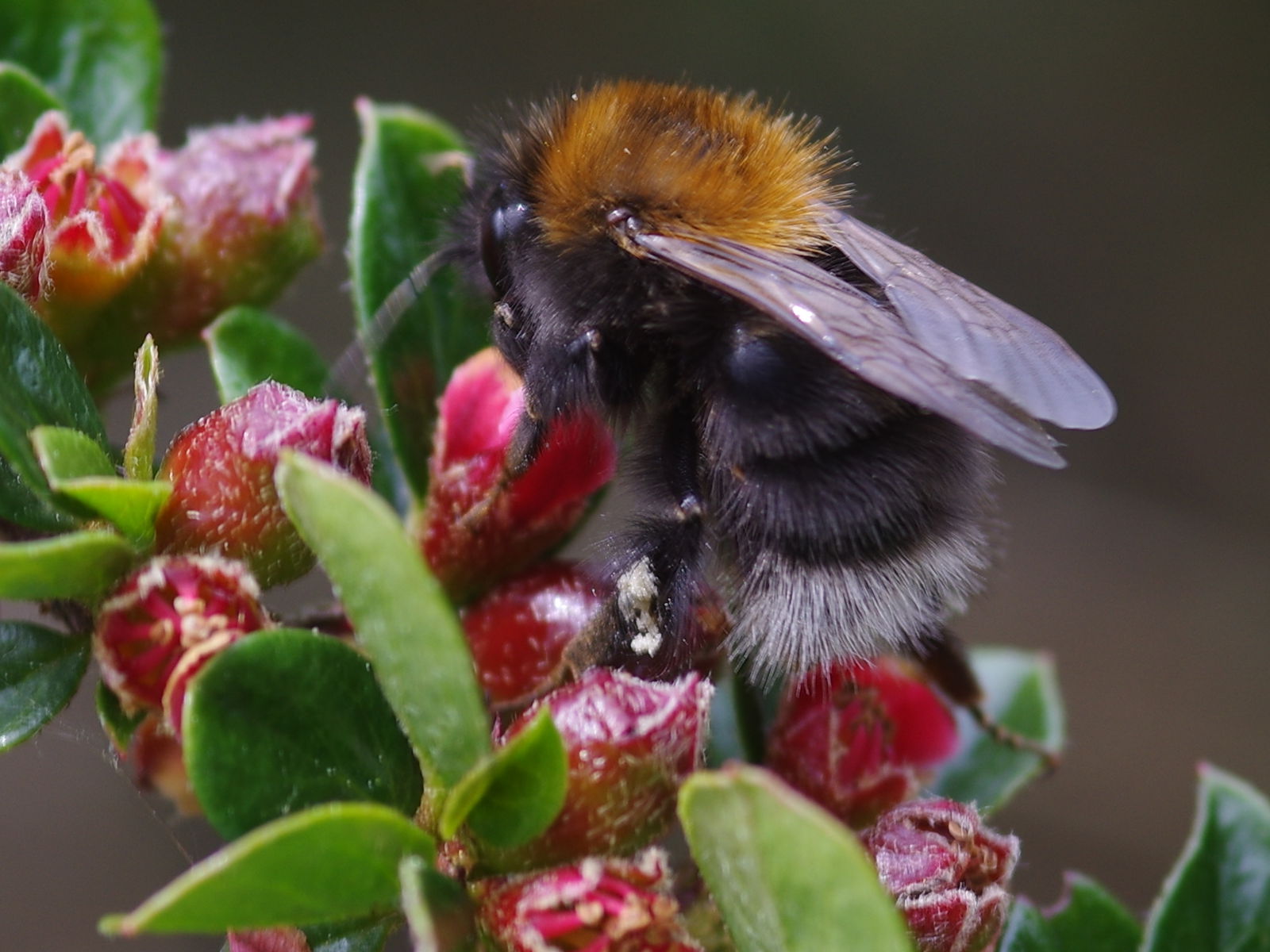
I was particularly pleased to see @DaveyManMcG tweet "Loads of honey bees & a few tree bees on my cotoneaster". This unregarded little shrub with its tiny flowers seems to be great for bees. Ours was covered in honeybees, tree and early bumble bees.

Tree bumblebee on cotoneaster
He has posted about his Garden BioBlitz on his Lancashire and Lakeland Outback Wildlife Safaris blog. I was amazed that he still had bluebells looking good at the end of May. In Sussex, ours peaked at the start of the month. It sounds like they had pretty challenging weather. Ours was OK but colder and windier than you would expect at this time of year so I didn't see many of the hoverflies that have been buzzing round our garden lately.
 
I am finding that social media is transforming my ability to observe and understand wildlife. I am learning so much from others. When I found out how many species of bees and hoverflies there are, I was fairly daunted by how difficult it would be to identify the creature that was in front of me. However there are loads of helpful resources online. Recently, I have found following Facebook groups very friendly and helpful:
So instead of being stranded by myself with books full of similar looking creatures, I can put a photo in the group and people, including experts, will help me identify them.
 
Back in the garden, I decided to try something I saw on Springwatch a few days previously. One of the presenters explained how many creatures could be found in an oak tree and shook a branch over a tray. He got several caterpillars and I got ... a disappointing rain of tiny bugs that I couldn't hope to identify and a fallen bit of leaf. Then I looked closer ...
 
Light emerald moth.
The leaf was a beautiful moth. It's light green colour and white 'veins' looked just like the back of an oak leaf. Then I looked some more and found a jaunty little yellow and black bug.
 
Dryophilocoris flavoquadrimaculatus bug from our oak tree.
I carried on poking around in the garden until the clouds rolled over and all sensible creatures including myself headed for shelter. I spent the evening processing photos and figuring out what I had found.  I entered my results on Sunday and was pleased that I had met my objectives, having:
  • identified 127 species
  • improved the accuracy of my identifications and added photos to enable verification
  • increased the number of 'minibeasts' identified - I have actually doubled the number of insect species in my count.
Breakdown of my BioBlitz Results.
When I finished at about 2:30pm, I was delighted to find that I was 3rd on the league table for the results overview. Of course, others will soon overtake me but it'll be nice while it lasts!
 
Overview of BioBlitz results at 2:30pm on Sunday.
I was intrigued to see that other results were building up for East Sussex. My 127 had contributed to a total of 141 species at that point.  I went into iRecord proper to find out what was going on. 
BioBlitz records in iRecord.
It seems that people have been doing a National Trust BioBlitz at Birling Gap.  Obviously their results are going to be very different - Birling Gap is right on the coast, is chalky and is a much more natural environment.  However, as their list has built up, it has been intriguing to see some similarities with mine.

Red tailed bumble bee was found in both Birling Gap and my BioBlitz.
Back to my own garden, I was pleased that some our garden minibeasts have become familiar enough to name on sight and I can identify some of the more distinctive creatures without too much trouble. However, I'm still struggling with many of them and have a lot to learn.  Also, after one little shake of an oak branch revealed two such pretty creatures, I really want to know what is going on in the canopies of our trees and who lives there.

Friday, 2 January 2015

2014's Garden visitors

I've been using a Bushnell trail camera throughout the year to find out more about the wild animals that visit our garden. This is similar to the recording I did in 2013 but a bit more systematic. This time, I kept the camera pointed at one area of the garden and put it out for nearly every day and night of the year. Average number of visits appear lower than last year but this is because I wasn't 'cherry picking' the best conditions and locations.

Fallow deer on the 25th of August.

How many visitors?

The following graph shows how many wild animals were "seen" by the trap camera per 24 hours.


Fox visits peaked in 3 months:
  • February, just like last year
  • August, again like last year - this is due to young foxes appearing in the garden as well as the adults
  • December, which is new - in December 2013 we had few visits, maybe due to the incessant rain we had over that winter.
Badger visits were occasional treats in Spring, Summer and Autumn but not in the Winter when they would be staying in their setts. 

Deer visits were more frequent than last year due to a delightful pair of males, one light and one dark, who sauntered in and out of gardens in the area from April to August. They even appeared in daylight. After they disappeared for the rut, one returned in November and December to take advantage of the tasty leaves in our garden.

When do they visit?

This graph shows the times of these visits.


Again, patterns were difficult to discern:
  • Foxes visit between sunset and sunrise but without any real pattern.
  • Badgers visit between sunset and sunrise - this year they were more likely to come after midnight whereas last year they mostly came before midnight.
  • Deer were much cheekier than last year - coming in the day as well as the night and often staying for long periods.
Although I haven't been able to draw any real conclusions, it's been lovely to keep opening up the camera and discovering new treats and surprises. In 2015, I intend to start experimenting with video.

References:
Month-by-month historic weather data - I looked at the Eastbourne figures.
Monthly averages - I searched by Uckfield, which gave me the nearest (unnamed) weather station.
Fallow deer rutting season.