Showing posts with label White-tailed bumble bee. Show all posts

Saturday, 5 August 2017

Holy Cross Churchyard Plant Survey - End of June

On the 24th of June, I recorded the plants in Uckfield's Holy Cross Churchyard for the Sussex Botanical Recording Society's Churchyard survey. As the weather was miserable on the day I did the survey I returned on the 1st of July to check some IDs and take some photos. This is my third visit, the first two being at the beginning and end of April

I've already recorded over 80 species and it was good to see some properly out in flower, like the Bird's Foot Trefoil (Lotus corniculatus) shown below.

Bird's Foot Trefoil.
I heard a buzzing and took a closer look at the bee pollinating the flowers.

Common Carder Bee on Bird's Foot Trefoil.
I was intrigued by the writing on the gravestone. The weather-worn letters were difficult to read but I could make out ...
 
THOMAS BROOKE ...
.... Uckfield ...
 
WHO DIED FEBRUARY 3rd 1876
....
Blessed are the pure in heart
... shall see god.

Thomas Brooke may have been a tailor on Uckfield High Street or one of his family.

Nearby a White-Tailed Bumblebee was foraging in the hedge alongside the churchyard.

White-tailed Bumblebee on bramble flowers.
Some of the plants I recorded are those little weeds that are so familiar that we hardly even see them. Identifying them obliged me to take a proper look at them.


Distinguishing between Willowherbs by comparing the share of the stigma (central female part).
The Collins Wild Flower Guide has keys that help me pick my way through different types of similar flower. The two Willowherbs I found were:
  • on the left, with an undivided stigma, is Square Stalked Willowherb (Epilobium Tetragonum)
  • on the right, stigma has four lobes, is Hoary willowherb (Epilobium Parviflorum).
The big, showy Evening Primrose flowers are a complete contrast to the dainty little willowherbs. Surprisingly, there are members of the same family.

Large Evening Primrose.
I thought that an evening primrose would be straightforward to identify but, again, there are several different species.

Red speckles on Evening Primrose stem.
The red speckles on the stem and other details helped me identify the plant as Large Evening Primrose (Oenothera glazioviana).

Yellow seems to be the colour of June. Another yellow flower that I added to the list was Smooth Hawkweed (Crepis capillaris)

Smooth Hawkweed.

Another plant we take for granted is grasses. I found a few more to add to my list including some that had escaped the mower because they are inside the metal railings around plots.

False Oat grass (Arrhenatherum elatius)
I'm sure that the Goldfinches and House Sparrows that I have seen in the churchyard will appreciate the seeds.

I finally managed to identify the large fern by the door as a Male Fern (Dryopteris filix-mas). I find ferns very difficult to identify. This time, my trusty plant guide directed me to inspect the spores and the edges of the leaves.

Male Fern - underside of leaf showing spores.
One of my favourites this time was Yellow Fumitory (Corydalis lutea).

Yellow Fumitory growing on the church walls.
After this it was time to leave the memorials, birds and flowers behind and visit the Farmer Market.

Saturday, 17 June 2017

Garden BioBlitz 2017

It was the first weekend of June, which meant it was time for the Garden Bioblitz giving me 24 hours to find as many wild species in my garden as possible. I have been doing the Bioblitz every year since 2014.
 
3rd June 2017 - 9am - let the Bioblitz commence
This year I wanted to:
  • beat last year's total of 144 wild species identified
  • successfully identify some tiny bugs that the iRecord verifier had been forced to reject because of my inadequate photographs
  • make more precise identification of plants in my garden especially grasses.
Hoverfly (Eupeodes) - a useful pollinator.
I started at about 9am on Saturday to try and find insects.  I was able to photograph some hoverflies and bees before they really warmed up and got too fast for me.  While I was exploring for insects, I could hear the birds calling in the trees. Thanks to what I have learnt on birdsong walks (guided by David of the Uckfield Local Nature Reserves Supporters Group) I found it easier to figure out where the calls come from and identify the bird. This means I got a couple of extra bird species compared to last year.

Leaf hopper - Iassus lanio
Our visiting birds are forever searching our oak and birch trees for insects to eat. I used a hook, hastily improvised from a packaging tube and a coat hanger to shake some branches. My catch included a number of tiny bugs and spiders. This time my replacement macro lens gave me a good enough photo to identify the Leaf Hopper shown above.

Corizus hyoscyami - Cinnamon Bug
I was a little disappointed not to find any Shield Bugs but I did find a colourful Cinnamon Bug amongst our flowers.

White-tailed Bumble Bee on ceanothus.
One of our star plants for bees is Mum's ceanothus. This was covered in different types of bees, such as the White Tailed Bumblebee shown, all day. After photographing the bees it was time to start checking the wildflowers. This is easier and quicker because, over the years, I have developed a list of what I expect to find. This year, because I have had some useful advice from the Sussex Botanical Recording Society I have been able add a few extras. For example, I have used the guides on the bottom left hand corner of BSBI Identification page to identify grasses more precisely.  Species new to my list included Fox Tail Grass and Perennial Rye Grass, both of which must have been in the garden for years without me noticing them.

Common Liverwort
Unexpectedly, I found a large colony of liverworts amongst the grasses on a sloping grass bank.


Frog tadpole
Doing a pond dip really brings out the big kid in me. I was delighted to find 15 fat tadpoles in one scoop.


Arion Rufus - Large Red Slug from underside
Mum called me over because she had found some slugs under her pots.  I photographed them from 3 angles as advised by Chris De Feu in February's Biological Recorders' Seminar. The bigger of the two was from one of those groups that are difficult to sort out but is probably Arion Rufus. Although they are big and very obvious in the garden, they do relatively little damage because they live on rotting vegetation. It's the little brown ones you need to look out for. After taking portraits of my slimy little sitters, I set up my beetle traps and went inside for tea.

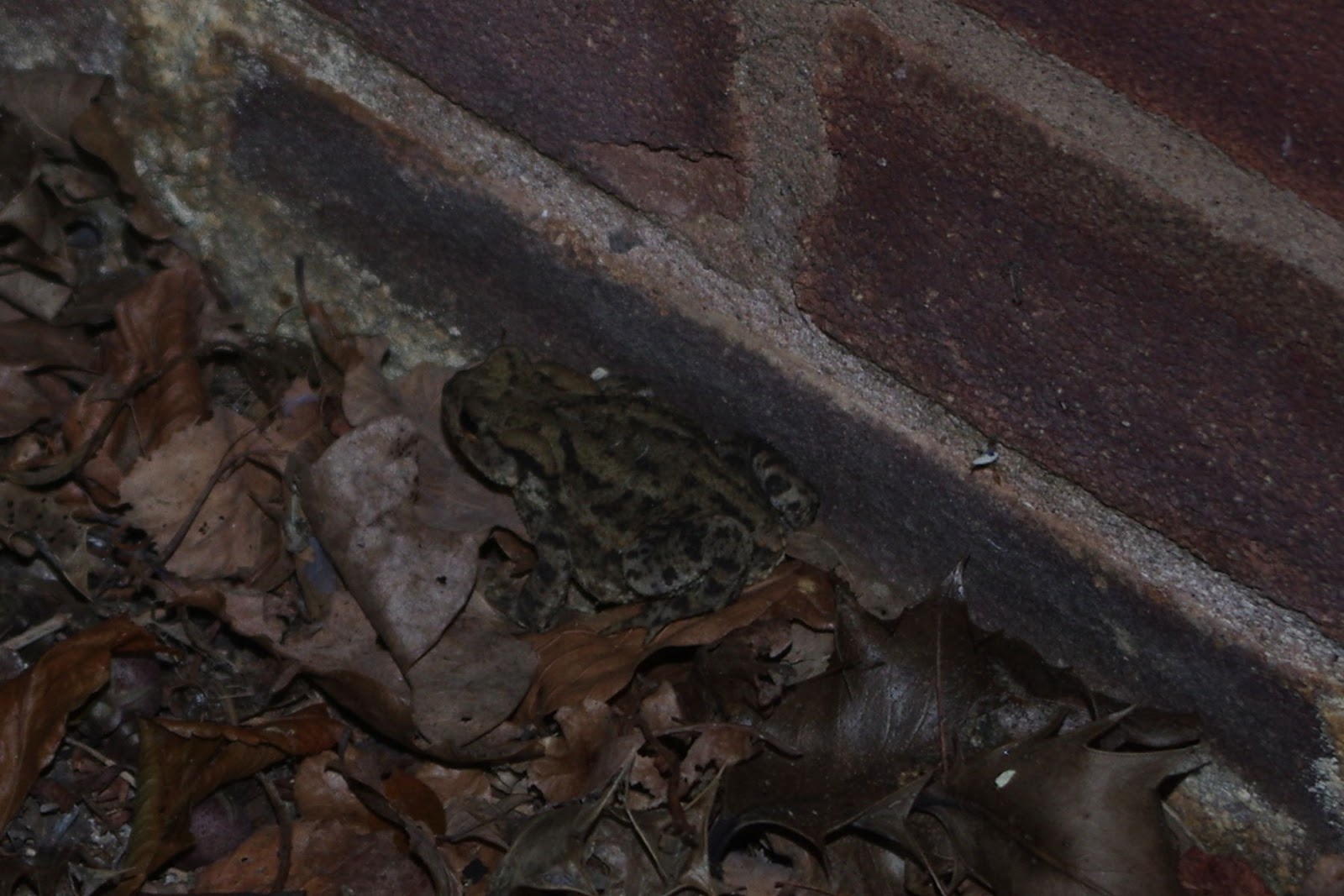
Toad, creeping through the leaves after dark.
As night was falling I went outside with my bat detector and detected a Common Pipistrelle. I heard some rustling behind me. Because there was no wind, this was seriously creepy. I slowly turned round, fearing that I would find a rat. Instead there was a toad moving through some dried-up leaves at the side of the house.  Toads eat insects, spiders, slugs and worms. Hopefully it is helping to keep our slug population down.


Millipede (Polydesmus)
The next morning, I got up early to check my beetle traps. I didn't find any beetles but I did find a millipede.  One last round of the garden yielded a few more insects and a forgotten wildflower and then it was time to enter my results.  So how did I do?

The National Results - I found 153 species in the garden.
I had just about beaten last year's record and, due to having replaced my 20-year old macro lens, had taken much better photos of the tiny bugs, enabling successful verification.  Thanks to other people, such as members of recording societies and Uckfield's own Nature Reserves group, I have been able to increase the number of species that I have recorded and share my own knowledge with others.

The 153 species I found broke down as follows.


My results broken down by group.

Before I close, I would like to give a big shout out to all the people who diligently sift through the records pushed into the system by people like me and verify or correct as required.

Sunday, 28 June 2015

30 Days Wild - Days 27 and 28 - Keeping it Local

30 Days Wild is drawing to a close. I wondered about trying to do something special for this weekend but, in the end, I had too much stuff that just had to be dealt with so I just kept it local.

Saturday, 27th June

For some reason I decided it would be a really good idea to go butterfly hunting before I was properly up, so apologies to early bird neighbours 'treated' to the sight of me chasing butterflies round garden while still in my dressing gown.

Um. Sorry.
All I can say in my defence is that it is from the excellent Carvills in our town, so I'm supporting local independent shops. Also I managed to get my first sighting of a meadow brown this year, 2 weeks later than in 2014.

Meadow Brown.
Once I was properly up (and dressed) I went across the road for a newspaper and enjoyed the sight of the Brighter Uckfield/The Uckfield Singers Community Choir planter in full bloom. Even better, there were two white-tailed bumble bees feasting on the flowers.

Planter outside Tesco Express on Manor Park, Uckfield.
White-tailed bumble bee on begonia.
One of the big treats of the weekend was opening up my Trail Camera to find out who has been visiting.
Another day-time visit - this time in good light.
Two young foxes have visited 3 times in the last 2 weeks.
It was particularly nice to see the young foxes visiting as, on Saturday afternoon, I found some soft, almost downy, brown fur. My guess is that the young foxes are beginning to shed their baby fluff.

Sunday, 28th June

Since we replaced the back window, we've had some birds hit it, including the unfortunate blackbird that I mentioned in 30 Days Wild - Days 7 to 12 - Travelling. I've added some stickers (from Allsorts in Uckfield) to try and prevent collisions.

Butterfly stickers on our back window.
After arranging my stickers, I did a little potting up and was amazed and delighted to see the tail-end of a bee disappearing into a small volcano-like hole in the earth between some paving slabs. I've seen various mining and leafcutter bees around the garden so it is good to see them making nests.

I spent most of the day editing the wild-life friendly part of the garden at the front. There is a fine line between a fairly natural-looking space and a mess. Part of that is keeping paths passable. The red-valerian is now more-or-less upright rather than sprawled over the paving, the forsythia will no longer whack tall people when they walk to our door and the lilac is now tree-shaped. While I was doing all this, I found an assortment of insects - so I'll leave you with some love bugs.

Mating Hawthorn Sheildbugs.
 

Saturday, 6 June 2015

30 Days Wild - Days 1 to 6 - Squeezing in

When I first heard about 30 Days Wild, a challenge in which you do something wildlife related, my heart leapt. Then it sank. I knew it was starting on the 1st of June, the Monday of what was going to be an exceptionally busy week. Surely I would never be able to fit it in.  I decided it would do no harm to try and squeeze in some nature observations while I went about my working week.

Monday, June 1st

I took my phone meeting in the garden. Buzzing bees and chattering sparrows are nicer than a screeching printer! I saw white-tailed bumble bees like the one shown, a tree bumblebee and a marmalade hoverfly on the weigela next to the bench I perched on for the call.
White-tailed bumblebee on the weigela next to our garden bench.

Tuesday, June 2nd

Just before leaving for Birmingham I tweeted that I was feeling and hearing the awesome power of the wind as I watch it toss oak branches. When it became apparent that - in the words of Southern "Tree on the line in the area which has caused damage to a Train as well as some damage to a rail." and that London Bridge was partly closed causing significant delays - I was less impressed.

Wednesday, June 3rd

I enjoyed watching house martins under the eves of my Birmingham hotel.
House martins' nests under the eves of The Arden.
This seemed a particularly miraculous "spot" as the hotel is adrift in a business park bounded by a dual carriageway, a mainline railway and the airport. As I walked to work, I noticed that one of the office buildings had house martins darting under a ledge. I met a fellow hotel guest, who was watching these birds and told him about the hotel nests. In return he showed me photos he had taken in his home country and told me about the birds he had seen in pond at the back of our building.
 
Thursday, June the 4th

Thursday was always going to be tough. I didn't have time during the day and I got home about 8:30pm.  After watching Springwatch and the continuing saga of Spineless Si the stickleback (this clip shows Si before he got his colouring from about 0:15), it was lovely listening to the birds singing their twilight songs while looking at Jupiter in the West.

Friday, June the 5th

I enjoyed running my hands over the craggy textures of a birch tree too big to get my arms round.
 
Birch bark
Saturday, June the 6th
 
I needed to go down the town anyway so decided to make a detour so I could walk through Lime Tree Avenue where I enjoyed the play of light through the leaves of ancient Limes.
Lime leaves.

I also swung through the Hempstead Meadow nature reserve. I remembered being told there were sticklebacks in the stream and decided to look for them. I found one drab-looking fish and a tiny baby in a rather muddy pool populated with skeeters, whirligig beetles and tadpoles.  Then I saw Uckfield's very own Stickleback Si near some flag irises. I could see his red tummy and I was delighted to see him duck into his tunnel nest for a moment. I also found myself explaining about the sticklebacks to a couple of walkers who were wondering why a middle-aged woman was sprawled over the bridge with her head through the bars.
 
Flag Irises near the stickleback stream.
So the first six days was about grabbing bits of time and having a fellow feeling for the wildlife that has squeezed itself into our lives by finding a niche in our built environment or occupying the slivers of land left when the estates grew up around avenues of trees and water meadows.