Showing posts with label bluebell. Show all posts

Monday, 11 May 2015

Boothland Wood

It's the early part of May, which means it's time to go and see some bluebells.  We have a bluebell wood, Views (Williams) Wood, just a few hundred yards from where I live. I looked round my old friends: the bluebells, the strange stumps and the kingcups on the May Day bank holiday weekend. Today, I visited Boothland Wood, owned by Uckfield Town Council.

Tall trees in Boothland wood.
Although I had never visited this wood before, it has been much in my thoughts recently. Within the next few years it will be engulfed by vast new housing estates.  There is also a Facebook group discussing the situation here. At a Neighbourhood Planning event that we held on the 7th of March, several people mentioned the lovely bluebells in Boothland Wood and their concerns that the wood would be spoilt by too many pairs of feet or the addition of inappropriate pathways.

The wood itself is charming. Although, like Views (Williams) Wood it is an ancient woodland carpeted with bluebells, the atmosphere is very different.  The wood is much smaller but it has a light, airy feel. Partly this is because the trees are different. Views (Williams) Wood is full coppiced sweet chestnut with some sturdy oaks.  Because it was once part of a grand house's park and adjoins a housing estate, a mixture of odd species such as sycamores and rhododendrons have been planted or have found their own way in. To my inexpert eye, Boothland seems to be full of hornbeam and elegant beeches soaring skywards.  It appears to have far fewer 'interlopers'.

Light slanting into the wood.
Because Boothland is surrounded by fields, light seems to bounce in from the slides, playing beautifully with the textures of bark and greenery.

Looking outside of the wood, you can see a farm. Seeing wool caught on the wire seems especially poignant, knowing that the sheep that once grazed there will soon be replaced by houses.

Wool caught on a fence and farm equipment in the background.
On a brighter note, the plans suggest that the farm and oast houses will be kept.

Farm and oast house.
At the moment, the woodland floor is thick with bluebells. A myriad of small paths thread through allowing a curious animal or photographer to get right into the flowers without doing any damage.  As I found my way through the wood a small group of great tits squabbled amongst themselves with little concern about the lumbering human watching them.  Butterflies flitted between the sunlit fields and flower rich woods.

Female holly blue butterfly.
The spring succession of flowers is well under way. I came too late for the wood anemones but there are bluebells, cow parsley, red camion, lesser celandine, herb robert and so many more. The delightfully named, goldilocks buttercup was a particular treat.

Goldilocks buttercup and lesser celandine with the bluebells.
I fear that the paths and the flowers surrounding them will be trampled into dust and the birds will find nesting much harder once the wood is surrounded by thousands of people and their cats and dogs. So it was a lovely but rather troubling visit. The wood seems quite delicate and will need considerable care if it is to survive the new estates.

Note: The outline planning application is here - you need to scroll down the page and hit accept to see it.  It is too late to make comments on this stage of the application.

Sunday, 22 June 2014

Views (Williams) Wood - Repelling the invasion

A little while ago the Woodland Trust asked for some volunteers to help Sandra, of the TrUck project, to remove some of the Himalayan balsam which, in their words, "is getting a foothold in a couple of places within the wood". A couple of months ago I had noticed small seedlings beginning to grow amongst the bluebells and other wild flowers. Now those 'seedlings' are taller than I am. If left to grow and spread, they would soon overwhelm the other wild flowers and cause other problems as explained in The River Uck - not so pretty in pink.
 
Himalayan Balsam in Views (Williams) Wood.
Unfortunately, I couldn't join the rest of the party so I went and did some by myself. As described in an earlier post, I have done this before and am happy that I can identify the plants properly.  The work itself is reasonably easy, it is just a matter of pulling up these shallow rooted plants and stacking them by the path.  I was there from about quarter past nine and had the wood more-or-less to myself. The only noise was birdsong and church bells, which was lovely.  While I worked in the shade of the trees, I saw many different types of wild flowers including dainty enchanter's nightshade, speedwell and red campion.
 
Red campion.
As I progressed and the heap of discarded Himalayan balsam got higher inquisitive dogs nosed around my work and their owners stopped for a chat. Later joggers and family groups passed by.
 
Heap of Himalayan balsam.
After about two and a half hours I went home, having spent an enjoyable morning getting rid of an alien invader - and don't worry - I'm not greedy, there is more balsam for other people to pull up.
 
 
Himalayan Balsam and honeysuckle.

Wednesday, 14 May 2014

How Doctor Who helped me spot a lizard

Yesterday we took a walk through The Woodland Trust's Views (Williams) Wood to Buxted Park and back. We visited earlier in the spring when the spring flowers seemed to be in a frantic race to bloom before the tree canopy closed over them. Now serene greens of fresh leaves are taking over from the fading flowers.

Serene greens and fading blues in Views (Williams) Wood.
The wood is quieter too as the birds that, earlier, were singing to attract mates and protect territories silently hunt food for their young. Fortunately for them the wood is humming with insect life.

Black headed cardinal beetle.
The most colourful insect we saw was a black headed cardinal beetle. It was eye-catching enough when I first saw it resting on an old stump. Long scarlet wing cases contrast with black head, body and legs. When its comb-like antenna detected me creeping up with my camera, out flashed black wings and it flew away in a swirl of red and black. The larvae of this insect live under the bark of freshly dead broad leaved trees. Maybe they benefitted from last year's coppicing.

The woodland rides are still lined with greater stitchwort, which has now been joined by delicate white caraway (I think) flowers. These still appeared here and there as we crossed the river to Buxted Park.  In the more open parkland, hawthorn are blossoming and rabbits lolloping around in the sun.

Bluebells and hawthorn blossom - Buxted Park
Most of the daffodils in the graveyard of St Margaret's Church have faded but a few of the late, pheasant eye, variety are hanging on. The shaggy grass is full of pea-family flowers: red clover, black medic (which is actually yellow), vivid magenta common vetch and the tiny blooms of hairy tare. As bees work systematically through the flowers, a cloud of shiny micro moths dances above.

Lizard draped round the neck of an angel.
As we walked to the gate I spotted an angel headstone, I gestured towards it and was about to make the usual joke about not blinking (this is from an episode of Doctor Who called Blink) when I spotted a lizard draped round the back of the neck of the angel. In a blink it was gone. I hope it had scurried away from the looming human rather than being zapped back into the past. If it hadn't been for me wanting to make a daft joke about a TV show, I never would have seen the lizard.

Buxted Park Hotel

It looks like some trees have been lost in recent storms and, maybe, some of the Limes that fell in the great storm of 1987 have been cleared away. Parts of the park feel a little more open now and there are some fine views of the Buxted Park Hotel.

Geese and goslings.

Passing between the lakes there are a variety of geese with fluffy goslings. Like us, they fled to the shelter of the trees when a hail storm interrupted the sunshine. We went home to our warm, dry house, leaving the creatures of the park and the wood to fend for themselves.

Monday, 13 May 2013

Hempstead Lane and Lime Tree Avenue in May

In my last post, I spoke about walking through Hempstead Meadow on the way home from the dentist. That, of course, wasn't the end of my little journey.

Hempstead Lane
Hempstead Lane is an old road that long predates the houses that line part of its route and the school hidden behind the trees in the photo. The grassy bank under the trees is covered in bluebells, cow parsley, stitchwort, alkanet and other wild flowers.


Bluebells, stitchwort and cow parsley
Turning right took me into Lime Tree Avenue. This wonderful avenue led up to the long gone Uckfield House. I feel very privileged to have worked there, removing unwanted growths from the feet of the magnificent trees. Over the last couple of weeks the new leaves have been bursting out of tight buds that protected them from the winter weather. Cow parsley, alexanders and other wild flowers have created white, frothy clouds below the trees.


Lime Tree Avenue, with cow parsley at the feet of the trees.
It was only a 30 minute walk from the dentist and was so much nicer than taking, and trying to find somewhere to park, the car.

Monday, 6 May 2013

Views Wood - spring on fast forward

We took advantage of the lovely spring weather and the May Day bank holiday to walk though the Woodland Trust's Views (Williams) Wood today. The much delayed spring is now on fast forward. 


Wood anemones and bluebells in Views Wood

Because of the cool spring, the last of the wood anemones have hung and are now combining beautifully with the first of the bluebells.  Other flowers such as yellow archangel and cuckoo flower are appearing too.

The lovely carpet of wild flowers was animated by little birds - wrens, robins and blue tits - flitting around as they collect food for hungry nestlings.  Amongst the gentle spring colours, there's the dazzling flash of an orange tip butterfly's wings.


King cups in a soggy dip
One of the hidden treasures of the wood is the gold of king cups that gleams from the bottom of a soggy dip. They are surrounded by banks of bluebells.  

When we reached Buxted Park, this sunny bank holiday had one more treat for us. The sound of cuckoos, who must have recently arrived from Africa.

Tuesday, 30 April 2013

Bluebells - just starting

They seem rather late, but finally the bluebells are beginning to bloom.  There are just a few, here and there, making tiny puddles of blue in the garden and local woodlands but it won't be too much longer before the puddles become ponds, the ponds become lakes and finally the lakes join up to make a sea of blue that covers the ground.

Bluebells in our garden, photographed 28th April.

One of the treats of this year's cold spring has been the way in which the primroses are hanging on - giving us a beautiful display of bluebells and primroses together.

Sunday, 14 April 2013

Stealing ideas from nature

It's true confession time. When gardening, I steal most of my best ideas from nature. When walking through Views (William) Wood near my Manor Park home I see many pretty sights.  One of my favourites is the mossy old stumps and coppice stools surrounded by dainty wild flowers and ferns.


Wood anemones around the foot of a coppice stool, photographed 14 April 2013
I wanted to make something similar in my garden. Wood anemones, bluebells and wild arum grow naturally there. Maybe the woodland once extended as far as the location of our 1960s home.  


Here's one I made earlier, photographed 14 April 2013
We asked a professional gardener to remove some laurels, giving us a clear space in the shade of our tall birches.  Next, I bought a couple of old coppice stools from Wilderness Wood. My family are always amused by my habit of buying manky old bits of wood but I find they make good garden ornaments without the worry that some light-fingered so-and-so will take a fancy to them.  I got most of the plants by taking pieces of what we already had in the garden. I transplanted seedling wild arums and sprinkled seed from bluebells, cuckoo flower and foxgloves. I supplemented these with ferns, hardy geraniums and a red campion-like plant that I bought from local nurseries and open gardens. I don't stick rigidly to native plants. Sometimes I choose garden species that are similar to local wild flowers. I find that these cope just as well with local conditions, including greedy deer, and extend the options available to me.

The final step was to wait. It will be a year or two before the bluebells are flowering properly but the other flowers and leaves are giving plenty of interest. So that is how I designed my little woodland garden.

Tuesday, 19 March 2013

Spring Equinox - green shoots?

Well Spring's arrived - allegedly.

It's less than 2 weeks ago I was crowing about "spring becoming an unstoppable force". Since then we've had heavy, drifting snow and rain and unrelentingly cold miserable weather. The frog spawn is looking a bit sorry for itself and the daffodils are decidedly confused but ...

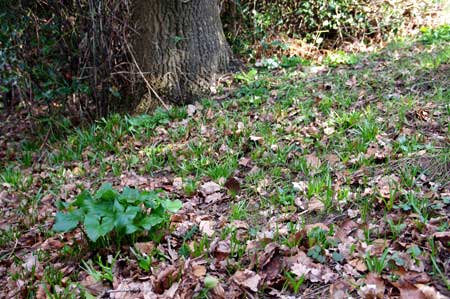
Wild arum, bluebell and fritillaria leaves under oak.
... green shoots are breaking through all over. Just a few weeks ago the area below our oak was barren looking mud. Now leaves of wild arum, bluebell and fritillaria are growing rapidly. Maybe, just maybe spring is arriving.