Showing posts with label Sussex. Show all posts

Saturday, 2 January 2016

New Year Plant Hunt 2016 - Uckfield

The Botanical Society of the British Isles regularly runs a flower hunt. I did my first hunt in Uckfield, Sussex last year and found 19 natives and 3 naturalised garden flowers. To my surprise, very few of my finds were in nature reserves and other 'official' places for nature. Instead I found most of my flowers in the scrappy edges: near shops, on walls and under hedges. So this time, I decided to focus my attention on these sorts of areas.

I was a little pessimistic because I haven't been seeing wild flowers in some of the places I usually see them. On the other hand, it has been very mild so maybe I could expect a good haul. Then on the very morning of the hunt, a frost - just enough to make flowering plants drop their petals and sulk.

Oh no! A frost!
I checked out the area near Tesco Express and found various little weeds tucked away in sheltered spots by walls and under hedges. I found more plants than last year. New finds included Herb Robert and Ivy-leaved Toadflax.  I like the story that Ivy-leaved Toadflax came to Britain with Italian statues that young gentlemen brought from their grand tours in the 1600s. I have no idea if it is true but it is a pretty story for a pretty flower.
Ivy-leaved Toadflax near Tesco Express, Browns Lane.
I also found the same resilient little weeds that I found last year.

Detail of Common Groundsel, which I also found last year.
As I made my way through the estate I found a fairly large group of Red Deadnettles at the foot of a wall. This seems to part of a pattern - this year I have found many more substantial groups of flowers rather than ones and twos of last year.

Swinging into Southview Drive, I found large numbers of flowers and berries on the large ivy on the corner. Once in the High Street, I eagerly examined the old wall at the top of the town and found Wall Bellflower and Yellow Corydalis, just like last year. The flowers were more numerous and in better condition than before.

Wall Bellflower, High Street.
Our town has many little treasures tucked behind the high street. The previous day, I had popped into Parade Radio to pick up light bulbs and chanced upon deeply coloured violets just outside. I couldn't believe they were Sweet Violets but their leaves were much rounder than the Dog Violets that are familiar from our own garden.

After checking Holy Cross's walls and graveyard I cut down ancient Belmont Lane. I drew a blank last year but this year found Holly flowers and Bush Vetch.
Bush Vetch in Belmont Lane.
The Holly wasn't the only plant showing flower alongside its berries. On the bypass, the Hawthorn hedge surrounding the allotments also had a scattering of bloom. I definitely identified it correctly as I was able to trace the stem back to the still green leaves. Once again I found Yarrow and Black Medic by the fire station.
Yarrow near the Fire Station.
I cut through the bell walk shopping area to the river bridge. The hazel catkins over the river are lengthening and getting very yellow unlike those in our North-facing garden, which are still tight and green.
Hazel catkins in front of Bridge Cottage.
I had timed my route so that 11 o'clock saw me outside the Station pub, just as it opened. So I was able to take a break and warm up.
Taking a break.
By the time I left, quite a few people were filtering in and I reluctantly left the friendly pub to go back into the cold for my final lap.  As I was out-and-about I decided to check out Uckfield Town Council's Bridge Farm Wood, which overlooks the new station car park. I didn't find any flowers there but there was a variety of ferns and mosses as well as a lively squirrel.
Bridge Farm Wood.
I had to get home quickly as I still needed to check the garden. Taking a short cut through one of the twittens (alleyways) I found Green Alkenet, False Brome and naturalised Yellow Strawberry.
Green Alkanet, Manor Park twitten.
Finally, in our own garden, I found several different wildflowers including an out-of-season Cowslip giving me a total of 30 native and 3 naturalised plants in flower.
Cowslip, Manor Park garden.

The Science Bit

Location: Uckfield, East Sussex.  Start point: TQ479219

30 wild plants flowering on New Year's Day:

Achillea millefolium Yarrow
Bellis perennis Daisy
Brachypodium sylvaticum False-brome New in 2016
Capsella bursa-pastoris Shepherd's Purse
Cardamine hirsuta Hairy Bittercress
Corylus avellana Hazel New in 2016
Crataegus monogyna Hawthorn New in 2016
Crepis capillaris Smooth Hawk's-beard New in 2016
Cymbalaria Muralis Ivy-leaved Toadflax New in 2016
Euphorbia peplus Petty Spurge
Geranium robertianum Herb Robert New in 2016
Hedera helix  Ivy
Ilex aquifolium Holly New in 2016
Lamium album White Dead-nettle
Lamium purpureum Red Dead-nettle
Lapsana communis Nipplewort New in 2016
Medicago Arabica Black Medic
Pentaglottis sempervirens Green Alkanet New in 2016
Poa annua  Annual Meadow Grass
Primula veris Cowslip New in 2016
Primula vulgaris Primrose
Ranunculus ficaria Lesser Celendine
Senecio vulgaris  Groundsel
Sonchus oleraceus Smooth Sow-thistle
Stellaria media Common Chickweed
Taraxacum officinale Dandelion
Ulex europaeus Gorse
Vicia sepium Bush Vetch New in 2016
Viola odorata Sweet Violet
Viola riviniana Dog Violet New in 2016

4 naturalised plants flowering on New Year's Day:

Helleborus foetidus Stinking Hellebore New in 2016
Campanula portenschlagiana  Wall Bellflower
Corydalis lutea Yellow Corydalis
Duchesnea indica Yellow-flowered Strawberry New in 2016


Saturday, 8 August 2015

Flying ants

Mum pointed them out first. Tiny golden angels rising in the sunlight. A closer look revealed hundreds of flying ants on and around the stepping stones at the bottom of our garden.

Preparing for take off.
There were also many small, wingless ants scurrying busily about.  This frenzy was an amazing sight in such a quiet area of the garden. I hadn't even realised there was an ants nest in this part of the garden. Maybe I should have done, as I've often seen blackbirds sunbathing down there. I understand that they like ants to run around their feathers to help get rid of parasites so they indulge in behaviour known as anting.

I imagine that it is a real bonanza for predators. Mum thought she saw a red dragonfly catching the ants on the wing.

It wasn't just our garden. I posted in the UK Bees and Wasps Facebook group (open) and people from all over the country commented that they had seen flying ants too. 

My photo was picked up in a Mirror article, which was posted in the Uckfield Talk Facebook group (closed - you'll only be able to see the post if you are a member). Several people from the town mentioned that nests of flying ants had appeared around their houses.

My photo was also picked up by West Sussex's Spirit FM for their article on the "invasion" of flying ants.

Saturday, 4 July 2015

30 Days Wild - Free the Human


It's just a few days since I finished my 3 days wild. I've seen so many surprising and lovely things, from Bee Orchids on waste ground in Birmingham to the creatures that visit our Uckfield garden.

I wouldn't be me if I didn't reflect on and analyse my 30 days wild. So here is a wordle based on my #30DaysWild tweets.

As you can see, I've been observing nature in my home town of Uckfield (in Sussex) and my current place of work, near Birmingham. Although the weekly commute is a chore, it's given me a chance to be wild in both the city and the countryside. Given the challenge to find wildlife every day motivated me to really look at places near the office and hotels giving me some unforgettable encounters.
Young house martins at the Arden Hotel
I notice that two words I used a lot were love and enjoy. I had an absolute ball trying to find nature every day. It gave me the impetus to explore new places. It also gave me a reason to really look at familiar friends like my favourite bee.

Patchwork leaf cutter bee in my Uckfield garden.
All this searching for wildlife is a pleasant way of taking exercise. Tiny interludes, like a teleconference taken outside or visiting a pond next to the office, can make the working day less stressful and more fun. At work, we recently received an email suggesting we spend a few minutes outside in the sun each day to top up vitamin D levels. Who am I to argue?

Topping up vitamin D as per my employer's instructions.
I've been exploring outside wherever I find myself - not just waiting for holidays. In Birmingham, I discovered a huge park just opposite one of the hotels I use. Closer to home, I visited Chailey Common properly for the first time. I hope to be exploring both places much more in the future.

Ellie-May and Hamish bracken rolling at Chailey Common.
Some of my wildlife encounters came about because others were generous with their knowledge. When a fellow commuter at Uckfield station realised I was interested in the local wildlife, he told me where to look for a pair of grey wagtails. In turn I showed some of my colleagues where to find orchids in a surprising place.


Bee orchids at Trinity Park business park, near NEC Birmingham.

I just have to do it - 30 days wild in numbers:
  • 76 Tweets
  • 12 blog posts
  • about 100 photos shared out of a thousand taken
  • 3 drawings.
Drawing of Tern in front of an NEC hotel.
I've learnt so much from 30 days wild. Obviously, I've learnt about the wildlife around me but there is much more. Just one example - getting the photos that told the stories I wanted to share, really pushed my photographic skills.

I've even found that I am using my senses more.  I like to observe things but my observations have tended to be visual. Over the 30 Days, I've been listening much more to the twitter of house martins arriving at their nests, buzzing bees and swishing grasses. I've enjoyed feeling the wind and rain on my face, tasting the sweetness of strawberries eaten straight from the garden, touching rough barked trees and soft fur.
Taking a few minutes out of the working day to get wildlife photos.
So will I continue my wild life? Of course I will.

Saturday, 20 June 2015

30 Days Wild - Day 20 - Where are all my Hoverflies?

Day 20 was about trying to track down some insect life, specifically hoverflies.

Saturday, 20 June

This morning, I had an online conversation, in the Facebook group UK Hoverflies about how few hoverflies we have been seeing recently. Until today, I had been assuming it was just me seeing so few of these insects. So I decided to keep my eyes peeled for insect life throughout the day.

Ichneumon Wasp
First thing, when I went to get the newspaper, I saw a gangly black and yellow creature in the wild flower patch I mentioned at the end of yesterday's post. I just managed to snap a rather iffy photo with my phone - I though it was a field digger wasp.  However, a verifier on iRecord kindly pointed out that it was an  Ichneumon wasp - possibly Ambylytes.

On the way back from the town, I went through the Hempstead Fields nature reserve. 

Hemlock water dropwort - alive with honey bees.
The reserve was full of hemlock water dropwort, which was alive with honey bees. For a while, I followed a small tortoiseshell butterfly. It looked very fresh and bright but, encumbered by shopping, I couldn't get a photo. Butterfly 1 : Wendy 0.

Back at home, I had some clearing up to do in the garden and looked out for insects. There was one early and a few white-tailed bumblebees. There were also 3 honeybees on the borage. I had another look round and found a distinctive black and yellow sawfly on a rose bush.

Sawfly - probably Allantus cingulatus
Finally, I found some hoverflies. There were four of the wonderfully named marmalade hoverflies stationed round the garden and a Syrphus ribesii.

Syrphus ribesii
Otherwise the insects I saw were too tiny or too fast to photograph. The last creature I found was a hawthorn shield bug, which fell into my hand while I was tidying our hop and refused to let go when I was trying to put it back where I found it.

Hawthorn shield bug.
Oh, and earlier on, I bought this bee house when I was shopping . The green token went in the East Sussex Wildlife Rescue and Ambulance Service section. These were the people who took in an injured wood pigeon from our garden.
So, not a huge number of insects but a fair amount of fun and interest.

Thursday, 18 June 2015

30 Days Wild - Day 15 and 16 - Zooming in on familiar places

Days 15 and most of 16 were about revisiting familiar places and zooming in. In my own garden and on my Uckfield to Birmingham run, I am getting to know the best places to find wildlife. Sometimes experience tells me where to look but often I've been able to see something special because someone was generous with their knowledge.


Monday, June 15

Monday was a working at home day and, as I had another phone conference, I took my note book and a pen and tiptoed outside hoping that the loudly buzzing bees on the flowers wouldn't give me away. One of the others commented on the birdsong, and our client confessed that he'd taken the call in the garden. Emboldened I 'fessed up to being outside too. While I was outside, I saw white-tailed and early bumble bees, a carder bee and a pair of speckled wood butterflies.

Tuesday, June 16

Heading to Birmingham again. In a previous post, I said that a fellow commuter had showed me where to see some grey wagtails. So I looked over the River Uck, where it flows under the platform.
The River Uck from the station platform.

There were swifts screaming overhead and then ... there they were. I was delighted to see a pair of grey wagtails courting on the ledge, partly hidden by the leaves of the tree on the right of the photo.
Grey wagtails
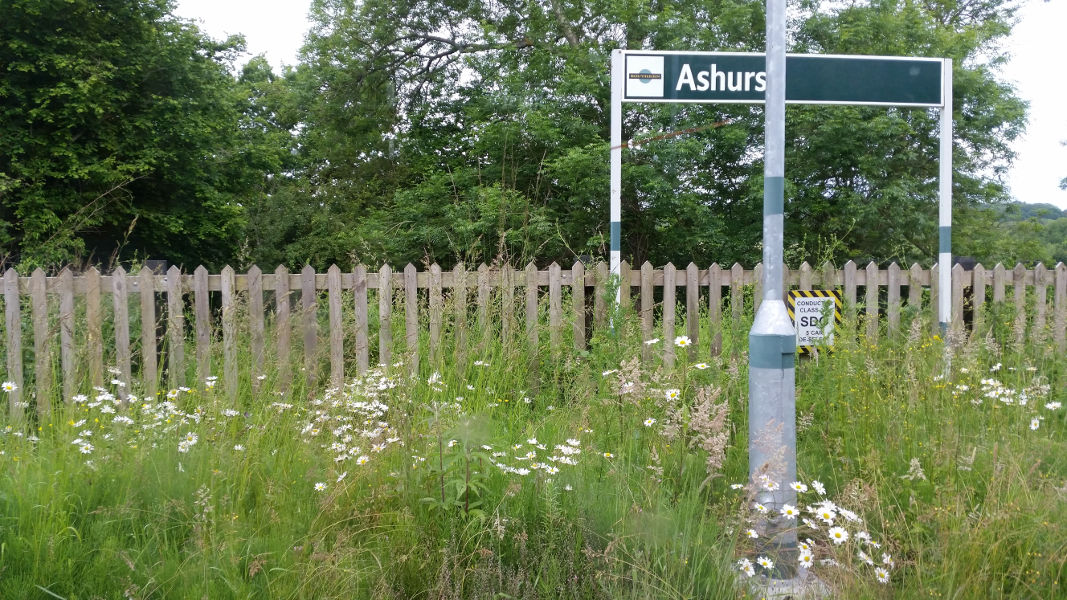
Just before Buxted, where I had previously seen some fallow deer, I saw a fallow doe and her fawn. Then, at Ashurst, a joyous romp of moon daisies.

Moon daisies at Ashurst.
One I got to Birmingham, I took a few moments to check out the wayside flowers, on my way into the office. There are quite a few roses, including both cultivated and wild varieties.

Wild roses between the road and main-line railway.
I paused for a moment by the white roses and noticed an iridescent green beetle.

Fat thighed beetle.
Then straight in to the office. I wanted to get into work as quickly as possible - I had a plan ...

Sunday, 14 June 2015

30 days wild - Days 13 and 14 - the Weekend!


It's the weekend and the first time I went on a #30DaysWild outing. So far all my encounters with nature have been opportunistic - squeezed in, sometimes while travelling. Saturday was still like that but on Sunday, I visited Ashdown Forest.


Saturday, June 13

On the way back from the shops, I was happy to see that East Sussex council had managed the mowing of local grass verges so that the wild flowers including orchids could flower.

Spotted orchid.
My Saturday lunchtime treat was to open up my trail camera and see what has been visiting our garden. To my surprise, a fox had appeared in daylight so we have some colour pictures rather than the usual infra red. The badger continues to be a total diva, rushing by so we don't get a decent photo.


Fox, visited in the afternoon on the 11th of June.
I did a little tidying and watering outside and was filling the pond when I heard calls. To my delight there was a family of pied wagtails on our roof.

Sunday, June 14 - Old Lodge Nature Reserve

The day was dry but rather overcast. I decided to head out to Sussex Wildlife Trust's Old Lodge Nature Reserve on Ashdown Forest. Even before I left the Uckfield bypass, I saw young rabbits feeding at the side of the road. Once I got to the reserve, I decided to concentrate on details because the light was too dull for landscape shots.

Lichen on birch trunk.
The first thing I spotted was lichens and mosses on a craggy old birch tree.  As I walked along the top edge of the reserve, I was fascinated by the colourful and rather weird pine flowers and amazed to find bluebells still out.

Pine flower.
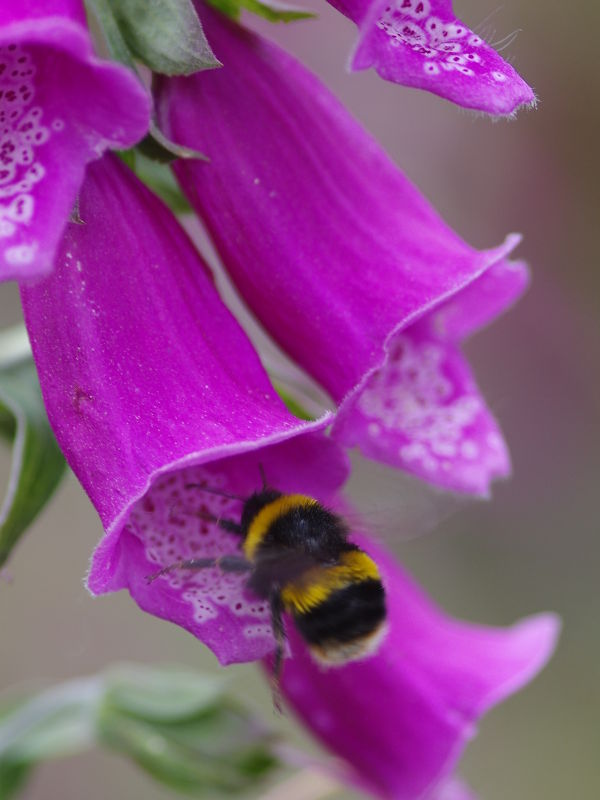
I was glad to see a cluster of foxgloves had sprung up again on the old bank and even more pleased to see a bumble bee scrambling in and out of the flowers.

Buff-tailed bumble bee on foxgloves.
Pink and purple flushes here and there show that the heaths and heathers are already beginning to bloom.

Cross-leaved heath.

Bell heather.
On the path down to the dragonfly ponds I noticed many other plants including the tiny, startlingly beautiful flowers of a sedge.

Heath sedge, just a few inches high.
Along the way I met a couple. The man was clutching binoculars and was pleased because he has seen a greater spotted woodpecker and heard the calls of its mate. The woman wanted to know about the white tufts she could see from the path. I explained they are cotton grass and told them about the green woodpecker I had seen on the higher ground.

Cotton grass.
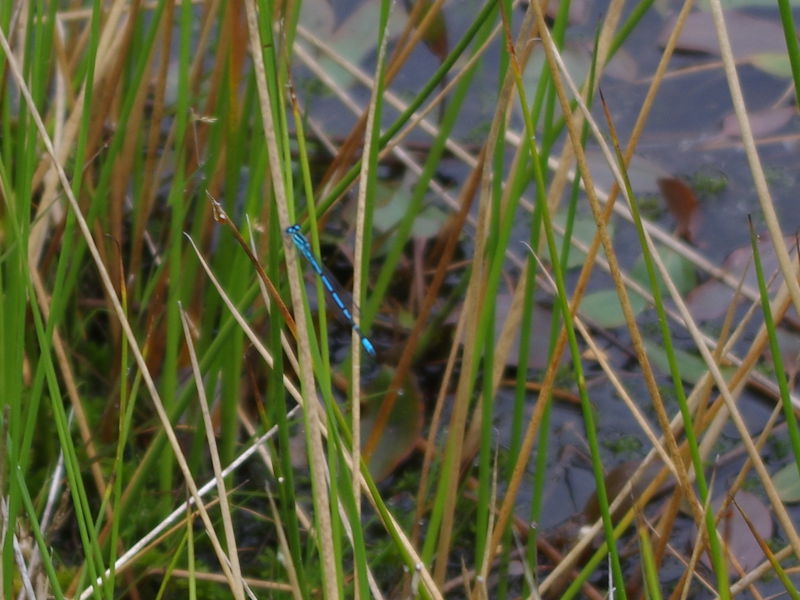
I think it is too early and certainly to dull for dragonflies but I did see a damselfly.

Damselfly - Common blue, I think.
I was far to slow to catch up with the many ochre coloured moths that I disturbed while walking but I did manage to photograph a brown china-mark moth, which is unusual in that its larvae are aquatic.
Brown china mark moth.
Across the path from the ponds, three ancient and magnificent beeches cast a deep shade.

Three huge, ancient beeches.
For me, the sight of these lovely and rather mysterious trees is always the high point of a visit to Old Lodge. After spending some time with them, I returned to the car, pausing to enjoy something on an altogether different scale.

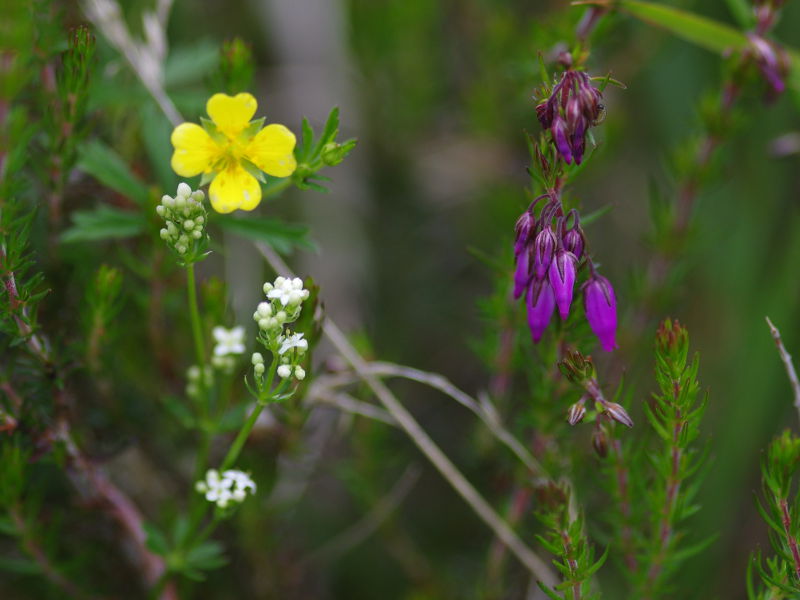
Tormentil, heath bedstraw and bell heather.
Three colourful little flowers had mixed to give the effect of a tiny garden.

Our own garden

After being out on the forest, our own garden seems so much more confined but is full of colour and interest. After lunch, I grazed my way through our alpine strawberries. Then I watched some bees feeding from our own foxgloves and borage. The borage had at least three different sorts of bee. White-tailed and early bumbles as well as a leaf cutter.

Patchwork leafcutter bee.
Just after 10pm, to round things off, I saw bats swooping past my window.