Showing posts with label woodpigeon. Show all posts

Saturday, 27 January 2018

Big Garden Birdwatch - 2018

This year, I had to do my Big Garden Birdwatch a bit earlier (8:05 to 9:05 am) than usual because I needed to get to the hairdresser. I thought this might be why my scores were a bit low but I am assured that there were very few birds in the garden while I was away.

2018's Big Garden Birdwatch
I got a total of 18 individuals from 7 species:
  • Blackbird - 4
  • Blue tit - 3
  • Carrion Crow - 1
  • House Sparrow - 3
  • Magpie - 1
  • Robin - 1
  • Starling - 4
  • Woodpigeon - 1 
This compare's to last year's scores of 17 individuals from 11 species.  Mum suggested that the birds might still be finding plenty of food in nearby wild places and so are staying away from the garden.

The first birds to appear were the cheeky ones - a Magpie and a Robin, which both haunted the garden for much of the hour. I first saw the Robin amongst the purple cascade of Birch twigs. About 10 minutes in, they were joined by a group of Blackbirds, a Wood pigeon and a Crow, which lurked - rather shyly - in a branch just above the hedge.

I was a little concerned when Max, next door's cat showed up - but he just took a brief tour round the front garden before disappearing.  It was just after this, I started seeing the small garden birds including a lovely group of 3 Blue Tits in the Oak, their yellow chests almost glowing in the low sunshine.

I got slightly annoyed by 3 House Sparrows that seemed to be tormenting me by scuttling up and down the edge of a nearby house. Finally, they flew into our magnolia tree so I could count them.  That done, it was time to drop my note book and binoculars and head off to the town.

Sunday, 29 January 2017

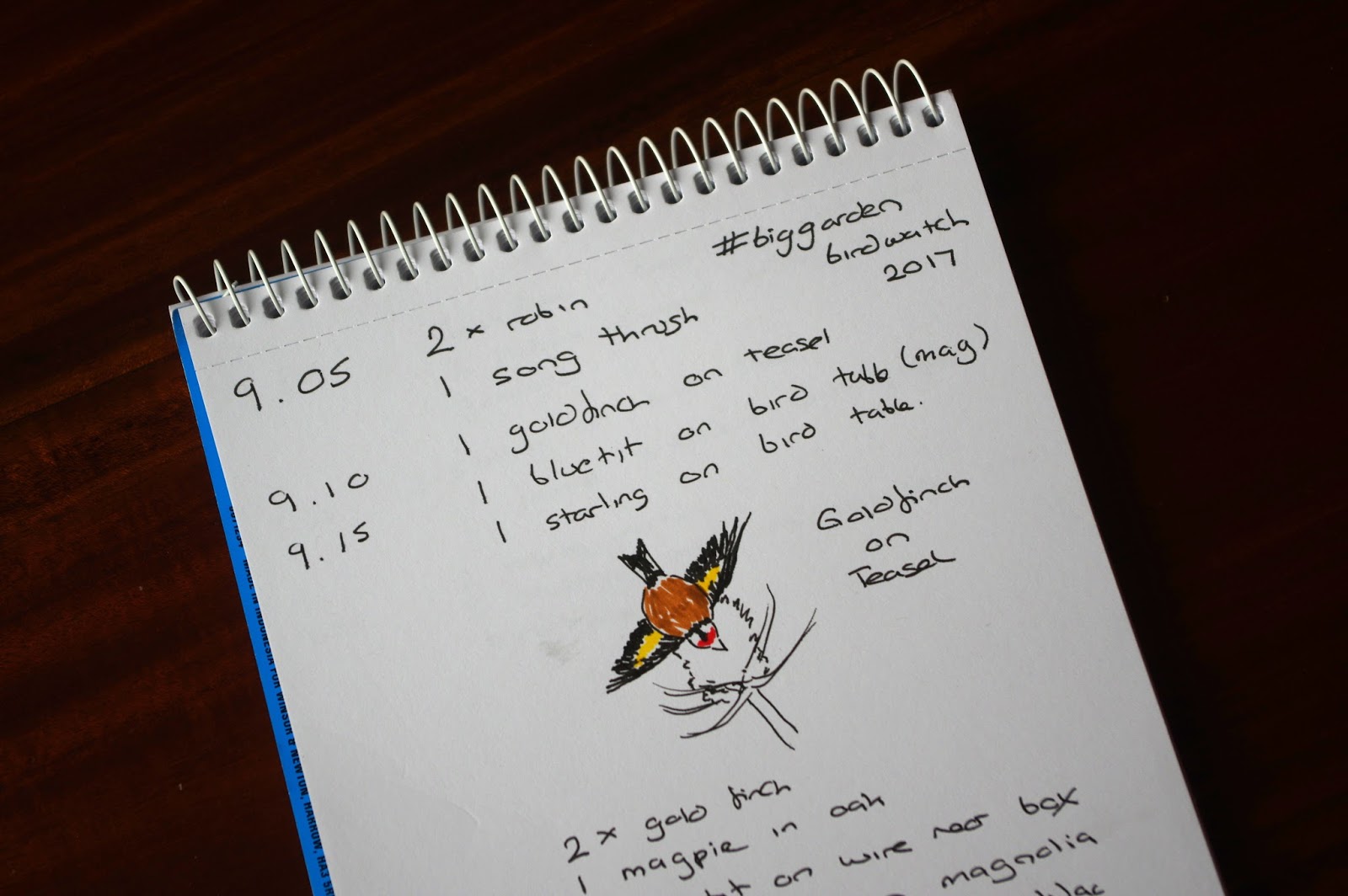
Big Garden Birdwatch - 2017

As I settled down for this year's RSPB Big Garden Birdwatch, I kicked myself for not doing it in yesterday's beautiful sunshine. At 9am the light was so murky that I was afraid that I wouldn't be able to see the birds, let alone identify them.

Then two cheeky Robins flitted into the trees at the front of our garden.  As I watched their boisterous progress through the branches, I noticed a Song Thrush sitting quietly in the Robinia.

Notes from my Birdwatch.

Looking out at the back I noticed a Goldfinch on the old teasel seedheads.  In the next quarter of an hour, several different types of birds appeared in the garden. Great tits, Blue Tits, Robins and Starlings were all attracted by the food I had put on the  bird tables. 


Woodpigeon feeding on tiny crab apples.
Perhaps the most bizarre sight was a Woodpigeon tying itself in knots while gathering up the last of the crab apples.  When it finished, it stared glumly at the empty branch.

At about 9:35 a Jackdraw, a first for my birdwatch list, perched briefly on a conifer. I found myself glaring at a Herring Gull that seemed to be glued to my neighbour's roof and couldn't be counted.  My hour was rounded off by the reappearance of the robins.

One of our pair of Robins.
The final score was 17 individuals from 11 different species. Strangely many of the birds that usually come as a flock appeared in ones, twos or threes.  I didn't positively identify House Sparrows but there was a group of birds that I couldn't see properly in the poor light and wasn't able to include in the count.

2017 Great Garden Bird Watch Results.
Compared to previous years, the variety of birds was good. It has only been better in 2011, the first year I did the birdwatch. However the number of individuals counted, at 17, was well below the average of 21.  Results of this and previous years' counts are shown below.

  2011 2012 2013 2014 2015 2016 2017
No of species 12 11 10 6 11 7 11
No of individuals 30 26 15 20 28 12 17
Blue tit 3 3 2 3 2 2 1
Blackbird 2 2 3 3 2 2 2
Collared Dove 2 1 1   1   1
Goldfinch     1   7   2
Great tit   1         1
Jackdaw             1
Magpie 2 2 2 2 1 1 2
Robin 1 1 1 2 3 1 2
Song Thrush 2   1   1   1
Starling 8 9 2 8 5 2 3
Woodpigeon 1   1 2 2 2 1
Chaffinch 2       2    
Coal Tit   1          
Carrion Crow           1  
Dunnock 3 1          
House Sparrow 3 4     1    
Pied Wagtail 1 1 1        
  Saturday, 29 Jan Sunday, 29 Jan Saturday, 26 Jan Saturday, 25 Jan Sunday, 25 Jan Saturday, 30 Jan Sunday
29 Jan
Start time 8.45 am 8.45 am 9.07am 8.50 am 8.45 am 8.55 am 9:05am
Weather dull, icy   cold, bright damp, misty bright, cold dull, mild damp, mild

Saturday, 13 June 2015

30 Days Wild - Days 7 to 12 - Travelling

I'm continuing with 30 days wild. My first post was about me squeezing time out of a very busy week to see wildlife that had squeezed itself into our lives.  I'm juggling my time between Uckfield and Birmingham but my journey is nothing compared to that of some creatures, which travel enormous distances.


Sunday, June 7th

A week into 30 days wild, I finally some quality time in our garden. As I was trimming back the foliage threatening to overwhelm our windows I loved hearing the bees buzzing and the church bells ringing.

Tree bumblebee on ceanothus.
Many of the bees were tree bumblebees. BWARS tells us that these bees were first recorded in Britain in 2001. Since them they have travelled throughout Britain.

Monday, June 8th

I found a nest and attentive woodpigeon well camouflaged by the shadows of our robinia tree.

A homely woodpigeon with its nest hidden amongst exotic robinia flowers.
Tuesday, June 9th

The river Uck runs alongside our little station. Just before I got on the train, I enjoyed a serene moment watching the ducks.  I had a chat with a fellow commuter who had just been watching a pair of grey wagtails working their way along a ledge near the edge of the platform. We discussed the lack of insects this year and how some exotic ducks have joined forces with our local mallards.

Ducks on the Uck.
Most of the time, I was busy reading documents on my laptop but I was able to glance out of the window and enjoy nature as I travelled. As we pulled into Buxted, I spotted a herd of fallow deer. A carpet of wild flowers was an unexpected treat at Milton Keynes.

Carpet of wild flowers seen from train window at Milton Keynes.
Later, when I looked out of the window of my Birmingham hotel room, I was astounded to see house martins darting around almost at eye level. These little birds will have travelled from Africa and are nesting under the eves of the hotel.

Wednesday, June 10th

On Wednesday morning I got up early and dropped my laptop off in the office and settled down by a nearby pond to watch this little slice of nature wake up.

Just a few steps but a world away from the office.
The first birds I saw were a moorhen and two chicks. Then a coot, dabbling under the surface for its waterweed breakfast.

Rushes provide perfect cover for coots and other birds.
As a female tufted duck ventured across the pond a furious coot appeared out of nowhere. Maybe it was defending a nest?  As I returned to the office, a rabbit lolloped into the bushes.

Thursday, June 11th

On the way out of the Arden, I spotted one of the house martins zoom into a nest made from a thousand beakfulls of mud. I stacked my baggage by the kerb and watched them for a while. As passenger jets roared into the air behind them, about half a dozen of these African visitors seemed to dance in the air by the hotel.

Arrivals.


Departures.
 
Friday, June 12th

Today's wildlife moment was sad but gave me a chance to get close to something lovely. A blackbird had hit one of our windows and died. I was able to examine his subtly coloured plumage and vivid yellow beak. There was a perfect graduation from the tiny soft feathers on his back to the long flight feathers on the tips of his wings.

Blackbird wing.
Of course, my drawing doesn't do the blackbird justice but spending time trying to copy the shapes of the feathers gave me time to appreciate just how lovely this fallen angel was and how perfectly birds have evolved for flying.

So the last few days have been about appreciating how good wild creatures are at travelling. They may be tiny compared to our trains and jets but they are never stopped by a signal failure or lost baggage.

Saturday, 23 May 2015

Casulty 152461 - An injured pigeon in our garden

A while after I got home from Birmingham on Thursday, I glanced into the garden and saw a woodpigeon. There's nothing unusual in that but this one was lying on its back with its legs in the air. I checked it and it was still breathing. I decided to give it about 20 minutes to see if it would come round by itself.

The rescue
20 minutes spent watching for cats between mouthfuls of my microwaved meal and I was out again. The pigeon was still on its back, but clearly conscious and alive - it was blinking now and then.  The situation was clearly not going to resolve itself. Fortunately our area is well served by the East Sussex Wildlife Rescue & Ambulance Service (WRAS).
WRAS to the rescue.
I phoned up and was instructed to put the pigeon in a box, making sure that it was the right way up. I got a box from the loft, put on a pair of soft gardening gloves and squatted down by the pigeon. It looked at me with bright black eyes as I noted the lovely shading from pink on its side to almost white on its belly. As I cupped my hands around it rather plump body, it stretched out a protesting wing. It had a rather nasty wound on its back. I put it in the box the right way up but pigeon had other ideas and promptly rolled over again. I decided to leave it be and carried the box into the conservatory. I dropped an old towel over the whole thing, vaguely remembering that excluding light would calm a stressed, caged bird.

As I waited, I wondered what had happened. I think the most likely explanation is a sparrow hawk. We've seen some clusters of feathers on the ground recently and I glimpsed one in the garden carrying a rodent just a few weeks ago.  Some feathers from our pigeon, scattered over the grass, seemed to confirm this.

The ambulance arrived with two gentle but efficient rescuers. They asked me some questions and examined the bird while completing a form. Admin and examination over, they put the pigeon in a carrier. It snuggled into the soft pink lining, tucking its head into its wings as if it knew it was in good hands. They gave me a casualty number (152461) and information about the organisation including how to donate. I have already donated a few times. I remember giving when I heard about the cascade of baby hedgehogs they got over one winter then to the related Sussex Badger Vaccination Project. However, I've done the decent thing and texted a another donation.

Woodies in our garden

Woodpigeons are regular visitors to our garden. They are rather amusing with their self-important walk and are surprisingly agile when dangling from oak twigs to reach for acorns.  They sometimes build their untidy raft-like nests in our trees and I have occasionally found a discarded eggshell.

Woodpigeon in our garden - 21st May.
Back on the 21st of March, I was surprised to see a juvenile bird. It must have been born at the start of that month. I understand that pigeons make a sort of milk that enables them to start breeding early in the year.  I was able to identify it as a juvenile using the information on the Pigeon and Dove Rescue site.

The post script

On Friday (23 May), WRAS put a post on Facebook outlining the tremendous number of rescues they had done on the day they collected my pigeon. They kindly told me that "He is still with us, doing ok but early days, he was trying to push himself up on the side of the towels we are using to support him earlier."

On Saturday (30 May), WRAS responded to a question on Facebook by saying "Was he the adult one falling on his back with the wounds? ... doing well. Early days for the adult as he has a lot of healing to do, but he is standing and more balanced and eating. It is woodie central at the moment"

Saturday, 25 January 2014

Big Garden Birdwatch - 2014

It's that time of year again. Time to do the RSPB's big garden birdwatch. Otherwise known as big migrations of birds to somewhere that is not my garden. The idea is to count the birds that land in the garden during a one hour period.

It was very damp and misty and, at first, I thought I wasn't going to get anything at all. I had heard some bird song when I left the house to fetch the paper but no sign of any birds landing in the garden.

While I was doing my birdwatch, I was amused by the starlings that perched just outside the garden. I wasn't so happy about the magpies that frightened the little birds off.


So here are my numbers for this and a few previous birdwatches.  This year, during a spell of record breaking wet weather, we had fewer species than previously but we had greater numbers of individuals thanks to our starlings boucing back from last year's poor showing.


2011
Saturday, 29 Jan
2012
Sunday, 29 Jan
2013
Saturday, 26 Jan
2014
Saturday, 25 Jan
Start time 8.45 am 8.45 am 9.07am 8.50 am
Weather dull, icy
cold, bright damp, misty
House Sparrow 3 4

Blue tit 3 3 2 3
Starling 8 9 2 8
Blackbird 2 2 3 3
Woodpigeon 1
1 2
Great tit
1

Chaffinch 2


Robin 1 1 1 2
Collared Dove 2 1 1
Magpie 2 2 2 2
Pied Wagtail 1 1 1
Song Thrush 2
1
Dunnock 3 1

Coal Tit
1

Goldfinch

1
No of species 12 11 10 6
No of individuals 30 26 15 20

If you are reading this on the weekend I wrote it, you can still fit your hour in. Just spend an hour noting the birds that land in your garden or other patch of ground and submit your results using the RSPB website.

Saturday, 30 March 2013

Big Garden Birdwatch - where are my sparrows?

At the end of January I took part in the RSPB's Big Garden bird watch. I wrote an account of my experiences in my Big Garden Birdwatch post. Now the RSPB have collated the results from over half a million people. The table below shows the top ten birds in East Sussex.

Rank in East Sussex Species Average per East Sussex garden In my garden
1 House Sparrow 3.4 None
2 Blue tit 3.3 2
3 Starling 2.6 2
4 Blackbird 2.6 3
5 Woodpigeon 2 1
6 Great tit 1.4 None
7 Chaffinch 1.4 None
8 Robin 1.3 1
9 Collared Dove 1.2 1
10 Magpie 1.1 2

We also got 1 goldfinch (19th in East Sussex), 1 pied wagtail (30th), 1 song thrush (22nd). Our scores for the top 10 birds are a little less than average, which is surprising since we have a big garden with plenty of trees. That said, the trees and bushes allow the birds to stay out of sight and I didn't include any that I couldn't positively identify from a tantalising glimpse of a shape or a tail.

We do have one gaping gap right at the top of the table - no house sparrows. On previous years we've had a few but this year - none. For me, this is a particularly sad omission. I grew up in the London area and the cheeky sparrow was very much a bird of my childhood. Every time we threw crumbs out in the garden - no posh RSPB food then - dozens of squabbling sparrows would descend to enjoy our scraps. I didn't really notice them going. I had moved around, gone to university in Sheffield and then moved to Sussex. Now seeing or hearing this lively little bird has become a special treat rather than a part of every day life.

If it was only our garden that is missing sparrows, it wouldn't matter, but - although house sparrows are the most common bird in our counts - the RSPB say "Numbers of house sparrows, also on the red-list, dropped by 17 per cent in gardens compared to 2012 ..."

On their Red, amber and green explained page the RSPB tell us that "Red is the highest conservation priority, with species needing urgent action."

Kate Vincent completed a PhD Investigating the causes of the decline of the house sparrow in Britain and the associated web site has some information on What you can do. Her suggestions include:
  • provide seed all the year round - especially sunflower hearts
  • provide mealworms in summer, to help the fledglings
  • provide a good mixture of shrubs in the garden
  • leave some grass long
  • provide a well topped-up bird bath all the year round.


Tuesday, 26 March 2013

Listening to an Uckfield morning - Late March

A month ago I wrote Listening to an Uckfield morning, a post about the sounds I heard as I walked from my Manor Park home to the station. It's a regular walk for me. Now, at 6 a.m,.it is light but still bitterly cold. In fact, I think it is is colder than when I took the same walk towards the end of February.

Last time it was all robins and blackbirds. This time, it is mostly pigeons. As I left home, I could hear the coo-coo coo-coo of woodpigeons. Some still roosting in tall trees, others are already on the wing. As I pass a hedge of conifer by Tesco Express, there is the cheeky chatter of house sparrows.

Woodpigeon - captured by Bushnell 3rd March 2013


One good thing about the lousy weather is it gives early risers common cause. Instead of the usual nod or wave, we speak. “Freezing, isn’t it?” then there's a cheery hello from a walker who has braved the cold to exercise her dog.

While winding round Downsview Crescent, I hear some rather raucous crowing and see a small group of rooks overhead. Are they heading off to their feeding grounds? I see a large black bird perched on a TV aerial – it has a black beak, which makes it a crow.

As I head into Southview Close the sound of traffic starts to dominate. The sulky morning light lets me see as well as hear what is about. Two collared doves perch in the robinia tree near Streatfield House and seagulls are wheeling overhead. I wonder if we are due more snow? The gulls often herald a storm of some sort. A blackbird clinging to the edge of the building sings a rather mournful song. It is the only one I hear on my journey. Did the others sing earlier in the day? Or did they not bother on this dreary apology for a morning?

As I turn into the town the cooing of the woodpigeons is replaced by a more bubbling, purring noise. I am hearing the feral pigeons who find perches all over the facades and roofs of Uckfield’s higgledy piggeldy shops.

As I approach the station, I hear the hiss of a hydraulic brake. My heart sinks as I see two buses pulled up next to the pub. This is never a good sign. They are replacing trains that can't run due to an electrical fault. Over the sound of grumbling commuters is the pip pip pip of a blue tit.

Briefly in the warm to get my ticket then about 20 minutes tooing and froing then onto a bus. Looking out of the window as we trundle along the road to Haywards Heath, I see lambs. The first I’ve seen this spring.