Showing posts with label big butterfly count. Show all posts

Sunday, 25 August 2019

Big Butterfly Count -2019

This post outlines my Big Butterfly count results for 2018. It was obvious, even before doing the counts that we were getting more butterflies than usual, particularly grassland species.  People are asked count butterflies and a couple of the more distinctive moths for 15 minutes. The count is over for this year but more information including results can be found at https://www.bigbutterflycount.org/


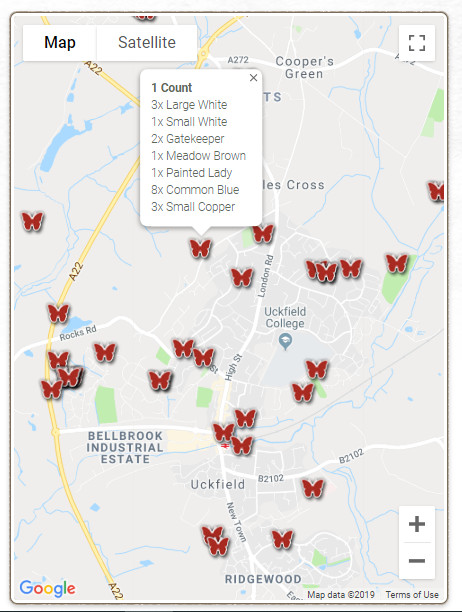
It is obvious that quite a few Uckfield people have done counts giving good coverage of the town and surroundings. For example, I can see that someone has done a count in the field alongside Snatts Road and found 19 butterflies including a Painted Lady and 8 Common Blues.

This year and last I did counts in several places, focussing on those such as local playing fields and Holy Cross Church, where I have done plant surveys. For these notes, I've picked out 6 sites that I did in both 2019 and 2018. I got:

  • a total 77 butterflies in 2019 compared to 52 in 2018
  • 10 species in 2019 compared to 9 in 2018

The difference would have been even more dramatic but the last few counts for this year were reduced by windy weather.

Gatekeeper in Holy Cross Churchyard
Nearly all of the difference is accounted for in a real boom in Gatekeepers.  These are a medium-sized brown and orange butterfly.  They are very easy to confuse with the other common grassland butterfly, the Meadow Brown, but they tend to have more vivid markings and if you can get close enough to see the black eyespot - it contains two white dots instead of one.

The Gatekeeper is one of the grassland butterflies - it gets its name from it's habit of fluttering around in the gaps (gateways) in hedges etc.  Both of my best sites (with 25 butterflies and moths each) this year had significant areas of long grass:

  • our own garden, where cultivated blooms, wild flowers - 7 species
  • the Dene, which has a variety of long grasses (which had just been cut) - 5 species

6-spot Burnet Moth on long grass
Both the Dene and our garden attracted 6-Spot Burnet moths. The caterpillars of these colourful moths live on birds-foot trefoil, which is present on both our garden and The Dene.

Burnet moth Chrysalis
When they are ready to metamorphose (change) into a moth they climb up a grass stem and make a chrysalis.

Painted Lady sunbathing on a tombstone in Holy Cross churchyard
One of the real surprises this year was a Painted Lady attracted by the buddlia in the Holy Cross churchyard. Reports this year suggest that we are having the biggest migration of these butterflies since 2009.  I've compared the Uckfield counts in the 2019 and 2018 Big Butterfly Counts and found:

  • 2019 - approx 17 Painted Ladies
  • 2018 - approx 6 Painted Ladies

My own records (other than Butterfly Count) in iRecord give me:

  • 2019 - 6 records for Uckfield, often more than 1 individual and 2 for Reading
  • 2018 - 1 record for Duddleswell, 1 individual
  • 2015 to 2017 - none
  • 2014 - 2 records - both Uckfield, 1 individual each

Saturday, 31 March 2018

Butterflies in the garden

Now that I'm starting to do some serious gardening again, I am trying to think what plants and garden features are beneficial to resident and visiting wildlife. In this post, I am going to focus on butterflies. I like to observe wildlife including butterflies and often record what I see using either iRecord or during the Big Butterfly Count. Here, I will use the photos taken in the garden and elsewhere to identify which plants are attractive to butterflies.

Gatekeeper - making the most of July warmth.
Many of my photos show butterflies basking in the sun - on sunlit leaves, fences, grasses, rocks, bare earth etc. So places where they can find warmth are important.

The summer banquet

The Butterfly Conservation people have a page on Gardening with butterflies in mind.  They list the best plants for summer nectar and these are very much in line with my expectations. One of the more useful hints is to plant nectar rich plants in sunny parts of the garden.

Peacock on Verbena Bonariensis - July
One of the plants they recommend is Verbena Bonariensis, which also comes right at the top of my personal list of flowers attractive to butterflies. This is consistent with the results of a more general survey I did in 2014.

Holly Blue on Marjoram - July
Another summer favourite is wild Marjoram.  The browns seem to particularly attracted to this plant if it is growing close to long grass.

Snacking through the rest of the year

Small Copper on Aster - September
As the days shorten and the summer flowers fade away, Asters and Sedums are a good source of nectar.  Butterflies will also feed on fruit. The Natural History Museum page - How to attract butterflies to your garden - suggests putting fruit on the compost heap for them. Our compost heap is in a shaded corner, so I drop overripe or fallen fruit into a sunny patch. I've sometimes seen Red Admirals feeding on it.

Red Admiral on Mahonia - November
On the subject of Red Admirals, these can be seen flying during the winter months and are likely to need a winter snack. Mahonia is very popular with these butterflies and many other pollinators. Be sure to get the type with the long spikes of flowers that bloom during the winter months. Avoid the type that blooms in spring when there is plenty of other food around.

Brimstone on Sweet Violets - March
Butterflies will take nectar from early spring flowers such as Violets.  Many will visit Blackthorn blossom and Lesser celandine but these two are thugs that will swamp garden plants.

Speckled Wood on Bowles Mauve Perennial Wallflower - May
The Perennial Wallflower, Bowles Mauve, appears on the Butterfly Conservation summer nectar list andit starts flowering in April and so bridges the gap between the early spring flowers and the classic, summer butterfly flowers.

Caterpillars need to eat too

Peacock on Stinging Nettle - June
Sorry, I'm a bad nature lover and have no intention of having a nettle patch in our garden. Luckily our neighbour doesn't cut the nettles in his parking area and I think this is where our steady supply of Red Admirals and Peacocks comes from.  The Butterfly Conservation gardening page links to a list of food plants (pdf) and the Natural History Museum page advises allowing your garden to be wild around the edges. I suggest wild corners rather than edges. The difference between a wildlife-friendly garden and a mess is tidy edges, a prominently positioned log pile and a bird box.

Metamorphose in peace 

Green-Veined White on Garlic Mustard - I check old stems before composting
When a caterpillar is changing into a butterfly it protects and disguises itself in a pupa. They hide away in all sorts of places so be careful what you clear away. I cringe whenever I think about the way that I used to carefully leave Garlic Mustard (Jack-in-the-Hedge) as a food plant for Orange Tip and Green-veined White caterpillars and then cleared away the stems that probably had pupa attached.

Do butterflies dream of electric flowers?

I don't know if butterflies sleep but they do need somewhere hide away at night. If I brush against our hedge as I pass it first thing, a cloud of brown and orange butterflies - Meadow Browns and Gatekeepers - appears.  While taking evening walks along the A45, which runs alongside a hotel I regularly stayed in while at Birmingham, I saw Large Whites disappear into the canopies of trees alongside the road. So hedges, shrubs and trees provide butterflies with useful shelter.

Next steps

I think we are doing reasonably well with our butterflies but I need to focus more on caterpillar food plants. Of those mentioned in the Butterfly Conservation (pdf) list, we have all sorts of rough grasses, Bird's Foot Trefoil, Garlic Mustard, Violets, Blackthorn, Sorrel/Dock, Holly and Ivy. This means I have both butterflies and food plants. The next step is to find out if the butterflies are breeding in the garden - and that means getting down on my hands and knees to find caterpillars.


Monday, 7 August 2017

Big Butterfly Count - 2017

This post outlines my results for the 2017 Big Butterfly Count. I didn't even have to wait for results to know that 2017 was a much better year for butterflies than 2016. This year I decided to do my counts in as many different places as possible so I don't have as many garden counts as usual.

Counts from an Uckfield (Sussex) garden

I recorded more butterflies per count than in previous years.

Year Number of garden counts Average number of butterflies Total number of species Most numerous species
2014 10 6.6 10 Gatekeeper
2015 12 9 13 Gatekeeper
2016 10 6.1 8 Large White
2017 4 11.75 9 Meadow Brown

For the first time, since I started taking part in this survey, Small Coppers appeared in my counts.

Small Copper in our Uckfield garden.
One morning, when coming back from getting my newspaper, I saw several Six-spot Burnet Moths clinging to the long grasses in our no-mow zone. I started my count right away so I could include them.  I found a chrysalis attached to one of the stems and wondered if they were all newly emerged.

Six-spot Burnet moth in our Uckfield garden.
The graph below shows that Meadow Browns and Gatekeepers dominated my garden counts.  Last year, Large Whites took the lead.

Butterflies counted in our Uckfield garden during 4 counts.

Hempstead Meadow Nature Reserve, Uckfield

I did one count at Hempstead Meadow.

Hempstead Meadow count 1
Common Blue 3
Gatekeeper 4
Large White 1
Meadow Brown 5
Red Admiral 1
Ringlet  1
Small Copper 1
Speckled Wood 1

I was charmed to see a trio of Common Blues dancing around the Meadow Vetchling in the grassy area.

Common Blue dancing amongst the vetchling flowers.

West Park Nature Reserve, Uckfield

I did two counts in West Park Local Nature Reserve and someone else did a third. I know about the third count because the Big Butterfly Count results page enables you to zoom in on a location and find out more about the counts taken there. The counter found a fantastic number of Common Blues.

West Park Nature Reserve count 1 count 2 count 3
Common Blue 4 10
Gatekeeper 5 3 10
Large White 2
Meadow Brown 5 2 4
Red Admiral 1 1
Ringlet  2
Silver Y 1
Small Copper 1 1
Speckled Wood 1

Of course, there are butterflies that I missed. One of the ones that got away was a possible Fritillary in West Park. It was big, orange and too fast for me to catch up with. I also did some counts in Leatherhead, where I took the photo below.

Silver Washed Fritillary - Leatherhead
Now I just need to wait for the results of the whole count to be analysed and published.

Sunday, 16 October 2016

The Big Butterfly Count 2016

The 2016 Big Butterfly Count has just published its results. According to the Big Butterfly Count 2016 Results page, 36,400 people carried out 38,233 15-minute counts from July the 15th to August the 7th.

Holly Blue, 25 July 2016.

Considering just the counts I did in our own garden:
  • 2014: 10 counts, 10 species of butterfly, 66 individual butterflies
  • 2015: 12 counts, 13 species of butterfly, 108 butterflies as well as some moths
  • 2016: 10 counts, 8 species of butterfly, 61 butterflies and a 6-spot burnet moth.
So this year's count was lower than previous years.  It seems that others had the same experience.  The results page says:

The average number of individual insects of the 20 target species seen per 15 minute count during big butterfly count 2016 was the lowest recorded since the project began in 2010.

Large White, 25 July 2016.
In my garden, nearly half the butterflies I counted were large whites. This species was slightly more numerous than last year, whereas numbers of the others had dropped dramatically.

Butterflies recorded during 12 counts in our Uckfield garden.

In 2015, gatekeepers had been the most numerous butterfly in both: my counts (47 individuals) and nationally. However this year this species had tumbled to a miserable 4th in both.  I've certainly missed seeing them dancing in our front gateway.

Speckled Wood, 31 July 2016.
On the other hand another dancer, the Speckled Wood, did really well in my 2016 counts - it came joint second with the Meadow Brown. I counted 11 individuals this year, compared to 2 last year. The national count recorded a small (12%) increase.

Red Admiral, 21 July.
Sadly, most of the big colourful butterflies were missing from our garden counts this year. No Peacocks, Small Tortoiseshells or Commas - all of which I counted in 2014 and 2015. We did have 3 Red Admirals - but that compares to  8 last year and 4 in 2014. Nationally numbers were up a by 70%.

An Guardian article on the Big Butterfly Count says:

“The drop in butterfly numbers this summer has been a shock,” said Richard Fox of Butterfly Conservation. “When we have cold, wet summers, as in 2012, we expect butterfly populations to plummet, but that wasn’t the case this year."

“The summer months were warmer than usual, yet most Big Butterfly Count participants saw fewer butterflies. Perhaps the very mild winter had a negative effect, or the cold spring, or perhaps the impacts of intensive farming and pesticides are really hitting these common species now.”

We can only hope for better next year.

Saturday, 26 December 2015

My 2015 in Uckfield nature photos

As the year draws to a close it's time to look back on the wildlife I have seen in and around Uckfield during 2015.

January

January started with the BSBI New Year Plant hunt, in which I spent an hour looking for wild flowers that were out in bloom. I found a total of 21 different types - surprising considering that we had a few days of hard frost. 
Campanula on old wall at the top Uckfield's High Street.
Towards the end of the month, I took part in Lime Aid's volunteer session - trimming back unwanted growth at the feet of the amazing old Lime trees that once led to Uckfield House.
Before and After - Lime Tree Avenue.
As usual, the month ended with the RSPB's Big Garden Birdwatch.

February

On the 8th, four tiny Goldcrests were fluttering round the lower branches of our laurels and nearby bushes. One was displaying to the others with his normally inconspicuous crest feathers fluffed up in a bright orange "quiff".  One sunny day brought out a tattered but still lovely Red Admiral.

Red Admiral, Manor Park garden.

March

When Hazel catkins are shaken by the wind, you can see how they get the name "lambs tails". This year has been exceptionally windy.
Hazel, Manor Park garden.

April

Two Fallow Deer bucks, who are regular visitors to the Manor Park estate, came into the garden for a couple of hours. I and others were concerned that the darker one was limping. However it showed a fair turn of speed when escaping would-be rescuers.

 
Fallow deer, Manor Park garden.

May

May is, of course, bluebell time. This year I visited Boothland Wood, which in the next few years will be surrounded by the Ridgewood Farm development.  The woodland has a light, airy feel because it is surrounded by open farmland and has many elegant, slender beech trees.
Bluebells, Boothland wood.
Later in the month, the splendid WRAS rescued an injured woodpigeon from our back garden.
WRAS to the rescue, Manor Park.
The month ended with the Garden Biobliz in which I tried to find as many wild flowers and creatures in the garden as possible.  In the end, I identified 129 species compared to 104 last year.
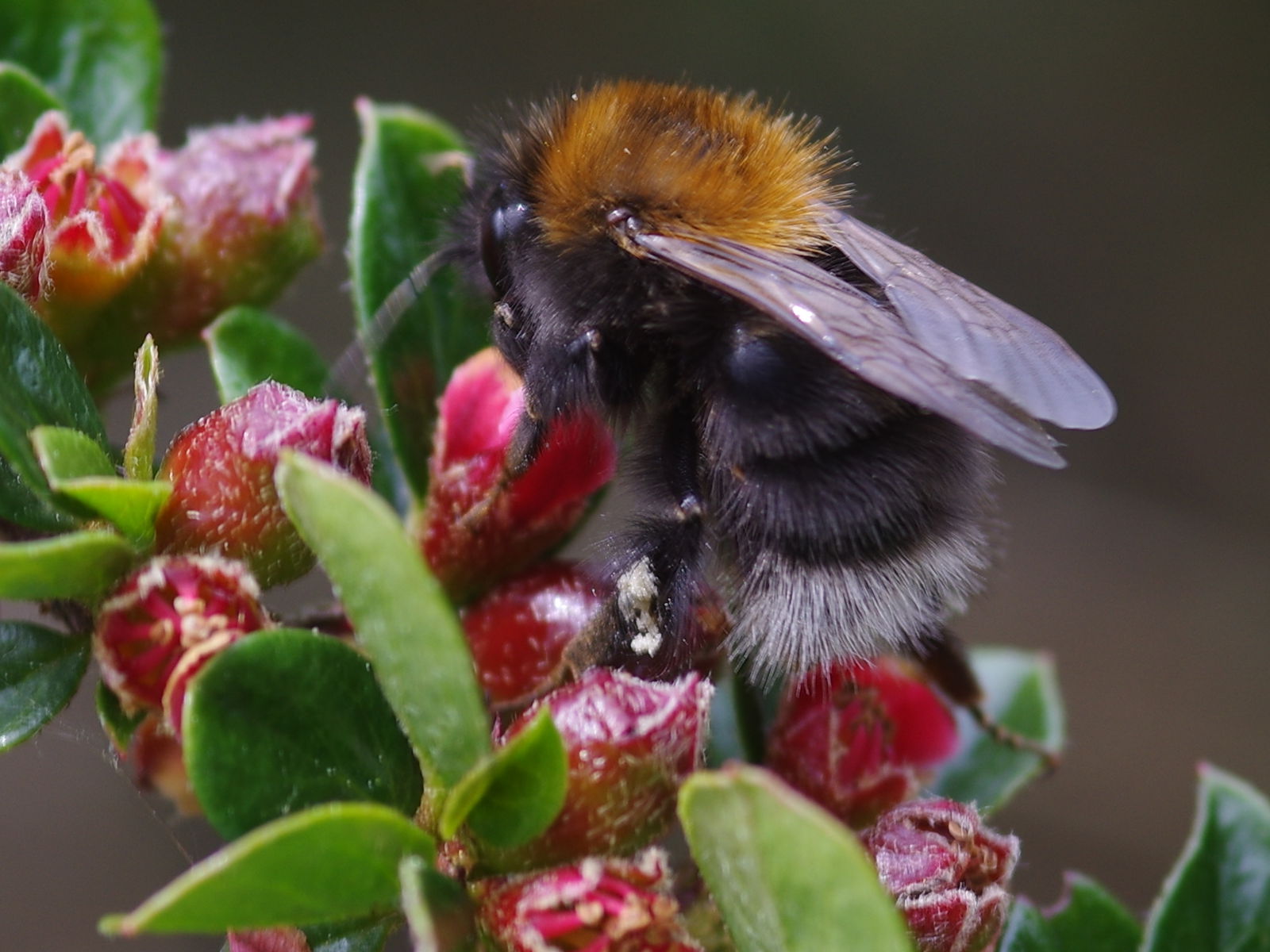
Tree bumble bee spotted during Garden Bioblitz, Manor Park garden.

June

June was dominated by 30 days wild. This project meant having one wildlife moment a day.  To me it meant pausing and really taking notice of what was around me. My most memorable Uckfield discovery was a pair of Grey Wagtails that live on the part of the River Uck that flows under our station. I saw them courting and mating and was able to follow their progress up to the point when I saw a fluffy youngster.

Grey Wagtails on riverbank, seen from Uckfield station platform.

Another highlight was spotting Uckfield's very own Stickleback Si (named after one featured on BBC's Spring Watch) in the Hempstead Meadow Nature Reserve. I could see his red tummy and I was delighted to see him duck into his tunnel nest for a moment. 

July

Towards the end of July, I spent time pulling invasive Himalayan Balsam in the Hempstead Meadow Nature Reserve.  It was very pleasant to spend time in the reserve like that and getting to see special trees like rare Black Poplars and all manner of tiny creatures.
Black Poplar (left) and Himalyan Balsam (right). Hempstead Meadow
July was also marked the start of the Big Butterfly Count.  This year I saw more butterflies (108 in 12 counts) than last.  Our most regular visitor were bright orange and brown Gatekeepers. 

Gatekeeper butterfly, Manor Park garden.

August

The 8th of August was flying ant day. Suddenly they erupted from our lawn and were flying skywards like so many golden angels. It wasn't just us - all over the country, people were commenting, via social media, on the ants.  
Black ants, Manor Park garden.
On the 22nd of August 2015, I spent a lovely hour in our garden experiencing the light fading away and the creatures of the day finding their way home.  I counted about 400 Rooks as they flew past our house to their roost - probably Lime Tree Avenue.

On a wet bank holiday, I finally found the little remnant of heathland habitat on Manor Park, which is home to hundreds of dainty Autumn Ladies Tresses flowers.
Autumn Ladies Tresses, Manor Park estate.

September

September mornings found our garden full of spider webs sprinkled with jewel-like drops of dew. I was pleased to see that they seemed to be catching plenty of crane flies.
Garden Spider (Araneus diadematus) in Manor Park garden.
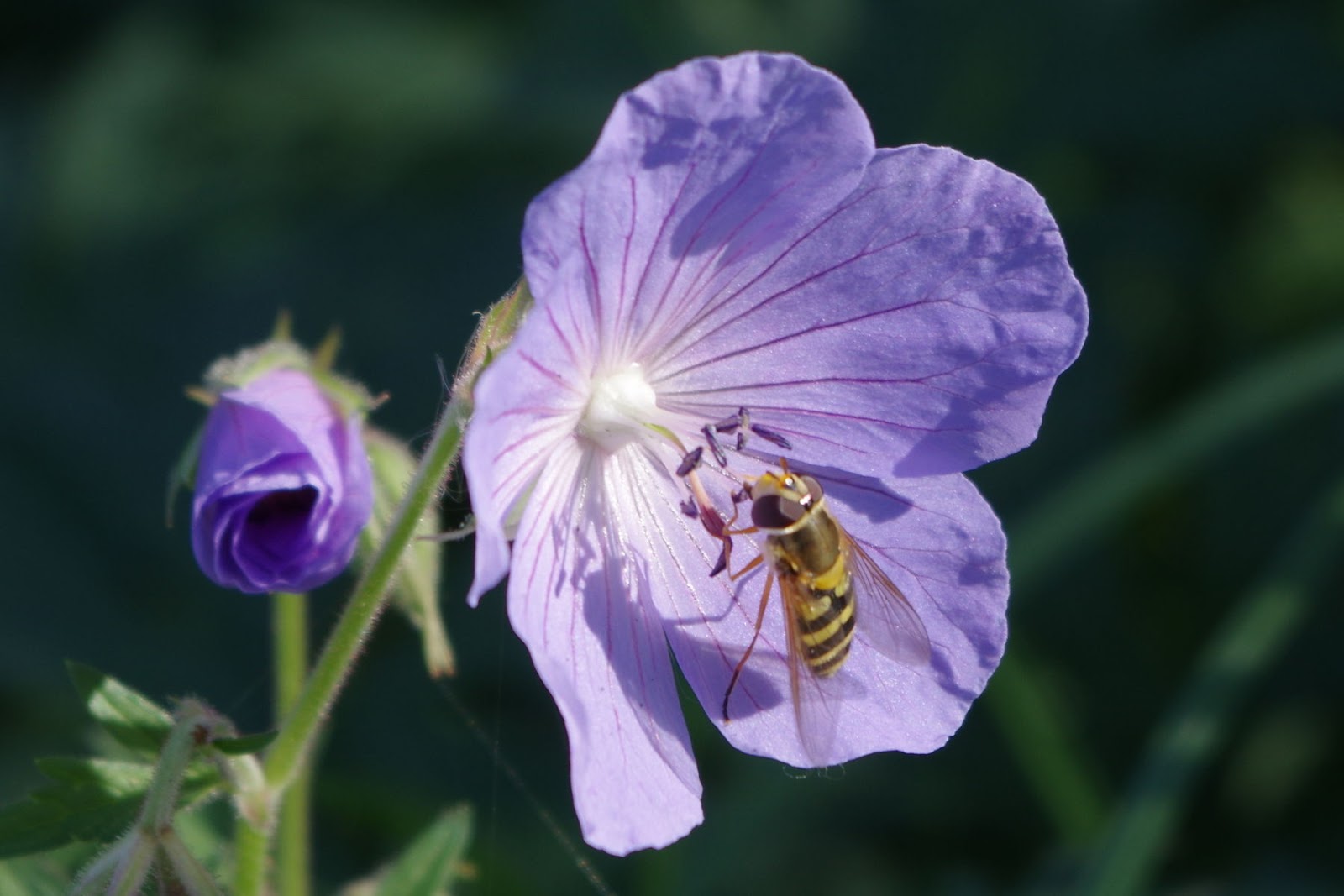
At the end of the month, I cut through Hempstead Meadow Nature Reserve and found plenty of flowers still out including a blue, Meadow Crane's-bill.
Hoverfly (Syrphus ribesii) on Meadow Crane's-bill. Hempstead Meadow.

October

In the run up to Halloween I expect to hear much talk about bats and other spooky things but I don't expect to see real ones. However the long, late summer brought us two surprise visits. One on October the 18th at about 6:15pm when we saw three dancing in the fading light and another at about 5pm on October the 30th.
Autumn leaves and Halloween decorations.

November

A grim month in all sorts of ways. At the start of the month fog swept in closing both Gatwick and Heathrow and on the 21st there were snowflakes in the rain.  Even the foxes that regularly visit our garden stayed away for most of the month.
One of the few fox visits in November. Manor Park garden.

December

In the run up to Christmas we had a few visits from a fallow deer with fine antlers. This is probably the lighter of the two bucks that we saw earlier in the year. Sadly the darker one wasn't with him.
Fallow buck, Manor Park garden.
Christmas is a time when we traditionally bring greenery inside. I'll leave you with the lovely Nordman tree that I bought from Vulcan Farm. 


Saturday, 8 August 2015

The Big Butterfly Count 2015

Between the 17th of July and the 9th of August, people all over the country counted butterflies for periods of 15 minutes. This citizen science is backed by The Butterfly Conservation people. This year’s results can be found on the web site.  

Me, counting butterflies, notebook in hand.
I was pleased with the results I got in 2014 but this year was so much better.
  • 2014: 10 counts, 10 species of butterfly, 66 records
  • 2015: 12 counts, 13 species of butterfly, 108 records as well as some moths.
Although I've done more counts, the average number of butterflies per count is 9 compared to 6.6 last year. All the numbers in this post are for butterflies only, although the moths were pretty and interesting too.
Attractive 6 spot burnet moth.
Here is a graph showing how many butterflies I recorded.

Butterflies recorded during 12 counts in our Uckfield garden.
The top three species were the same as last year:
1. Gatekeepers, which took an even more commanding lead than before
2. Meadow Brown
3. Large White.

Meadow Browns mating.
Otherwise, there were some differences. Last year, Ringlets and Small Tortiseshells were in the top 6. This year, I had no Ringlets and only one Small Tortiseshell. On the other hand, Red Admirals had held their position in the rankings.

Small Tortiseshell.
In both years, I saw one common blue butterfly. It has become less common over the last few years due to the reduction of habitats suitable for its food plant, bird's-foot trefoil. I've often found this little character clinging to a flower first thing in the morning. It is very hard to persuade it to let go of its perch. Most of the blues we see are Holly Blues.

Holly Blue.
Then I read an article about Commas, which explained that they had adapted to the decline in their formerly favourite food plant, hop, by feeding on nettles.This got me thinking about caterpillar food plants. Next year, I will be looking out for caterpillars on the following plants.

Food TypeButterflies
GrassesGatekeeper
Meadow Brown
Ringlet
Small Skipper
Speckled Wood
 BrassicasLarge White
Small White
Nettle, hopComma
Peacock
Red Admiral
Small Tortiseshell
Bird's-foot trefoilCommon blue
Six spot burnet
BrimstoneBuckthorn, Alder Buckthorn
Holly BlueHolly, Ivy, Dogwood, Gorse