Showing posts with label #30DaysWild. Show all posts

Sunday, 24 June 2018

#30DaysWild in Watercolour

During June, the Wildlife Trusts have been running the #30DaysWild Challenge. The aim is to have one wildlife encounter everyday. I usually take a photo and put it on Twitter but this time, I decided to try and do a mini-watercolour instead. So each day, I've carved out between 20 and 90 minutes to do a little painting.

1 June - Ox-eye daisy - Crowborough.

This little project nearly fell on the first day because I expected to get home in time to create something. Instead due to a timetable meltdown, I had to content myself with some Ox-eye daisies at Crowborough.

3rd June - Ashdown Forest.
At the weekend, things were a little more relaxed and I found myself in Ashdown Forest, surrounded by Orchids and birdsong, painting the view of the gently rolling downs.

7 June - Uckfield garden - Insects on Ceonothus
Sometimes it was the tiny things that caught my attention.  One morning, I found a Rose Chafer and a selction of bees on our Ceonothus.

5 June - The Vapourer Caterpillar who hitched a ride on my hat. 
One day, I went on a walk through Uckfield's West Park Local Nature Reserve with the Uckfield Local Nature Reserves Supporters Group. On the way back I noticed that the brim of my hat was moving! It turned out to be a little punk rocker of a caterpillar - one that would grow up to become a Vapourer moth. I put it on a suitable food plant in our garden and wished it well.

16 June - Sussex Flag and Swifts

Saturday, the 16th of June was Sussex Day, so I painted the Sussex Flag that flew above our Civic Centre along with some of the Swifts that frequent the area.

17 June - Meadow Thistle - Chailey Common

Last September, I visited Chailey Common with the Sussex Biological Recording Group. One of the aims of the visit was to check on the progress of Marsh Thistles. At the time, there were plenty of rosettes but, of course, the flowers were long gone. I decided to pay them a visit and was delighted to find some in flower and being visited by Large Skipper butterflies and bees.  I could hear the Longhorn Cattle used for conservation grazing mooing in the distance.

22 June - Moon peeping through Honeysuckle

When I got back on the evening of June the 22nd, the scent of honeysuckle was already heavy in the air and the moon was rising in the Cobalt blue sky.

23 June - Fallow doe and fawn at Ashdown Park Hotel
One of my favourite sightings happened by chance. On the Saturday we went to the Ashdown Park Hotel for a wedding tea. On the way in, we saw a doe step out of the bushes onto the Hotel's private road. She was followed by a tiny fawn.

30 June - Hempstead Meadow Nature Reserve
I felt a little sad when I reached the end of the challenge with this view of Hempstead Meadow Nature Reserve. Several passerbys were interested in what I was doing and a group of lads settled down in nearby trees to have a chat while they waited for the train. 

19 June - After all that walking I needed some pud!
I've really enjoyed and learnt from my self-imposed challenge. Most of my paintings were done outside and I have found that spending time in the presence of nature enables me to see so much more than if I were to take a quick photo and move on. I can hear what's happening and feel the atmosphere. Creatures come and go. While I was painting a pair of Swans in Leatherhead, a kingfisher whizzed by! Often people will pause and, seeing me painting a bird or flower, will tell me about good places for wildlife spotting or just simply want to see my little collection of paintings and pass the time of day.

There are several very talented local wildlife artists who exhibit at Uckfield events so keep a look out for local shows and, if you get a chance, pay a visit.

Thursday, 30 June 2016

#30DaysWild in Hats

I have to say that the WildLifeTrust's #30DayChallenge has been tricky this year due to unrelenting workload and rain. I didn't get out to nature reserves this time but I noticed and appreciated the nature around me as I went about my daily routine, here in Uckfield and around the office that I visit in Birmingham.

The met office post shows that rainfall has been significantly higher than usual - it was about 125% in Birmingham and Sussex but this doesn't tell the full story of sulky skies that make photography a pain rather than a pleasure.

On a lighter note, flicking through my photos from the Wild Life Trusts' #30DaysWild I realised that the weather conditions had tested my collection of hats to the limit!

June 2nd - Shivering on Watford Junction Station.
At the beginning of the month it was still very cold so I was still wearing my woolly beret.

5th June - The sun popped out for the 2nd part of Garden BioBlitz.
Just a few days in, when doing my BioBlitz, a brief sunny spell meant that I needed my battered old gardening hat.

11th June - Getting hotter
Hotter sun means a bigger hat!

14th June - I'm wearing a waterproof tweed cap for a reason.
Then the rains came down and went on, and on, and on.

19th June - This is a bit more like June.
By the 19th, things were getting back to normal, changeable English weather with some weekday sunshine alternating with weekend rain.  I was in Birmingham for the last few, grey days and I will write these up later.  I've enjoyed finding nature as I go about my daily business and will continue enjoying MyWildLife.

Monday, 27 June 2016

#30Days30 Drawing to a close

We are getting close to the end of the Wild Life Trusts' #30DaysWild. Having been out and about on Saturday, I was busy in the garden on Sunday and working at home on Monday.

Day 26 - Tiny things in the garden

Before starting work in the garden, I took a tour round, camera in hand.

Hedge Woundwort
Wool Carder Bee - gathering plant hairs for her nest.
The best thing I saw was a Wool Carder Bee gathering hairs from a Lambs Ears plant.  Last year I read a post about this species of bee, which mentioned that it harvested hair from this type of plant. A few days later, I saw the plant on sale and bought it. I put it in it next to the path so, if the bee turned up, it would be easy to photograph. The first time I saw a Wool Carder Bee was during this year's Garden BioBlitz.

The BWARs Information sheet for the Wool Carder Bee says that it:
  • is one of the largest British solitary bees
  • has one generation per year, which flies from June to August
  • the male is larger than the female
  • Nests are constructed in existing aerial cavities, such as beetle holes in dead wood in addition to artificial sites such as cut bamboo canes
  • It uses the hairs that it collects to make brood cells.
I watched her collecting hair from the underside of a leaf into a ball. I saw her fly in the direction of our Camellia but then I lost her. This happened twice.

Crab spider, lying in wait.
Day 27 - Leaves from our trees

After a busy day working, I packed up my laptop and went outside just as the sun went in.

Leaves and immature fruits from our trees.
At first I was not really sure what to do for the day's #30DaysWild. Then I started looking at the shapes of the leaves on our trees. We have a wonderful variety of trees in the garden, some of which support a terrific variety of life.

Friday, 24 June 2016

#30DaysWild Canal in the Capital

After seeing the clouds start to gather on the previous night, I wasn't surprised to open the curtains to another sulky grey sky. On the 22nd of June and the 22nd day of the Wildlife Trusts' #30DaysWild,  I left Uckfield to head into London because I needed to visit our office in Kings's Place, near King's Cross.

Yellow Corydalis in front of traditional hanging tiles.
Wednesday gave us another sulky sky but, scurrying up our own high street to the station, I found bright yellow flowers tucked away next to traditional hanging tiles.

Regent's Canal, London - Coot.
After travelling by train and tube to Kings Cross station, I walked into work, pausing to look over the Regent's Canal.  I was pleased to get a close view of a coot sitting on its nest but dismayed to see it surrounded by litter.

King's Place - Seed sculptures.
Kings Place always has artworks on display. Today there were seedhead sculptures displayed in recesses in the exterior walls.

Viewpoint and artificial islands at the edge of Camley Street Natural Park
At lunch time, I took a walk along the tow path. As the canal swings to the North, I stepped onto a boardwalk to bypass some building work. I was able to look right down into the river and see thousands of tiny fish.  Looking across the canal, I could see the edge of the London Wildlife Trust's Camley Street Nature Reserve with the Viewpoint floating platform and artificial islands.

Canada Geese and goslings on an artificial island.
One of the islands was occupied by ducks and another by geese with goslings.

St Pancras Lock.
I enjoyed many interesting scenes are walked up to the railway bridge, where Eurostar trains dwarf quaint canal boats and a huge new development is growing up round a spruced up gasometer.


Young heron on an artificial island.
On my way back, I followed a group of people along the board walk. As I was passing the artificial islands, the oddly primeval shape of a heron descended. I'm pretty sure it's a young bird. It seemed a bit inept and clumsy and didn't look entirely finished.  The group and I spoke briefly about places we had seen herons and then I returned to the office. On the way back I saw a heated argument between a couple talking about Brexit and migration.

Thursday, 23 June 2016

#30DaysWild Getting Grumpy about the Rain

This has been the most unrelentingly awful June I can remember. The sulky grey skies and incessant rain seem to mirror the attitude of a country in the grip of an incredibly ugly European referendum.  In the Wildlife Trusts' #30DaysWild Challenge people are making the best of it with a lot of jolly posts about children splashing around in puddles and talk of dancing in the rain. I feel like I'm the only one that's being grumpy about the weather. It's not just because it's spoiling my photos and fun. Homes are being flooded, crops damaged and wildlife harmed.  Early in the month our blue tits fledged just two youngsters - presumably down to the difficulty in collecting caterpillars.  Most days there has been relatively little visible insect life because of the difficulty that bees, butterflies etc. have foraging in this ghastly weather. 

Day 20 - Undercover Robin

First thing in the morning I found the deer poo that told me we have had an overnight visitor. The day's rain was unrelenting.

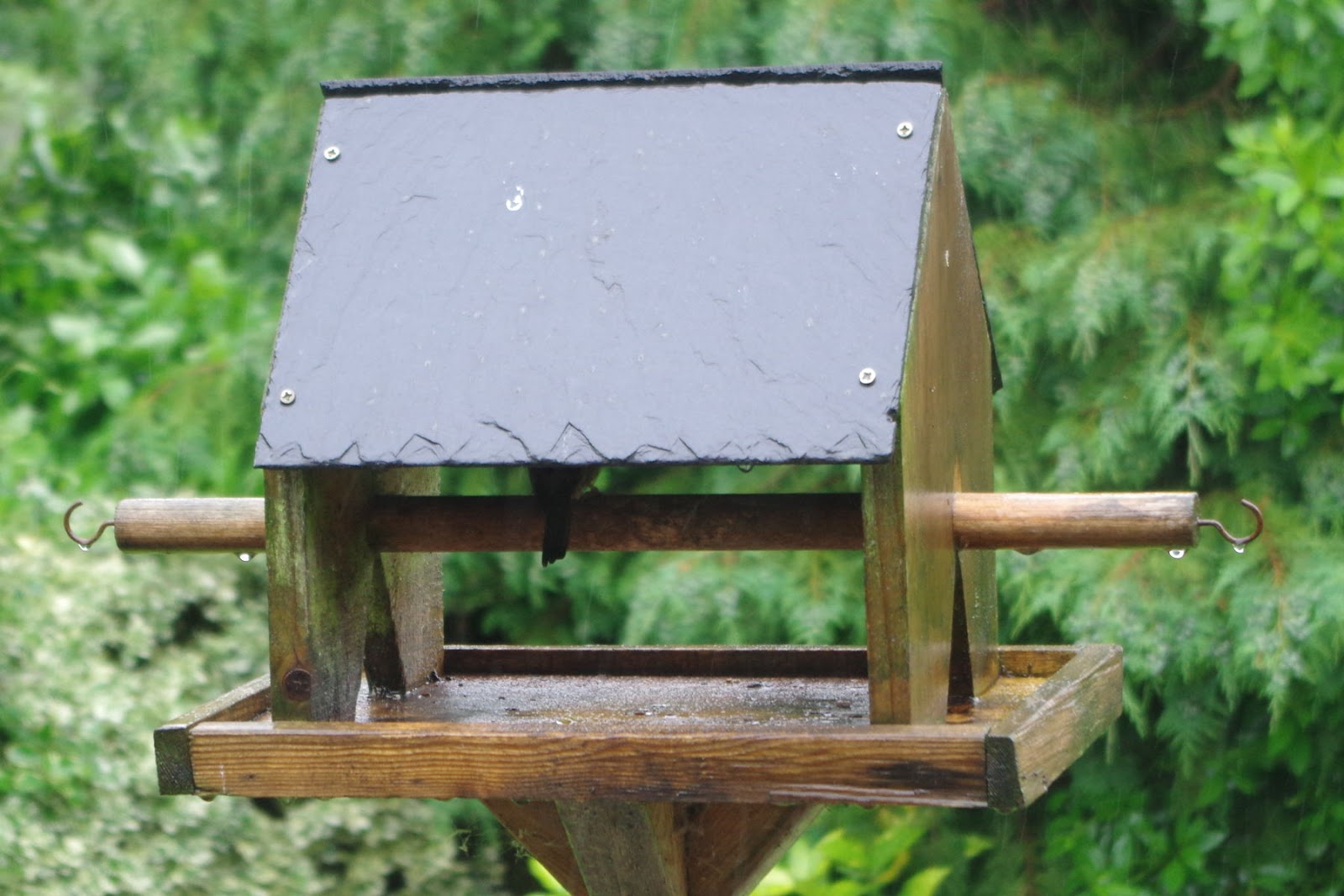
Look carefully and you can see a robin sheltering from the rain.
A robin hid from the rain under the bird-table roof. You can only just see it, but it totally nailed my attitude to all the rain and lousy light we've had this June. 

Day 21 - Glimpses of blue

Another day of dull wet weather

Bumblebee taking advantage of a short respite in the grim weather.
Busy bees took advantage of a brief burst of watery sunshine later in the afternoon.


7:20pm - Cirrus Clouds in a cobalt sky.
By 7pm I was desperate for something to photograph for #30DaysWild. The grey had cleared away so I took a photo of the sky.

9pm - Beautiful but slightly ominous.
After sundown it was lovely hearing the church bells and blackbirds singing while the light faded.

9:25pm - The grey creeping back on angels' wings.
As the sun dropped, the clouds greyed - a harbinger of things to come.

Tuesday, 21 June 2016

#30DayWild Do you know how fast antlers grow?

On June the 20th I started the day with all the enthusiasm that a wet Monday morning deserves. Heading out to get my daily newspaper I saw a pile of deer poo on our path. As excited as a kid on Christmas Eve, I glanced across at our Bushnell Trail camera, hoping it had caught something in spite of the constant rain.  After the day's work and meetings were done, I grabbed my the camera from the tree and downloaded the photos. 

My favourite visitor is a Fallow buck. He shed his antlers a few weeks ago and on his recent visits it's been interesting to see how quickly they regrow.  The photos here cover the period from April the 12th to June the 20th.  Times on the photos are in GMT. Add one hour to get BST.
April 12th - Antlers present and correct!
May 17th - Antlers gone.
Just 2 weeks later - his new antlers are nearly as long as his ears.
20 more days - the antlers are just over twice the length of his ears.
I don't know exactly when the Fallow buck lost his antlers but, in just over a month, they grew from nothing to twice as long as his ears.

I am currently doing the Wildlife Trusts' #30DaysWild challenge. For other blogs see MyWildLife.

Monday, 20 June 2016

#30DaysWild Using my senses

I've been taking part in the Wildlife Trusts' #30DaysWild challenge and have found that really using my senses is becoming a habit. I've been seeing, hearing, smelling, touching and tasting nature all around me.  

I had just spent a few days working in Birmingham and, in my spare time, had explored the area around the office and hotel. Walking back through Uckfield, I was pleased to see that East Sussex Highways had mown just the edge of grassy bank alongside Southview Drive leaving the Spotted Orchids and other flowers to thrive.

On Friday the 17th and Saturday I was just snatching sensations as I rushed by but I spent much of Sunday working in the garden immersed in nature.

Day 17 - Touch

Finding Pine Cones in my jacket pocket.
I put my hand in my jacket pocket to get my work pass out and touched the rough, knobby surface of a pine cone I had collected while in Birmingham.  There is something very #30DaysWild about finding a pine cone in your pocket!

My letter on the right-hand side of the page.
I was pleased that the Sussex Express had published my letter about mowing the grass verges.

Day 18 - Sight

Campanula and Beech Hedge.
As I rushed into town, I enjoyed seeing the intricate patterns made by campanula around the feet of a beech hedge.  While I photographed it, I could hear rooks calling and the distant sound of drumming as Spiritus practiced for a local event.

Day 19 - Sound, Scent and Taste

Listening to the hum of bees on a cotoneaster bush.
Just before I crossed the road to get my paper, a loud hum attracted my attention. Dozens of bumblebees were feasting on the tiny blooms of a Cotoneaster plant.

Herbs and other scented flowers in the garden.
I spent the morning gardening and, while tidying herbs in the sundial bed, I disturbed a tiny frog. Once I had finished my hands smelt of lavender, thyme and wild marjoram.

Tiny alpine strawberries.
When I finished, I rewarded myself with the taste of sweet, tiny alpine strawberries that have spread themselves throughout the garden.