Showing posts with label Lime Aid. Show all posts

Sunday, 3 March 2019

Lime Tree Avenue work on a rainy day

After some exceptionally sunny February days, Storm Freya was already making her presence felt when we (the combined forces of the old Lime Aid group and Brighter Uckfield) started work on the 200-year old Lime Trees in Lime Tree Avenue.

Lime Tree surrounded by epicormic growths before trim
Over the year since the last trim, these hybrid Lime Trees grow a forest of stems (epicormic growth) round their feet. Left unchecked, these would create an impenetrable forest that would sap the strength from the top of the tree.

Lime Tree - After Trim
I find it extremely satisfying to strip away these growths.  I just did one and a bit trees but the group as a whole, which had started on the previous day, managed nearly all of the hundred plus trees in the Avenue.

Wild Arum and Cow Parsley leaves
While I was working, I noticed the leaves of wild plants growing in the shad of these marvellous trees. The photo shows the young leaves of Wild Arum and Cow Parsley.

Sweet Violets - photographed in sunnier weather
Other plants that grow in the Avenue include Primroses and Sweet Violets.

White Lipped Snail
While I was working I found a couple of spiders, which I rehomed in the sticks piled up by the hedge, and some White Lipped Snails. I enjoyed music while I worked too. A Robin was singing nearby and a Great Tit was giving its "Teacher, Teacher" call.

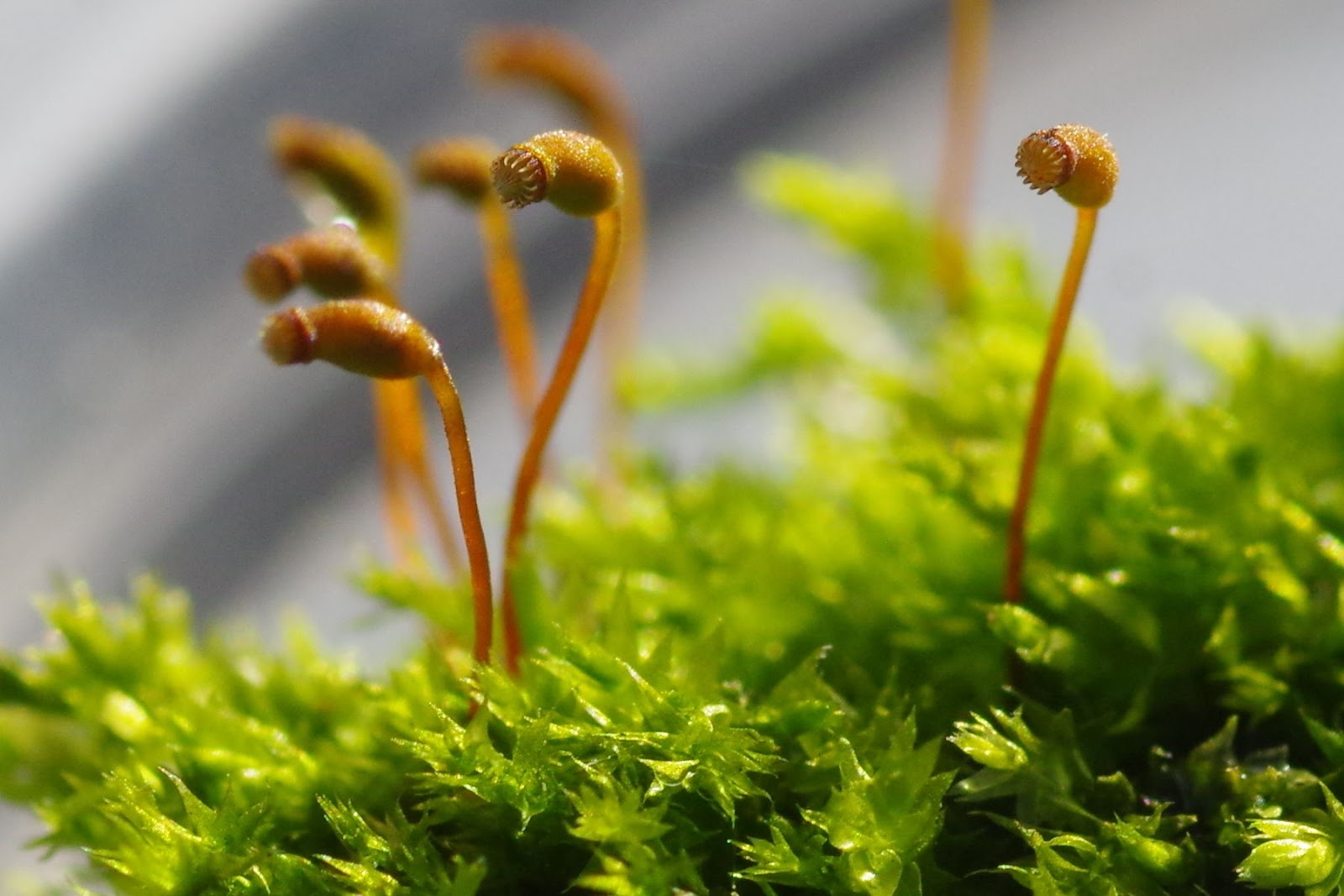
Clustered Feather Moss
Lime Trees Avenue provide a habitat for all sorts of plants and creatures. Lately, I have been taking more of an interest in mosses. Identifying them is tricky but it is interesting to look at them under a magnifying glass - the one photographed was on the bottom of one of the tree trunks and looks like a group of minature cobras!

Saturday, 6 January 2018

Brighter Lime Tree Avenue

As we stagger into 2018, it is time to give Lime Tree Avenue a good trim. This time I was working in a group with Brighter Uckfield.  As always, they are doing the town proud and there was a great turn out.  This is just as well. Since last February, when we last did the work, there had been plenty of growth.

The trees that make up the avenue are hybrids between Large-leaved and Small-Leaved Limes.  They are prone to producing "epicormic growths" (suckers), which both:
  • drain energy from the main trunk
  • produce a mini forest at ground level. 
This is why they must be trimmed off.  The photos below show a before and after.

Before and After - epicormic growths (suckers) have been removed.
That was one of the easier trees. I just had to clip over it with stout shears and the job was done.  Some are trickier though.

Stripping away leaf litter to get at older suckers.
The last tree I did had got sneaky. Over the years leaf litter had built up round the suckers, which - hidden from the attentions of volunteers - had grown thick and dense. I had to rake out years of composted leaf litter and then cut off as many stems as I could, one-by-one.

Fungi - about 7 inches across - Jan 2018
Although it was winter there were plenty of signs of life. Lime leaves rot very quickly and make an excellent mulch - although we appreciate it more on the earth than the path! This process relies on fungi and there was a big one near the trees.

White-lipped Snails with their "doors" closed - Jan 2018
While raking the leaf litter from between the suckers, I found several White-lipped Snails. They are small (about 1/2 inch) and are coloured either brown and white or amber. At the moment, the shells are closed with a little white door to keep them safe until they are ready to emerge. In our garden, they are eaten by Thrushes - but I haven't seen a Thrush in the Avenue yet.

Lime Tree Avenue is important to Uckfield for a number of reasons.  It is a real connection with the past. These wonderful old trees are one of the few remaining connections with Uckfield House. If you look on the Memories of Uckfield Facebook group (login required), you will see many stories concerning local people's experiences of Lime Tree Avenue.

Lime Tree Avenue acts as a "vertical nature reserve" that provides a home and food for many creatures. While we were working, we saw Robins, Dunnocks (Hedge Sparrows) and others, almost at ground level. How many others must there be in those tall trees?

Cow Parsley - 30 December 2017
It's not just birds. As I walk up and down the Avenue and through the connected Twittens on the way to and from the town I have encountered a variety of flowers.  When, just a few days ago, I did a New Year Plant Hunt, I found a Cow Parsley already in flower. Soon there will be Primroses, and a view of the whole Avenue frothing white with Cow Parsley is one of Uckfield's most beautiful sights.

Honeybee on Alexanders in Lime Tree Avenue - April 2015
Where there are flowers, there are pollinators.  While passing through the Avenue, I often see bees and hoverflies (bee mimics that are also pollinators) working their way round the flowers.

Ivy Bee - September 2015
There will be other sorts of bees too. Ivy flowers late in the season and supports pollinators in the autumn after other flowers have faded away. It also supports its own special bee - appropriately called the Ivy bee.

Beautiful Demoiselle - May 2017
One day, when walking back from the town I found a Beautiful Demoiselle. She may look dainty and pretty but if you are a small flying creature, she is a fearsome predator who hunts on the wing.

Frog and Primroses - Feb 2016
There are habitats for other creatures too. On one of the work days, we found a frog, which Martyn carefully put in a safe place.

As well as providing a home and restaurant for all sorts of creatures, Lime Tree Avenue is a highway - a "wildlife corridor" that enables insects, birds and other animals to get from one green space to another.  If a food source runs low in one place they can use a wildlife corridor to travel to another and live to munch another day. I particularly enjoy seeing wildlife in our Manor Park garden and I'm sure I would see less if we didn't have wildlife corridors such as Lime Tree Avenue, the Railway and the River Uck nearby.

Postscript

Tiny creatures from the leaf litter - 6 Jan 2018.
While I was scrabbling round in the composted leaf litter, I found and photographed a strange looking little creature about 1.5 cm long. It was only a snap with my phone, so I wasn't hopeful of getting an ID.  However I posted it in the Insects of Britain and Northern Europe Facebook group in the hope of getting some ideas.

Between them LS and DA suggested that the white larva was a beetle - probably Staphylinae (Rove beetle) or may be carabinae.  DA had spotted something else. Just above the beetle, by its legs, there are some tiny snails. She thinks these are probably Pupilla sp. (Chrysalis Snails) or Vertigo species. You might think that these are babies but this type of snail is just very, very small.

Saturday, 18 February 2017

Lime Aid - Rubies and Gold Cups

It's just past Valentine's Day, which means it's time to give Lime Tree Avenue a bit of love. I've have been doing volunteer work to help keep the wonderful old Lime Trees in this Historic Avenue for a number of years.  I missed last Saturday's session, which was reported by Uckfield FM, in which approximately 10 people worked their way up most of the avenue. This week, there was just the two of us - but we still managed to clear "epicormic growths" (suckers) from the feet of 5 of the most vigorous trees. If all goes to plan, there will be another session on March the 4th from about 9am.

A Lime Trees epicormic growths.
The first tree I tackled had an enormous number of large suckers galloping across the gap towards its neighbours. In the year since we last cleared them, some had grown to about 3 foot tall and as thick as my index finger.  Mercifully most were smaller. 

Wild Arum leaves.
While I was working my through the suckers, I noticed a carpet of delicate Cow Parsley leaves and a few clumps of Wild Arum - but no sign of any flowers yet.

Three Lime Trees - after this year's trim.
Once I had completed my first tree, it was satisfying to look back and see what we had achieved. Then onto the next tree.

Silvery lichen with tiny golden cups.
I couldn't resist collecting some treasure to take home. The suckers have ruby red buds, so a handful of the clippings went into my bag. These were followed by a twig with some Lichen. This is  a silvery, leafy structure made up from a partnership between an algae and a fungus.  If you look carefully at the photo, you can see tiny golden cups, which are the fruiting bodies of this strange cooperative organism. 

Crocuses at the North end
As I was heading home, a stray clump of crocuses were fully open as if to tell me that Spring is nearly here. I am looking forward to seeing the Lime Trees' bright green leaves burst from those ruby buds.

Saturday, 20 February 2016

Lime Aid - Spring's at our feet

Once again it is time to trim the "epicormic growths" (suckers) from the feet of the trees in Lime Tree Avenue, which led to long-gone Uckfield House.  The year since I last did this seems to have rushed by. About half-a-dozen of us spent the morning working our way through nearly half the trees.  The group will be at work again next Saturday morning (Feb 27th - 9am until 1pm - more volunteers are always welcome).

The first of my 7 trees - before and after.
The day job has been pretty heavy since December and it was great to spend time working in the presence of trees that have lived so long and seen so much. While we were there it became more-and-more obvious that Spring was drawing life from the soil at our feet.

A cheeky robin found morsels where we had been working.
White-lipped snails and worms hiding amongst the growths at the base of a tree.
The wild plants round the trees are growing fast. I saw violets, primroses and alexanders already in flower as well as clumps of handsome wild arum leaves.

Wild arum leaves.
While I was working on the last of my trees, my every move was scrutinised by a curious goat, one of a pair kept by the school.

The school goat.
In case we were in the slightest doubt about the approach of spring - a frog appeared near one of the trees and was placed gently by the fence so it could find its way to the pond.

Frog and primroses.
After a few hours, I began to run out of steam and went home, scooping up some well-deserved fish and chips on the way.


Saturday, 26 December 2015

My 2015 in Uckfield nature photos

As the year draws to a close it's time to look back on the wildlife I have seen in and around Uckfield during 2015.

January

January started with the BSBI New Year Plant hunt, in which I spent an hour looking for wild flowers that were out in bloom. I found a total of 21 different types - surprising considering that we had a few days of hard frost. 
Campanula on old wall at the top Uckfield's High Street.
Towards the end of the month, I took part in Lime Aid's volunteer session - trimming back unwanted growth at the feet of the amazing old Lime trees that once led to Uckfield House.
Before and After - Lime Tree Avenue.
As usual, the month ended with the RSPB's Big Garden Birdwatch.

February

On the 8th, four tiny Goldcrests were fluttering round the lower branches of our laurels and nearby bushes. One was displaying to the others with his normally inconspicuous crest feathers fluffed up in a bright orange "quiff".  One sunny day brought out a tattered but still lovely Red Admiral.

Red Admiral, Manor Park garden.

March

When Hazel catkins are shaken by the wind, you can see how they get the name "lambs tails". This year has been exceptionally windy.
Hazel, Manor Park garden.

April

Two Fallow Deer bucks, who are regular visitors to the Manor Park estate, came into the garden for a couple of hours. I and others were concerned that the darker one was limping. However it showed a fair turn of speed when escaping would-be rescuers.

 
Fallow deer, Manor Park garden.

May

May is, of course, bluebell time. This year I visited Boothland Wood, which in the next few years will be surrounded by the Ridgewood Farm development.  The woodland has a light, airy feel because it is surrounded by open farmland and has many elegant, slender beech trees.
Bluebells, Boothland wood.
Later in the month, the splendid WRAS rescued an injured woodpigeon from our back garden.
WRAS to the rescue, Manor Park.
The month ended with the Garden Biobliz in which I tried to find as many wild flowers and creatures in the garden as possible.  In the end, I identified 129 species compared to 104 last year.
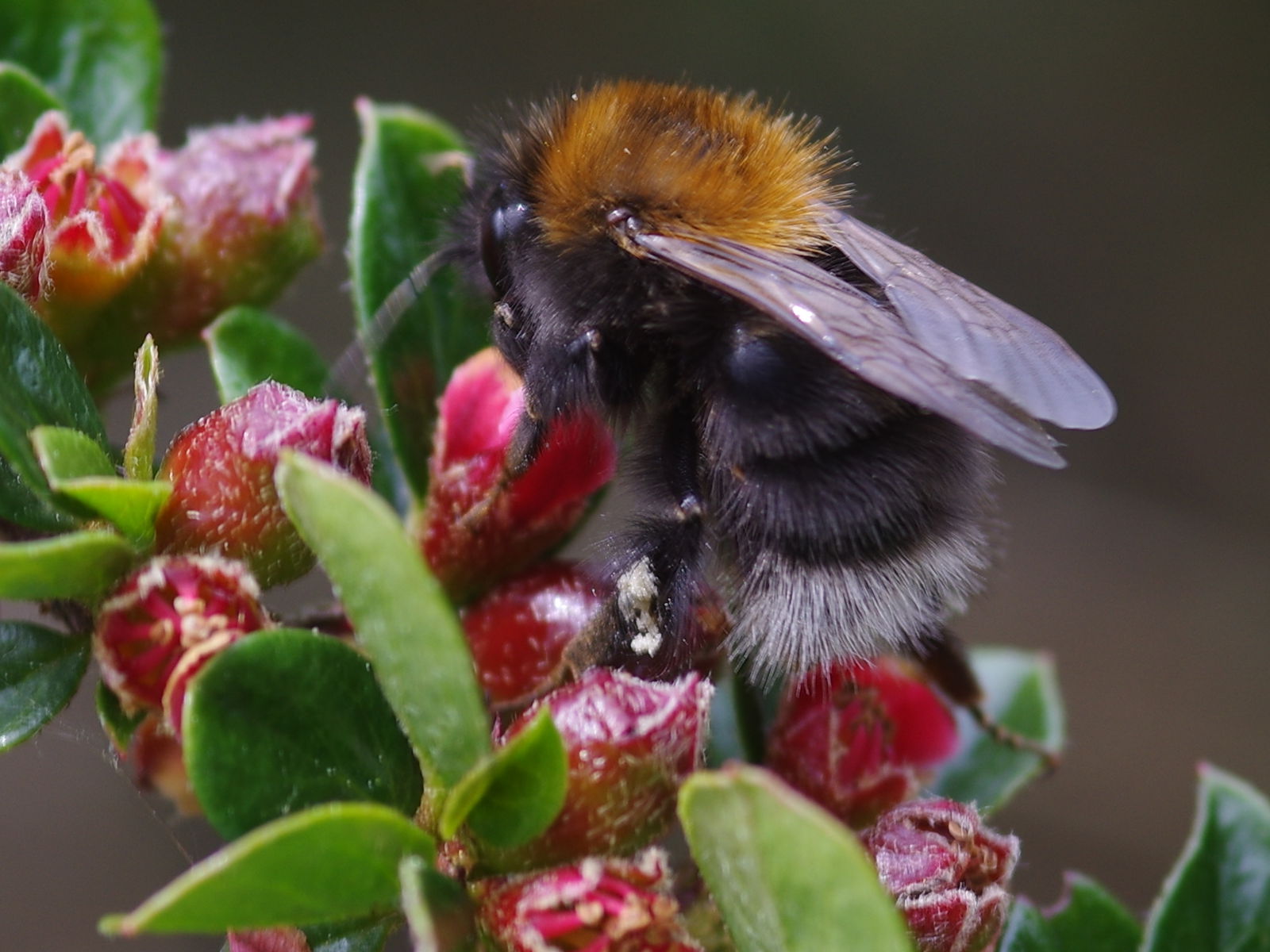
Tree bumble bee spotted during Garden Bioblitz, Manor Park garden.

June

June was dominated by 30 days wild. This project meant having one wildlife moment a day.  To me it meant pausing and really taking notice of what was around me. My most memorable Uckfield discovery was a pair of Grey Wagtails that live on the part of the River Uck that flows under our station. I saw them courting and mating and was able to follow their progress up to the point when I saw a fluffy youngster.

Grey Wagtails on riverbank, seen from Uckfield station platform.

Another highlight was spotting Uckfield's very own Stickleback Si (named after one featured on BBC's Spring Watch) in the Hempstead Meadow Nature Reserve. I could see his red tummy and I was delighted to see him duck into his tunnel nest for a moment. 

July

Towards the end of July, I spent time pulling invasive Himalayan Balsam in the Hempstead Meadow Nature Reserve.  It was very pleasant to spend time in the reserve like that and getting to see special trees like rare Black Poplars and all manner of tiny creatures.
Black Poplar (left) and Himalyan Balsam (right). Hempstead Meadow
July was also marked the start of the Big Butterfly Count.  This year I saw more butterflies (108 in 12 counts) than last.  Our most regular visitor were bright orange and brown Gatekeepers. 

Gatekeeper butterfly, Manor Park garden.

August

The 8th of August was flying ant day. Suddenly they erupted from our lawn and were flying skywards like so many golden angels. It wasn't just us - all over the country, people were commenting, via social media, on the ants.  
Black ants, Manor Park garden.
On the 22nd of August 2015, I spent a lovely hour in our garden experiencing the light fading away and the creatures of the day finding their way home.  I counted about 400 Rooks as they flew past our house to their roost - probably Lime Tree Avenue.

On a wet bank holiday, I finally found the little remnant of heathland habitat on Manor Park, which is home to hundreds of dainty Autumn Ladies Tresses flowers.
Autumn Ladies Tresses, Manor Park estate.

September

September mornings found our garden full of spider webs sprinkled with jewel-like drops of dew. I was pleased to see that they seemed to be catching plenty of crane flies.
Garden Spider (Araneus diadematus) in Manor Park garden.
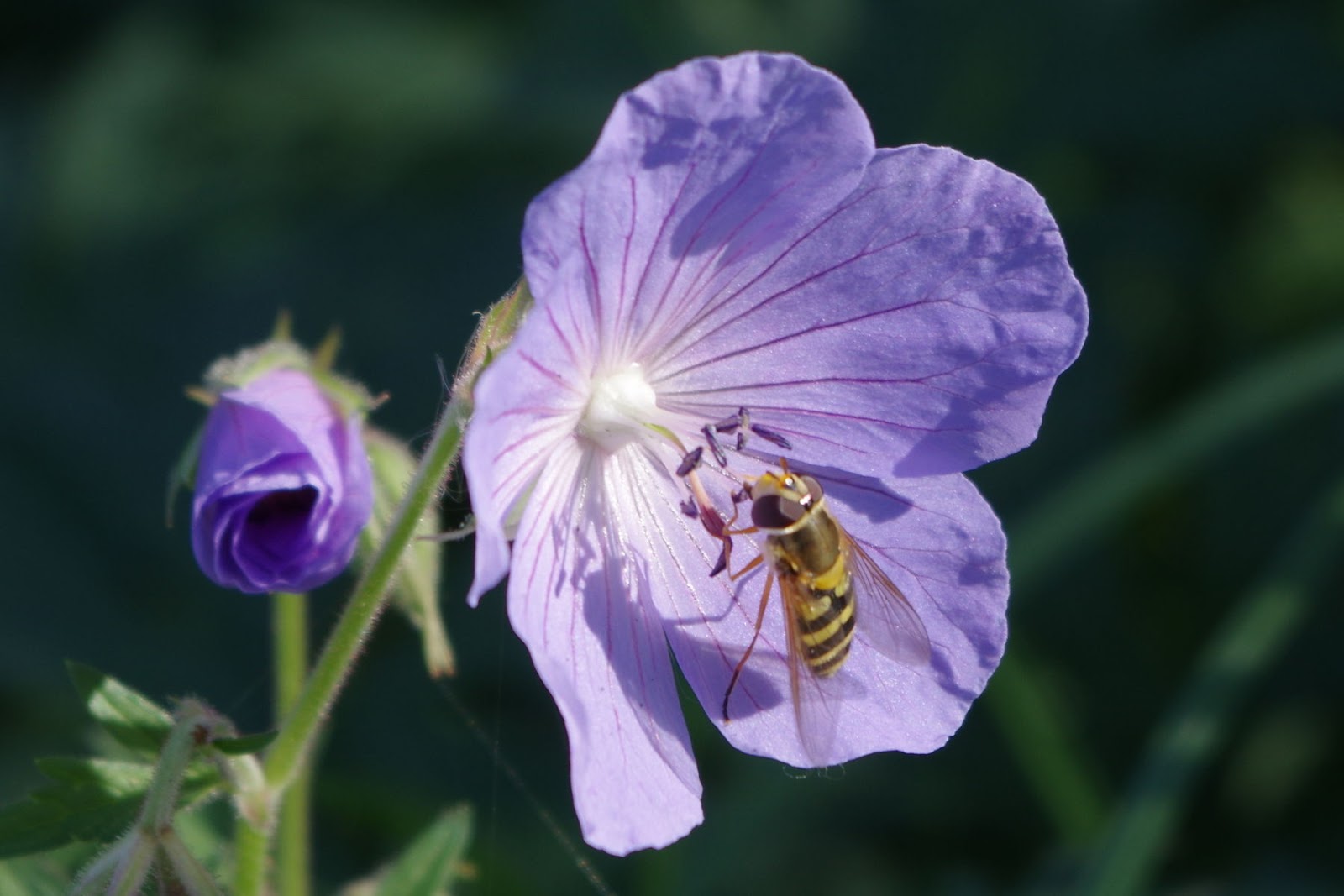
At the end of the month, I cut through Hempstead Meadow Nature Reserve and found plenty of flowers still out including a blue, Meadow Crane's-bill.
Hoverfly (Syrphus ribesii) on Meadow Crane's-bill. Hempstead Meadow.

October

In the run up to Halloween I expect to hear much talk about bats and other spooky things but I don't expect to see real ones. However the long, late summer brought us two surprise visits. One on October the 18th at about 6:15pm when we saw three dancing in the fading light and another at about 5pm on October the 30th.
Autumn leaves and Halloween decorations.

November

A grim month in all sorts of ways. At the start of the month fog swept in closing both Gatwick and Heathrow and on the 21st there were snowflakes in the rain.  Even the foxes that regularly visit our garden stayed away for most of the month.
One of the few fox visits in November. Manor Park garden.

December

In the run up to Christmas we had a few visits from a fallow deer with fine antlers. This is probably the lighter of the two bucks that we saw earlier in the year. Sadly the darker one wasn't with him.
Fallow buck, Manor Park garden.
Christmas is a time when we traditionally bring greenery inside. I'll leave you with the lovely Nordman tree that I bought from Vulcan Farm. 


Wednesday, 31 December 2014

My 2014 in Uckfield nature photos

It's the last day of the year. The morning was frosty and bright and I scurried out just long enough to set up the butterfly box that a neighbour had given us for Christmas. Back in the warm my eyes drift over the reviews of 2014 and I find myself thinking about the pleasure our local wildlife has given me.

This year, thanks to getting involved with surveys such as the great garden bioblitz and the Uckfield Neighbourhood Plan I have learnt a great deal about the wildlife in our garden and town.

January

In the early part of the year, the foul weather kept most of the wildlife away - we just had the occasional fox paddling through.

Fox photographed on 29 January.
At the end of the month, I took part in the annual Big Garden Birdwatch, otherwise known as birds disappear from our garden day.

February

In the garden, the frogs spawned in the first week of February. Further afield, it's roll our sleeves up time as the Lime Aid group trimmed the suckers that would otherwise weaken the trees in Lime Tree Avenue.

Before and after of one of 'my' trees.

March

The sun came out properly and butterflies flitted between the early flowers.

The peacock chose the most bedraggled daffodil in the garden

April

Two fallow bucks started to visit the garden at night.

Two fallow bucks photographed 18 April.

Nature was certainly in a rush. This year, the bluebells were amazingly early being in full flower by the end of April.


Bluebells in Views (Williams) Wood

May

I couldn't resist this lovely traditional phone box surrounded by wild flowers.
Phone box near station pub.
 If there's one thing more special than wild orchids, it's finding them on the estate where I live.
Wild orchids on a housing estate.

June

I took part in the Bioblitz, noting all the wild plants and creatures that I could find in our garden. This was something of a breakthrough for me because I started to try and identify the insects and other small creatures in the garden rather than sticking to flowers and larger animals.

Taking part in the Bioblitz.
 
The two fallow deer that have been visiting Manor Park gardens turned up and posed nicely for the count.
 
Two male fallow deer.
 
The badger, who has been a total diva this year, turned up too late to take part.
Badger, in our Manor Park garden.


July

I rescued George from a path near out house and put him near some birch leaves.

An alder moth caterpillar.

After years of seeing perfect semicircles cut into leaves in our garden, Ryan Clarke kindly identified the bee responsible. This deserves a toast - so, bottoms up!

Leaf-cutter bee on teasel.

August

Along with thousands of people across the country, I took part in the Big Butterfly Count.

A delicately marked small blue was one of 10 species in our garden.
One garden visitor that I became aware of was the common carder bee - for all the world like a tiny, fast-moving teddy bear.
A common carder bee on verbena.

 It was so wet that one morning I found a newt on Uckfield High Street.
Smooth newt.

September

I carefully cleared cultivated garden plants that had invaded my wild patch and planted some 'weeds' - because that's how I roll.

Newly planted ladies bedstraw.

Naturally, the butterflies and beetles preferred Mum's verbena to my carefully selected native wildflowers.

Painted lady on verbena.

October

I joined the Uckfield Neighbourhood Plan environment group and thanks to the generosity of others, I found out much more about places for nature in Uckfield. Nearer to home, I created a bug hotel from a broken planter and a pile of old prunings.

Bug hotel.

November

It's all about the mellow colours of Autumn.

View of Oast House and allotments from bypass.

As the warm, damp weather continued, fungi seemed to spring up everywhere. The ones shown are not the most colourful but they are the most appropriately named.

Herald of winter fungi in Holy Cross church yard.

December 

As we approached Christmas, I was surprised to find honey bees in the garden.

One of 6 honeybees on our mahonia.
Coming to a close - how could I round this up with anything other than our seasonal favourite?

Robin on our hazel, 14 December.