Showing posts with label frog. Show all posts

Sunday, 5 March 2017

Frogs spawning - better late than never!

With storms Doris and Ewan, March has certainly come in like a lion. More importantly our garden frogs have belatedly decided it is time to spawn. 

Spawn first seen 2nd March 2017
I wasn't around to see it myself but Mum let me know when I came home from work.  This year's spawning is quite late compared to the February dates for 2014-2016.
  • 2017 - 2nd March
  • 2016 - 14th Feb
  • 2015 - 22nd Feb
  • 2014 - 8th Feb
  • 2013 - 6th March
  • 2012 - 25th Feb
  • 2011 - 20th Feb
  • 2010 - 28th Feb
  • 2009 - saw frogs active in pond 18th Feb
  • 2008 - saw frogs active in pond 29th Feb
  • 2007 - saw frogs active in pond 11th Feb
  • 2005 - 19th Feb
Meanwhile, while I've been driving along country roads, I've seen the first daffodils and wild primroses appearing as we are blown headlong into spring.

Saturday, 20 February 2016

Lime Aid - Spring's at our feet

Once again it is time to trim the "epicormic growths" (suckers) from the feet of the trees in Lime Tree Avenue, which led to long-gone Uckfield House.  The year since I last did this seems to have rushed by. About half-a-dozen of us spent the morning working our way through nearly half the trees.  The group will be at work again next Saturday morning (Feb 27th - 9am until 1pm - more volunteers are always welcome).

The first of my 7 trees - before and after.
The day job has been pretty heavy since December and it was great to spend time working in the presence of trees that have lived so long and seen so much. While we were there it became more-and-more obvious that Spring was drawing life from the soil at our feet.

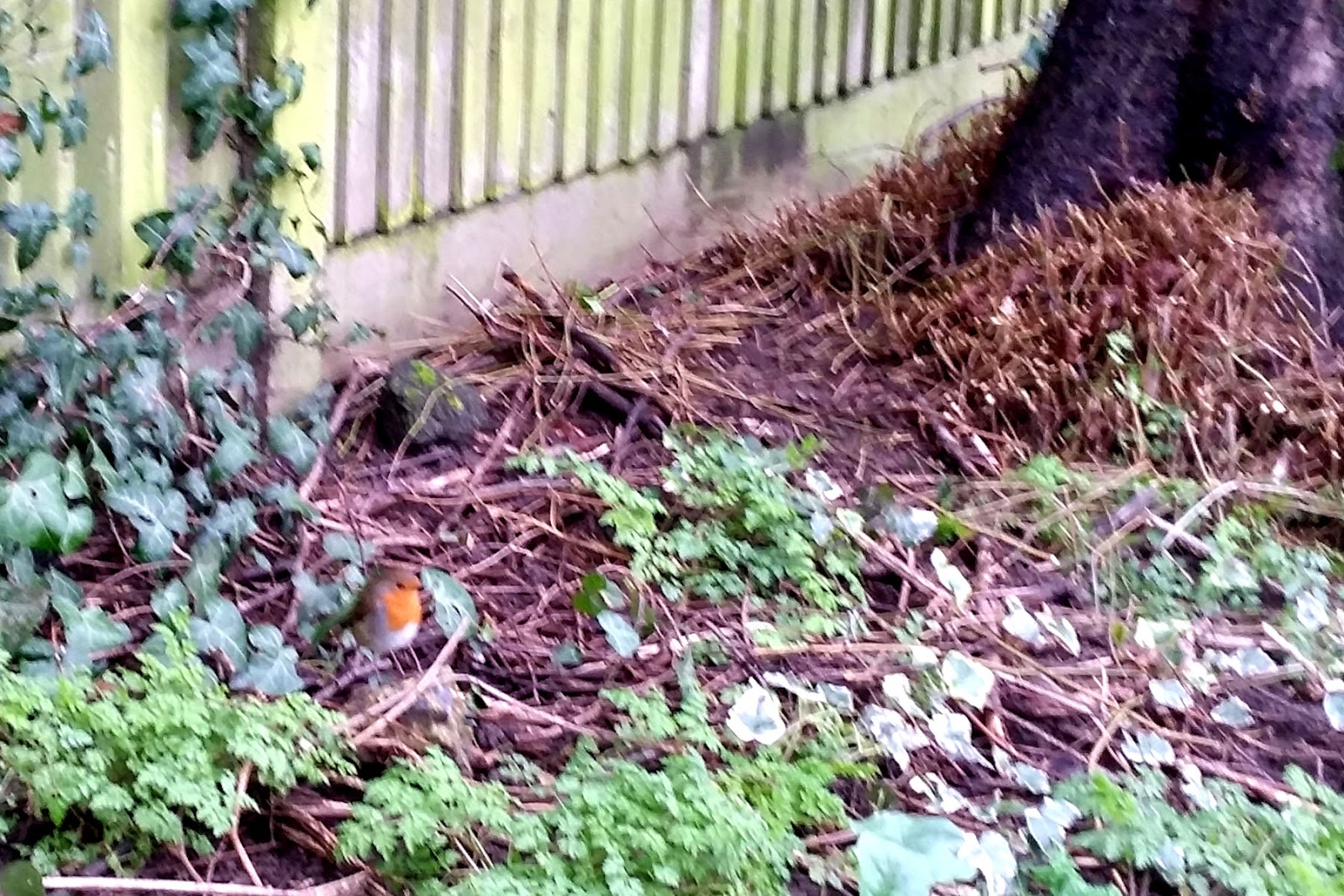
A cheeky robin found morsels where we had been working.
White-lipped snails and worms hiding amongst the growths at the base of a tree.
The wild plants round the trees are growing fast. I saw violets, primroses and alexanders already in flower as well as clumps of handsome wild arum leaves.

Wild arum leaves.
While I was working on the last of my trees, my every move was scrutinised by a curious goat, one of a pair kept by the school.

The school goat.
In case we were in the slightest doubt about the approach of spring - a frog appeared near one of the trees and was placed gently by the fence so it could find its way to the pond.

Frog and primroses.
After a few hours, I began to run out of steam and went home, scooping up some well-deserved fish and chips on the way.


Tuesday, 11 February 2014

It's all kicking off!


One week into February and suddenly everything is kicking off in the garden.

First, the frogs. On the 8th, I casually looked in the pond and noticed spawn. It might have been there for a couple of days. I have been noting the date that the frogs spawn since 2005. This year's spawning date is a month earlier than in the cold weather last year. In fact it is earlier than any of the years since I started recording.

As for animals recorded by my Bushnell trail camera, the wet weather has continued but animals have started visting again. We have had some fox visits and our first badger of the year.

Fox - quarter to nine on the 2nd of February.
Badger - just after midnight on the same night.


Sunday, 21 July 2013

Baby frogs and lammas leaves

The frogs spawned late, about the 6th of March and then we had a blackthorn winter. After the snow and ice had cleared the spawn looked rather sick and wrinkled. After not seeing any tadpoles I gave up hoping for young frogs this year. On the 20th of July I was delighted to see a hand full of froglets scrambling round the bottom of the kingcups.


Lammas growth, photographed on July 21st
At this time of year we see a flush of new growth on our oak tree. Unlike the acid green new foliage that first appears in spring this is red tinged. These leaves grow around Lammas day, August 1, which is the festival of the wheat loaf (Anglo-Saxon hlaf-mas, "loaf-mass"). Lammas growth appears in a variety of tree species. According to Wikipedia
This secondary growth may be an evolutionary strategy to compensate for leaf damage caused by insects during the spring.
After the manic spring breeding season, July and August always feel like a time when not much is happening in the garden but subtle changes are still happening and are worth looking out for.

Macbeth and wildlife - SPOILER ALERT

I was inspired to write this post by the National Theatre Live production of Macbeth at the Picture House, Uckfield. As I watched Kenneth Branagh and others doing their stuff, I was struck by the number references to wildlife and the forces of nature in Shakespeare's text. The Picture House at Uckfield is going to be showing some encore performances. If you are planning on going, don't read this - it is full of SPOILERS.

The first line of the play is the stage direction:
Thunder and lightning. Enter three Witches.
Throughout the play, foul weather foretells foul deeds. The line introduces the scene which the three witches decide on the meeting that fires and corrupts Macbeth's ambition. They end by chanting:
all: Fair is foul, and foul is fair: Hover through the fog and filthy air.
The good King Duncan of Scotland and his thanes win a battle and they return to Macbeth's castle. The King and Banquo see swallows (called Martlets) and regard them as a symbol of the wholesome air of Macbeth's family seat and, by implication, of the Thane himself.
Banquo: This guest of summer, the temple-haunting martlet, does approve
By his lov'd mansionry that the heaven's breath
Smells wooingly here : no jutty, frieze, 
Buttress, nor coign of vantage, but this bird 
Hath made her pendent bed and procreant cradle.
Where they most breed and haunt, I have observ'd 
The air is delicate
In Sussex, we are familiar with martlets as they appear on the Sussex coat of arms.

But the the fair air of Macbeth's castle is already being corrupted by the witches' prophesy of Macbeth becoming King. Lady Macbeth had already interpreted a raven's crowing as predicting the death of the King under her roof. As Macbeth murders the King, she hears an owl shriek and rejoices because it foretells death.  Mercifully the hooting of the Tawny owls that I hear coming from Views (Williams) wood means nothing worse than an early start to a long commute.

After the murder is discovered, an old man talks to one of the King's noblemen outside Macbeth's castle.
Old Man: 'Tis unnatural, 
Even like the deed that's done. On Tuesday last,
A falcon, tow'ring in her pride of place,
Was by a mousing owl hawk'd at and kill'd.
Ross: And Duncan's horses - a thing most strange and certain - 
Beautous and swift, the minions of their race,
Turned wild in nature, broke their stalls, flung out,
Contending 'gainst obedience, as they would make
War with mankind
Old Man: 'Tis said they eat each other.
Ross: They did so; to the amazement of mine eyes,
Here the owl represents Macbeth and the falcon, the King. In the exchange about horses, minion means favourite and the suggestion is that the Macbeths, who had been favoured by the king, turned on him and would eventually destroy each other.

At the beginning of Act 4, the witches are once more chanting in darkness and thunder. They chant about many animals from the humble "hedge pig" to the exotic baboon - and of course the famous:
Frog hiding from 2nd Witch
2nd Witch: Eye of newt, and toe of frog,
Wool of bat, and tongue of dog,
Adder's fork, and blind-worm's sting,
Lizard's leg, and howlet's wing,
For a charm of powerful trouble,
Like a hell-broth boil and bubble.
We are privileged to have frogs living in our garden. At this time of year, bats do a very nice job of keeping insects under control as they swoop in front of our windows. I would be grateful if everyone refrained from turning them into a charm.

In his guilt, Macbeth becomes a terrible tyrant, hunting down all who may threaten him. Macduff flees Scotland. His wife asks their little boy how he might live without his father and the boy sweetly refers to living as birds do. He doesn't get the chance, because Macbeth has the whole family slaughtered. When Ray Fearon's Macduff finds out, his grief steals the show as he laments over the loss of his "pretty chickens" and calls Macbeth a "hell kite".

The nobles corner Macbeth and he fights to the bitter end:
Macbeth: They have tied me to a stake; I cannot fly,
But bear-like I must fight the course.
So there he is. In the course of 2 and a half electrifying hours Macbeth changes from a man whose honourable home was good enough for the fussy swallow to one who was compelled to fight to the death like a wounded bear tied to a stake.

Reference: Information about birds from the Birds theme of Shakespeare Navigators.

Tuesday, 19 March 2013

Spring Equinox - green shoots?

Well Spring's arrived - allegedly.

It's less than 2 weeks ago I was crowing about "spring becoming an unstoppable force". Since then we've had heavy, drifting snow and rain and unrelentingly cold miserable weather. The frog spawn is looking a bit sorry for itself and the daffodils are decidedly confused but ...

Wild arum, bluebell and fritillaria leaves under oak.
... green shoots are breaking through all over. Just a few weeks ago the area below our oak was barren looking mud. Now leaves of wild arum, bluebell and fritillaria are growing rapidly. Maybe, just maybe spring is arriving.

Tuesday, 12 March 2013

Blackthorn winter

I must admit that I really didn't believe it when they first started forecasting snow just before the weekend. Surely the most we could expect at this time of year is a light dusting. Oh how wrong I was.  As I travelled to work Monday morning, I admired the pretty blossoms of blackthorn and almond. On the way back I was glaring at increasingly heavy, driving snow. In The Woodlands (1825) William Cobbett talks about blackthorn winter.

It is a remarkable fact, that there is always, that is every  year of our lives, a spell of cold and angry weather, just at the time that this hardy little tree is in bloom. The country people call it the Black Thorn winter; and thus it has been called, I dare say, by all the inhabitants of this island, from generation to generation, for a thousand years.

Over the last day or so the weather has been more than angry enough. When I was coming home Browns Lane in Uckfield was getting too treacherous for most vehicles. The snow seemed to be falling in gusts and flurries for most of the night. By morning it wasn't, on average, very deep but the wind had swept snow off the Dene and onto the pavement and road. When I trudged to the shops it came over the top of my boots. Our little daffodils were completely buried and there was a good dusting over the trees and shrubs.


The aptly named Cornish Snow camelia, photographed 12 March.

But what of our wildlife? This morning, there were very few foot prints in the snow. We put food and water out for the birds and were rewarded with a mob of squawking starlings. As for the frog spawn that was laid only a few days ago, I'm hoping that the snow has been a protective blanket rather than a shroud.

Sunday, 10 March 2013

Frog spawn

Give or take some forecasted snow and sub-zero temperatures, spring seems to have become an unstoppable force in the Uckfield area. The number of flowers blooming in the garden has increased from a few shy snow drops to a cascade of daffodils, primroses, hellebores and so many more.


Helebores and snowdrops photographed on 10 March, 2013.
Leaf buds are fattening, blue tits inspecting boxes and the frogs in our Manor Park garden are, at long last, spawning.

I've been keeping rough records for some time and this is the first time that I've noted them spawning so late. Here are the dates I've recorded over the past few years
  • 2013 - 6th March
  • 2012 - 25th Feb
  • 2011 - 20th Feb
  • 2010 - 28th Feb 
  • 2009 - saw frogs active in pond 18th Feb
  • 2008 - saw frogs active in pond 29th Feb
  • 2007 - saw frogs active in pond 11th Feb
  • 2005 - 19th Feb.
The frogs have produced a reasonable quantity of spawn in a few days.


 Of course, our frogs are not the only ones to have been busy recently. From Twitter, two local people had frogs spawning well ahead of mine:
  • Tim Benians (@UckFramingCo) on the 27th of February
  • Jenny Bacon (@Metique) on the 1st of March
Jenny is one of a heroic band that make sure that Uckfield's toads get to the pond on the Harlands estate by picking them up, putting them in buckets and carrying them across the roads. This work started around the 6th of March and continued for a number of days.