Showing posts with label Sweet Violet. Show all posts

Sunday, 4 January 2026

Botanical Survey 2025 - Buxted

For 2025, I decided to continue "square bashing" - finding all the wild plant species I can in two "tetrads", which are 2km squares on the ordnance survey map. My squares are

  • TQ42W, which covers Buxted Park
  • TQ52B, which includes Buxted Village

I did my surveys on 36 runs, covering 257 km (159 miles). I ran through Buxted Park, which is a Site of Scientific Interest, and explored the village, farmland and woodland.

Optimistically searching for plants in the frost.

I compared the species I found to the BSBI lists for the tetrads so I could see if/when they had been recorded and verified previously. Below, I will mention some of those that were not previously listed and those that had an old listing (1966). I think this represents a range of recording from 1966 to 1999. Either way, it is at least a quarter of a century since the species has been recorded in the tetrad.

Manor Park Estate

As always, the twittens and roadside paths of the Manor Park estate could be relied on to yield some unexpected treasure:
  • Malva sylvestris (Common Mallow) - 1966 listing
  • Verbena officinalis (Vervain) - Not previously listed
Malva sylvestris (Common Mallow)

Views wood

The wood lies between the Manor Park estate and Buxted Park. I found:
  • Lysimachia nemorum (Yellow Pimpernel) - 1966 listing

Stream between Views Wood and Buxted Park (TQ42W)

There is a stream and damp area between the Wood and the Park. The banks of the stream contain various treasures such as Common Valerian as well as:

  • Blechnum spicant (Hard Fern) - 1966 listing
  • Dryopteris affinis (Scaly Male Fern) - not previously listed


Dryopteris affinis (Scaly Male Fern) 

Buxted park

Buxted Park has many splendid trees including some non-natives that are new to the list.

  • Pinus nigra (Corsican Pine) - not previously listed 
  • Quercus rubra (Red Oak) - not previously listed

Pinus nigra (Corsican Pine) 

I also found:

  • Barbarea vulgaris (Wintercress) - 1966 listing
  • Nymphaea alba  (White Waterlily) - not previously listed 

Hurstwood Road and surroundings

The Hurstwood Road opposite the Buxted Park entrance leads to farmland. One field had many wild flowers as well as nesting Yellowhammers.

  • Fumaria officinalis (Common Fumitory) -  1966 listing
  • Sinapis arvensis (Charlock) - not previously listed
Fumaria officinalis (Common Fumitory)

Church Road and surroundings

Nearer to the village, Church Road has many interesting buildings including an Oast house. At the roadside I found:
  • Viola reichenbachiana (Early dog violet) - not previously listed
  • Erophila verna (Common Whitlowgrass) - not previously listed 
Erophila verna (Common Whitlowgrass)

Buxted Road/Station/High Street

The road that bounds the North side of Buxted Park and leads into the village gave me a number of firsts.
  • Barbarea vulgaris (Wintercress) - 1966 listing
  • Malva sylvestris (Common Mallow) - 1966 listing
  • Fallopia baldschuanica (Russian Vine) - not previously listed 
  • Avena satvia (Oat) - not previously listed
  • Viola odorata (Sweet Violet) - not previously listed
  • Medicago arabica (Spotted Medick) - not previously listed

Viola odorata (Sweet Violet) 

Pound Green area 

For some reason Comm Orache is missing from many local lists but I managed to find it in a few sites in and around Buxted including one at the furthest edge of one of my tetrads.
  • Atriplex patula (Common orache) - not previously listed

Atriplex patula (Common orache) 

Lanes

The lanes to the South of Buxted included my most exciting find.

  • Gnaphalium lutoalbum (Jersey Cudweed) - Neville Hutchinson noted that this is a "new tetrad record and 18th this century for East Sussex!"

Gnaphalium lutoalbum (Jersey Cudweed) 

Tickerage Stream and Woodland

There is a lovely little area of woodland, with the Tickerage Stream running through. It contains all sorts of wild flowers such as Wood Anemones, Bluebells and Red Campions. 

  • Lysimachia nemorum (Yellow Pimpernel) - 1966 listing
  • Ranunculus auricomus (Goldilocks Buttercup) - 1966 listing

Ranunculus auricomus (Goldilocks Buttercup) 

Finally

The impact of Monad recording

This time, the Sussex Botanical Recording Society asked us to record the species in each 1km square (monads). To be honest, the change caught me on the hop so rather than planning to do monads from the start, I crudely adapted my tetrad (2km square) plans so that I recorded in 8 small squares rather than 2 big ones.

I can't directly compare numbers of species ticked off per square with last year because of the change from tetrads to monads but:

  • In 2025, I ticked off an average of 83 species per square (8 monads), total = 667, average per km = 2.5
  • In 2024, I ticked off an average of 225 species per square (2 tetrads), total = 451, average per km = 3.8

The "efficiency" in terms of average per km is easily explained by me needing to go further to get into all four quarters of a tetrad rather than just cherry-picking the parts closest to home. To be honest, I bit off more than I could chew with 8 monads. The effect was that I focussed on the most easily found and identified plants. So the promises that I made to myself about learning more about identification of grasses, docks and willowherbs fell by the wayside. I also found it difficult to recall what I had seen where even with the help of my trusty spreadsheet.

In 2026, I intend to give myself space to learn more about my awkward squad by reducing the number of monads to about 5.

Finding "new" species

These tables show the number of species I found in each monad, how many were new to the square and how many were recorded for the first time since "1966"

Buxted Park TQ42W


Buxted village TQ52B 


This year, I have fewer species new to the tetrad or not recorded since 1966. 

Sunday, 3 March 2019

Lime Tree Avenue work on a rainy day

After some exceptionally sunny February days, Storm Freya was already making her presence felt when we (the combined forces of the old Lime Aid group and Brighter Uckfield) started work on the 200-year old Lime Trees in Lime Tree Avenue.

Lime Tree surrounded by epicormic growths before trim
Over the year since the last trim, these hybrid Lime Trees grow a forest of stems (epicormic growth) round their feet. Left unchecked, these would create an impenetrable forest that would sap the strength from the top of the tree.

Lime Tree - After Trim
I find it extremely satisfying to strip away these growths.  I just did one and a bit trees but the group as a whole, which had started on the previous day, managed nearly all of the hundred plus trees in the Avenue.

Wild Arum and Cow Parsley leaves
While I was working, I noticed the leaves of wild plants growing in the shad of these marvellous trees. The photo shows the young leaves of Wild Arum and Cow Parsley.

Sweet Violets - photographed in sunnier weather
Other plants that grow in the Avenue include Primroses and Sweet Violets.

White Lipped Snail
While I was working I found a couple of spiders, which I rehomed in the sticks piled up by the hedge, and some White Lipped Snails. I enjoyed music while I worked too. A Robin was singing nearby and a Great Tit was giving its "Teacher, Teacher" call.

Clustered Feather Moss
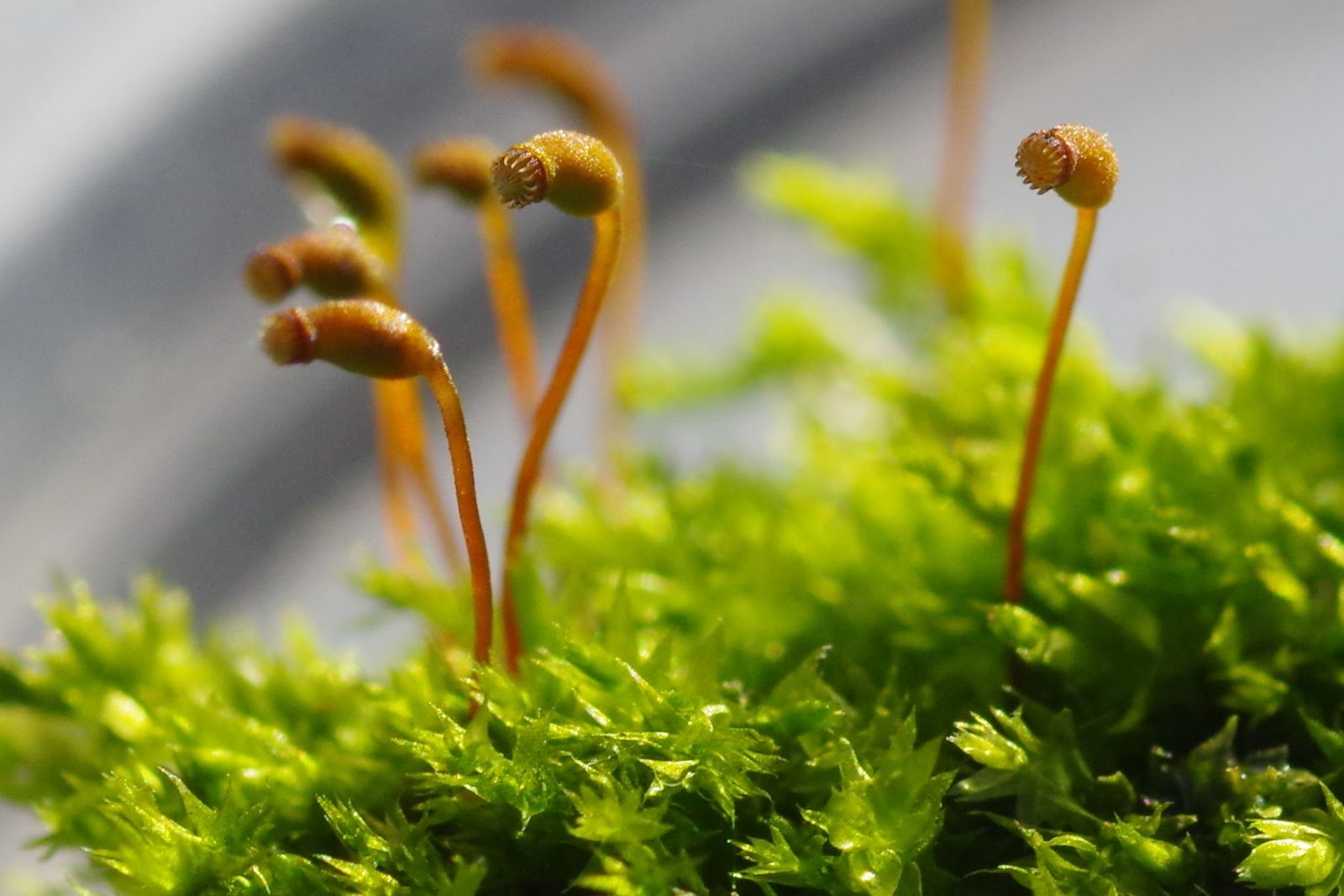
Lime Trees Avenue provide a habitat for all sorts of plants and creatures. Lately, I have been taking more of an interest in mosses. Identifying them is tricky but it is interesting to look at them under a magnifying glass - the one photographed was on the bottom of one of the tree trunks and looks like a group of minature cobras!

Saturday, 7 January 2017

New Year Plant Hunt 2017 - Uckfield

For a number of years, the Botanical Society of the British and Ireland have been running a New Year Plant Hunt. I've taken part in 2015, 2016 and again this year.  I didn't expect much because we have had some proper winter weather in the run up to the plant hunt.  Some of our own garden regulars such as Gorse and Lesser Celandine were not showing any signs of flower.

This year, I started the hunt from the new seat in front of the shops in Browns Lane, which was installed by the Manor Park and Hempstead Fields Residents Association.

Start - Outside Browns Lane shops at 9:30, 2nd January.
If you wish to go straight to a full list of my New Year's flowers, scroll to the bottom of the page.  This year my list comprised 23 flowering plants, compared to 34 last year. I had a sense this year of normal service being resumed after last year's bumper list.  This time there were no proper spring flowers such as Wild Primroses or Cowslips and few summer stragglers.

As usual, I started by walking through twittens on Manor Park. I didn't find as many wild flowers as usual. Maybe this was because 2016's odd weather encouraged thick grass growth. This had two effects: First, the grass competed out the wild flowers that usually grow along the edges of paths, and second, people had cleared away the vegetation, which had become a nuisance. I did find the ever-reliable Groundsel and Petty Spurge. Groundsel was the 2nd most frequently recorded flower on the plant hunt's lists.

Groundsel - 2nd most recorded flower
I moved on to the sunny corner where Southview Drive meets Beeches Close and found Ivy still in flower as well as some Yarrow.

Ivy flowers
At the top of the town, I managed to find a little Wall Bellflower in bloom but nothing like the numbers of flowers I had seen in previous years. The church walls also yielded very little - just some clumps of Common Field Speedwell, with tiny blue flowers. However, I had better luck in the car park, with a neat clump of Sweet Violets.

Sweet Violets
I didn't find anything in Belmont Lane. In a change from last year's route, I walked along the path that runs parallel to the bypass. Although I didn't see any flowers I was delighted to spot a Tree Creeper in a splendid old oak. Once I had reached the Meads Doctors' Surgery, I crossed the road to the Bellbrook Industrial Estate. This is new to my route and yielded some wild flowers that I had never recorded before.  One was Annual Mercury.

Annual Mercury
Another, the Guernsey Fleabane, is one that I had seen in various places but had never previously got round to identifying.

Guernsey Fleabane
After exploring the industrial estate (and surprising three Pheasants) I hurried to the warmth of the Station Pub.  After a break and glass of wine, I hurried back home to catch a few final stragglers before I ran out of time.  These included a Daisy, just across the road from where I live and a bedraggled Dog Violet in my own garden.


Daisy - On more lists than any other flower.

The Science Bit

Location: Uckfield, East Sussex.  Start point: TQ478219

What was missing?

Flowers that I had seen in both 2015 and 2016 but were missing this year were:
  • Wild Primroses
  • Cowslips
  • Yellow Corydalis (on the church walls)
  • White Deadnettle
  • Black Medick.

21 Wild Plants Flowering on 2nd January 2017

Achillea millefolium Yarrow
Bellis perennis Daisy
Capsella bursa-pastoris Shepherd's Purse
Cardamine hirsuta Hairy Bittercress
Centranthus ruber  Red Valerian
Conyza sumatrensis Guernsey fleabane New in 2017
Corylus avellana Hazel
Euphorbia peplus Petty Spurge
Hedera helix  Ivy
Lamium purpureum Red Dead-nettle
Mercurialis annua      Annual Mercury New in 2017
Poa annua  Annual Meadow Grass
Senecio vulgaris  Groundsel
Sonchus oleraceus Smooth Sow-thistle
Stellaria media Common Chickweed
Taraxacum officinale Dandelion
Ulex europaeus Gorse
Urtica dioica Common nettle New in 2017
Veronica persica Common Field Speedwell New in 2017
Viola odorata Sweet Violet
Viola riviniana Dog Violet

2 Naturalised Plants Flowering on 2nd January 2017

Bergenia cordifolia  Elephants ears New in 2017
Campanula portenschlagiana  Wall Bellflower


Saturday, 6 April 2013

Spring - rebooting?

In my post I wrote on the 10th of March, I said:

Give or take some forecasted snow and sub-zero temperatures, spring seems to have become an unstoppable force in the Uckfield area. The number of flowers blooming in the garden has increased from a few shy snowdrops to a cascade of daffodils, primroses, hellebores and so many more.

The frogs had spawned and leaf buds were fattening. Then we had the blackthorn winter and everything stopped or went into reverse.

Nearly a month on spring seems to be trying to reboot. This morning there is white frost on the grass but the sun is out. The yellow forsythia buds beginning show colour. Usually this shrub would be in full bloom at the end of February or beginning of March. Round Manor Park I've seen several clumps of sweet violet flowers, their intense purple flowers singing out against the still drab looking grass.

Sweet Violets


Best of all, yesterday afternoon I saw a blue tit inspecting the box. I was a little anxious to see one by itself. Had it's mate died in the cold? But soon enough it was back, with a friend.

The annual cycle seems to be picking up all round. Yesterday, at Uckfield's farmers market I bought some snowdrops "in the green".  This is the best way to plant them, when they have just finished flowering and before they have shrunk back into their bulbs. If you have big clumps already, you can dig some up and move them. Suddenly, I'm feeling enthusiastic about being outside again and looking forward to planting my little treasures.

So, how about you? Have you got any favourite signs of spring?