Showing posts with label red campion. Show all posts

Sunday, 17 May 2020

BSBI Garden Wildflower Hunt - 3rd Survey

Another 3 weeks has passed since I did the second BSBI Garden Wildflower Hunt. Although the weather continues dry and warm, the pace seems to have slowed down a little.

Foxgloves (Digitalis purpurea)
We are getting to some of the bigger, showier flowers such as Foxgloves (Digitalis purpurea). I think that these were introduced.

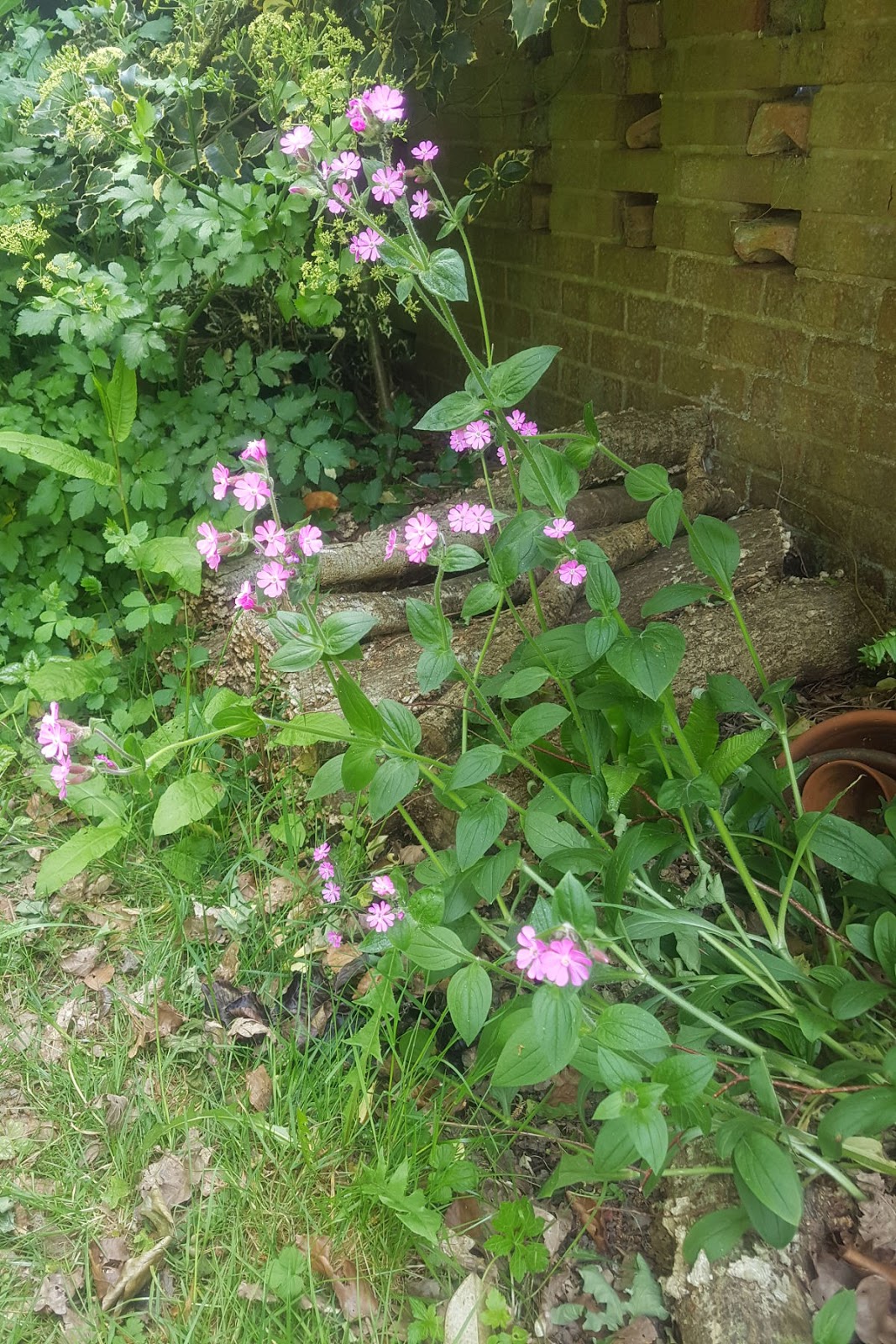
Red Campion (Silene dioica)
When my parents first arrived, there was a Red Campion (Silene dioica) already growing in the garden. Various creatures ate it and the Fallow Deer that used to visit the garden were the final straw and it expired. On an impulse, I planted replacement ones, along with some Ragged Robin (Lychnis flos-cuculi) last year.

Procumbent Yellow Sorrel (Oxalis corniculata)
There are still plenty of weeds popping up. The Procumbent Yellow Sorrel (Oxalis corniculata). This was actually introduced by gardeners by 1656 and has been spreading ever since.

Hairy Sedge (Carex hirta)
More grasses and sedges are beginning to show and become identifiable.  There were plenty that I recognised from previous years such as Barren Brome (Anisantha sterilis), Grey Sedge (Carex divlsa ss divulsa) etc.  However, there was one that was new to me, Hairy Sedge (Carex hirta).

Combining my three counts, I have recorded 77 wildflowers of which:

  • 57 probably occurred naturally in our garden
  • 20 were sown or planted.

Sunday, 22 June 2014

Views (Williams) Wood - Repelling the invasion

A little while ago the Woodland Trust asked for some volunteers to help Sandra, of the TrUck project, to remove some of the Himalayan balsam which, in their words, "is getting a foothold in a couple of places within the wood". A couple of months ago I had noticed small seedlings beginning to grow amongst the bluebells and other wild flowers. Now those 'seedlings' are taller than I am. If left to grow and spread, they would soon overwhelm the other wild flowers and cause other problems as explained in The River Uck - not so pretty in pink.
 
Himalayan Balsam in Views (Williams) Wood.
Unfortunately, I couldn't join the rest of the party so I went and did some by myself. As described in an earlier post, I have done this before and am happy that I can identify the plants properly.  The work itself is reasonably easy, it is just a matter of pulling up these shallow rooted plants and stacking them by the path.  I was there from about quarter past nine and had the wood more-or-less to myself. The only noise was birdsong and church bells, which was lovely.  While I worked in the shade of the trees, I saw many different types of wild flowers including dainty enchanter's nightshade, speedwell and red campion.
 
Red campion.
As I progressed and the heap of discarded Himalayan balsam got higher inquisitive dogs nosed around my work and their owners stopped for a chat. Later joggers and family groups passed by.
 
Heap of Himalayan balsam.
After about two and a half hours I went home, having spent an enjoyable morning getting rid of an alien invader - and don't worry - I'm not greedy, there is more balsam for other people to pull up.
 
 
Himalayan Balsam and honeysuckle.

Sunday, 14 April 2013

Stealing ideas from nature

It's true confession time. When gardening, I steal most of my best ideas from nature. When walking through Views (William) Wood near my Manor Park home I see many pretty sights.  One of my favourites is the mossy old stumps and coppice stools surrounded by dainty wild flowers and ferns.


Wood anemones around the foot of a coppice stool, photographed 14 April 2013
I wanted to make something similar in my garden. Wood anemones, bluebells and wild arum grow naturally there. Maybe the woodland once extended as far as the location of our 1960s home.  


Here's one I made earlier, photographed 14 April 2013
We asked a professional gardener to remove some laurels, giving us a clear space in the shade of our tall birches.  Next, I bought a couple of old coppice stools from Wilderness Wood. My family are always amused by my habit of buying manky old bits of wood but I find they make good garden ornaments without the worry that some light-fingered so-and-so will take a fancy to them.  I got most of the plants by taking pieces of what we already had in the garden. I transplanted seedling wild arums and sprinkled seed from bluebells, cuckoo flower and foxgloves. I supplemented these with ferns, hardy geraniums and a red campion-like plant that I bought from local nurseries and open gardens. I don't stick rigidly to native plants. Sometimes I choose garden species that are similar to local wild flowers. I find that these cope just as well with local conditions, including greedy deer, and extend the options available to me.

The final step was to wait. It will be a year or two before the bluebells are flowering properly but the other flowers and leaves are giving plenty of interest. So that is how I designed my little woodland garden.