Showing posts with label wood anemones. Show all posts

Saturday, 11 April 2020

BSBI Garden Wildflower Hunt

It is just a few short weeks since my last post. When we were trimming the old trees in Lime Tree Avenue, the COVID19 crisis was casting shadows across the spring. Over the last few weeks, the situation escalated. I'm very lucky that I can work at home. Even so, I am very scared of bringing the virus home with the shopping and worn out with juggling work, learning how to be effective as part of a scattered team and getting the essentials into the house. On the other hand, I have been heartened by the community response and that of our incredible "key workers" from too many roles to mention.

Setting up for the hunt
The Botanical Society of Britain and Ireland has responded to the situation by launching the #GardenWildFlowerHunt - so on Good Friday, I searched our garden for both the classic spring wild flowers and the weeds that I keep meaning to pull up. It was lovely to switch off the anxiety and focus on finding and identifying wildflowers.

Good Friday Grass (Luzula campestris)
I started by looking at the rather mossy patch of grass at the front of the house.  I found Dandelions and Catsear, as well as Field Wood Rush (Luzula campestris), otherwise known as Good Friday Grass.

Silver Birch ((Betula pendula)
I suffer from hayfever and so can't help noticing that the Silver Birch trees (Betula pendula) are flowering and shedding golden pollen.

Wood Anemones (Anemone nemorosa)
At the Birch's feet, there are lovely dainty Wood Anemones (Anemone nemorosa). Most of them are pure white but there was just one plant with pink backs to its petals and a very delicate pink flush on its face.

Primroses (Primula vulgarisand Dog Violets (Viola riviniana)
Primroses (Primula vulgaris) occur naturally in our garden but I have added to them to get a decent "ribbon" flowing down the slope. The photo shows them mixed up with naturally occurring Dog Violets (Viola riviniana).

Cowslips (Primula veris)
Over the years, we have introduced some of the showier wild flowers. Mum scattered cowslip (Primula veris) seeds about 30 years ago and they have been romping round the garden ever since. The BSBI form allows introduced wildflowers to be marked as such.

Honesty (Lunaria annua)
Last year I made a contribution of my own by scattering Honesty (Lunaria annua) near Dad's old leaf bin.

Thyme-leaved Speedwell (Veronica serpyllifolia)
I found various "weeds" too such as the Thyme-leaved Speedwell (Veronica serpyllifolia) pictured, dandelions and many more.

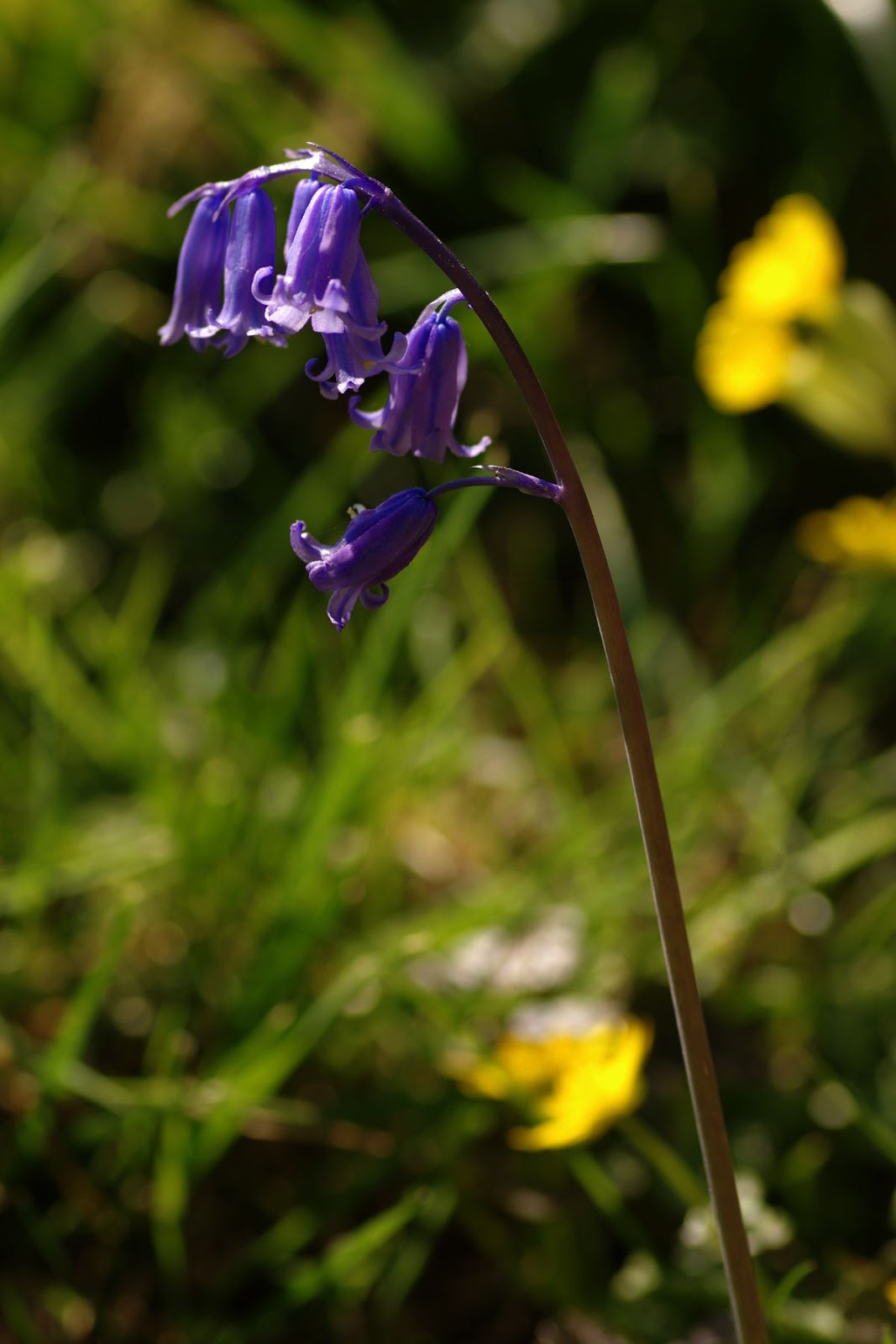
English Bluebell (Hyacinthoides non-scripta)
Even though we are less than two weeks into April, the Bluebells (Hyacinthoides non-scripta) are already beginning to flower.  I have to check carefully for hybrids with the Spanish bluebell but I think that I have eliminated the few interlopers.

In total, I found 48 species of wildflower of which:

  • 38 almost certainly got to our garden under their own steam
  • 10 were sown or planted.


Thursday, 18 September 2014

Taming the wild patch


Most gardeners pull out weeds and plant cultivated varieties.  Lately, I’ve been doing exactly the opposite.

We started the wild patch some years ago by sprinkling some wild flower seeds.  The initial results were a bit disappointing because the seedlings were massacred by slugs. However the survivors did well and gave a pleasing display. Since then, the patch has been overtaken by ground cover garden plants and it is long overdue for a clear out.  The photo below was carefully composed to hide the unwanted plants.

Wild patch with teasels, purple toadflax, red valerian, hypericum and many others.
I had been at a loss as to what to do next. After the slow start we had previously, I didn't want to use mixed seeds again. Then I read Alys Fowlers article on stitchwort. The article lead me to the British Wild Flower Plants website where it is possible to buy wild flowers as seeds, plugs or half-litre pots. There were so many lovely wild flowers to choose from I didn’t know where to start.

Newly planted lady's bedstraw.
I have bought my flowers now and have found the British Wild Flower Plants people absolutely lovely to deal with. When I asked about a species that was not on their list, they said they still had a few of those and added it to the list especially for me. We were able to sort out a date when I knew someone would be in to receive my precious plants and the Interlink Express delivered them without any problems or drama.

However, before I could get my wild flowers, I had to have a clear out. I removed all those unwanted plants. While the geraniums are prolific, the euphorbias were the real problem. Their roots run deep, break easily and regrow as soon as you blink. I also removed as much cinquefoil as possible.  Although it is a wildflower, it is a real thug and I wanted to minimize the amount around my new plants.

As I worked through the patch, I was delighted to find just how much the surviving wild flowers had spread. I found myself carefully working round common yellow and purple toadflax, primroses, teasels, hypericum and the tubers of wood anemones. I also got tough with some of the more vigorous wildflowers such as marjoram and bloody cranesbill.  I’ve reduced the amount by about half to give everything else room to grow. All this has taken about half a day each weekend for the last half-dozen weeks.

Meanwhile, I have been deciding which plants to buy. I want to be sure that they have a reasonably good chance of growing well in our garden and so have been looking out for plants that thrive near where we live. 

Newly planted fox-and-cubs (diagonal line from bottom-left to top-right) and scabious, right.
My first “must have” was fox-and cubs, which is an orange flowered member of the dandelion family.  It brightens up many lawns and twittens in the area.  I added field scabious to my list after seeing it growing happily on the bypass.

Peacock butterfly on fleabane, in Ashdown Forest.
I first became aware of fleabane in the car park for Old Lodge nature reserve in Ashdown Forest – a pool of glorious yellow flowers covered in butterflies and hoverflies. Having seen it in Hempstead Lane near the horse rescue, it went on my list. My last purchase for this part of the garden was lady’s bedstraw. I can’t remember where I saw this but I have hopes of it being a good ‘doer’.

I have also sprinkled various seeds including a brightly coloured thistle and some corncockles that, a few generations of plants ago, were given to us by a neighbour.

I’ve deliberately left the edges messy, retaining some of the ground cover plants in those areas.  Partly it’s because, in proportion, they are attractive and partly to give the tiny creatures that live in the patch somewhere to hide and overwinter. Now, all I have to do is wait until the show really starts next summer.

Sunday, 30 March 2014

Celandines and peacocks

I look on the sea of golden stars that covers parts of our garden with mixed feelings. The stars are lesser celandine (Ranunculus ficaria), a plant that is a beautiful thug.
 
Beautiful but smothering blanket of celandine.

The flowers are very attractive to early butterflies. Yesterday I saw two peacock butterflies feasting on the little yellow stars.

Peacock butterfly on a rather limp daffodil.
The problem with wild celandine is that it spreads like crazy and smothers other small plants such as wood anemone that emerge at the same time of year. The RHS page on Celandine suggests some methods of control. We hand weed them in selected areas but you have to be very careful to remove the bunches of tubers intact. Otherwise you are just spreading them around. Another trick is to make sure that they are sharing space with bigger plants such as hellebores that can stand up for themselves.

There are some cultivated varieties that are a bit better behaved. We have some of the bronze leaved Brazen Hussy. This variety has bronzed, almost black leaves. Although it doesn't spread anywhere near as quickly as its green cousin, you still need to keep an eye on it. The butterflies seem to like it well enough.

Brazen hussy.

There are other varieties too. We quite often find doubles that have spontaneously developed from the singles in our grass. Celandine is a pretty but troublesome plant. Don't let the wild one into your garden if you can possibly avoid it but if you are stuck with it, enjoy the show.

Monday, 6 May 2013

Views Wood - spring on fast forward

We took advantage of the lovely spring weather and the May Day bank holiday to walk though the Woodland Trust's Views (Williams) Wood today. The much delayed spring is now on fast forward. 


Wood anemones and bluebells in Views Wood

Because of the cool spring, the last of the wood anemones have hung and are now combining beautifully with the first of the bluebells.  Other flowers such as yellow archangel and cuckoo flower are appearing too.

The lovely carpet of wild flowers was animated by little birds - wrens, robins and blue tits - flitting around as they collect food for hungry nestlings.  Amongst the gentle spring colours, there's the dazzling flash of an orange tip butterfly's wings.


King cups in a soggy dip
One of the hidden treasures of the wood is the gold of king cups that gleams from the bottom of a soggy dip. They are surrounded by banks of bluebells.  

When we reached Buxted Park, this sunny bank holiday had one more treat for us. The sound of cuckoos, who must have recently arrived from Africa.

Sunday, 14 April 2013

Stealing ideas from nature

It's true confession time. When gardening, I steal most of my best ideas from nature. When walking through Views (William) Wood near my Manor Park home I see many pretty sights.  One of my favourites is the mossy old stumps and coppice stools surrounded by dainty wild flowers and ferns.


Wood anemones around the foot of a coppice stool, photographed 14 April 2013
I wanted to make something similar in my garden. Wood anemones, bluebells and wild arum grow naturally there. Maybe the woodland once extended as far as the location of our 1960s home.  


Here's one I made earlier, photographed 14 April 2013
We asked a professional gardener to remove some laurels, giving us a clear space in the shade of our tall birches.  Next, I bought a couple of old coppice stools from Wilderness Wood. My family are always amused by my habit of buying manky old bits of wood but I find they make good garden ornaments without the worry that some light-fingered so-and-so will take a fancy to them.  I got most of the plants by taking pieces of what we already had in the garden. I transplanted seedling wild arums and sprinkled seed from bluebells, cuckoo flower and foxgloves. I supplemented these with ferns, hardy geraniums and a red campion-like plant that I bought from local nurseries and open gardens. I don't stick rigidly to native plants. Sometimes I choose garden species that are similar to local wild flowers. I find that these cope just as well with local conditions, including greedy deer, and extend the options available to me.

The final step was to wait. It will be a year or two before the bluebells are flowering properly but the other flowers and leaves are giving plenty of interest. So that is how I designed my little woodland garden.