I was in two minds about doing the BSBI's New Year Plant Hunt this year. Covid-19 levels are running high and there is a new, more infectious strain around. I wondered if I could do the hunt without taking unnecessary risks, or even if it was allowed by the Tier 4 rules. In the end, I did it as early as possible on New Year's Day and ran round much of my route so it definitely countered as exercise as well as getting me home before numbers of people started getting out and about.
 |
I did this year's New Year Plant Hunt at a trot!
|
The numbers of wild and naturalised flowers that I have found over the last few years are:
2015 - 21 species of which 2 were naturalised garden plants that had 'jumped the fence'
2016 - 34 species of which 4 were naturalised
2017 - 23 species of which 2 were naturalised
2018 - 28 species of which 3 were naturalised
2019 - 45 species of which 4 were naturalised
2020 - 36 species of which 4 were naturalised
2021 - 46 species of which 6 were naturalised - this hunt got a mention in the BSBI Summary of Day 1.
The first plant I encountered was Shepherd's Purse (Capsella bursa-pastoris) as I ran along Browns Lane. Pausing to post some letters, I saw some Red Dead Nettle (Lamium purpureum) near the bottom of the post box. As I trotted though the Manor Park twittens, I saw all the usual weeds including Groundsel (Senecio vulgaris), Bristly Ox-Tongue (Picris echioides) etc. Then through Lime Tree Avenue, where I found some Cow Parsley (Cow Parsley) in bloom.
 |
| Tall Ramping Fumitory (Tall Ramping Fumitory) |
I visited the grassy bank at the top of the town and found the Tall Ramping Fumitory (Fumaria bastardii) that was there last year.
 |
| Yellow Corydalis at the top of the town (Corydalis lutea) |
As usual, the lovely old walls at the top of the town are studded with the gold flowers of Yellow Corydalis (Corydalis lutea).
 |
| Smooth Sow Thistle (Sonchus oleraceus) |
I slowed down to go through the grounds of Holy Cross and found a patch, sheltered by one of the Yew Trees, that was still full of Cat's-Ear (Hypochaeris radicata), which in my mind is a real summer flower. There was also Smooth Sow Thistle (Sonchus oleraceus) and Annual Meadow Grass (Annual Meadow Grass).
 |
| Bush Vetch (Bush Vetch) in Belmont Lane |
One of my favourite finds was the Bush Vetch (Bush Vetch) in Belmont Lane. This partly sunken lane, with hedges each side and an Oast House at the end seems like a remnant of old Sussex tucked behind our usually bustling high street.
 |
| Ox-eye daisy (Leucanthemum vulgare) on the bypass |
Beyond the Oast House the illusion is swiftly shattered by the presence of the modern bypass with a petrol station and industrial estate on the other side. However year-after-year the patch near the fire station is the gift that keeps on giving. 2021 was no exception with Hawthorn (
Crataegus monogyna) in blossom in the allotment hedge, an optimistic Ox-eye daisy (
Leucanthemum vulgare) at the curb and lengthening Hazel (
Corylus avellana) catkins nearby. There were even some battered Bramble (
Rubus fruticosus) blossoms.
 |
| Yarrow (Achillea millefolium) near Greens DIY. |
After some worrying Government announcements about the second Covid vaccination, I looked at the Meads Medical Centre to see if there were any notices. There weren't, so I crossed the road to the Bellbrook Business Park where I found a number of Yarrow (Achillea millefolium) near Greens DIY.
 |
| White Ramping Fumitory |
I looked over a low wall and found another fumitory. At first, I thought it was the same species that I found at the top of the town but something about the flowers made me take another look. An indignant wren shot out. The fumitory flowers were subtly different to the one at the top of the town. They were more densely packed and were a clear white and crimson rather than washed out pinks. I took a sample for closer inspection when I got home. It turned out to be White Ramping Fumitory (Fumaria capreolata).
 |
| Canadian Fleabane (Erigeron canadensis) |
Across the road there was Canadian Fleabane (Erigeron canadensis), its tiny - usually nondescript - flowers glowing in the low, slanting sun.
 |
| A cheeky Common Chickweed (Stellaria media) in artificial turf. |
Running through the industrial estate, I was amused to see a cheeky Common Chickweed (Stellaria media) growing in artificial turf. Nature always finds a way.
 |
| Hawkweed (Hieracium agg) |
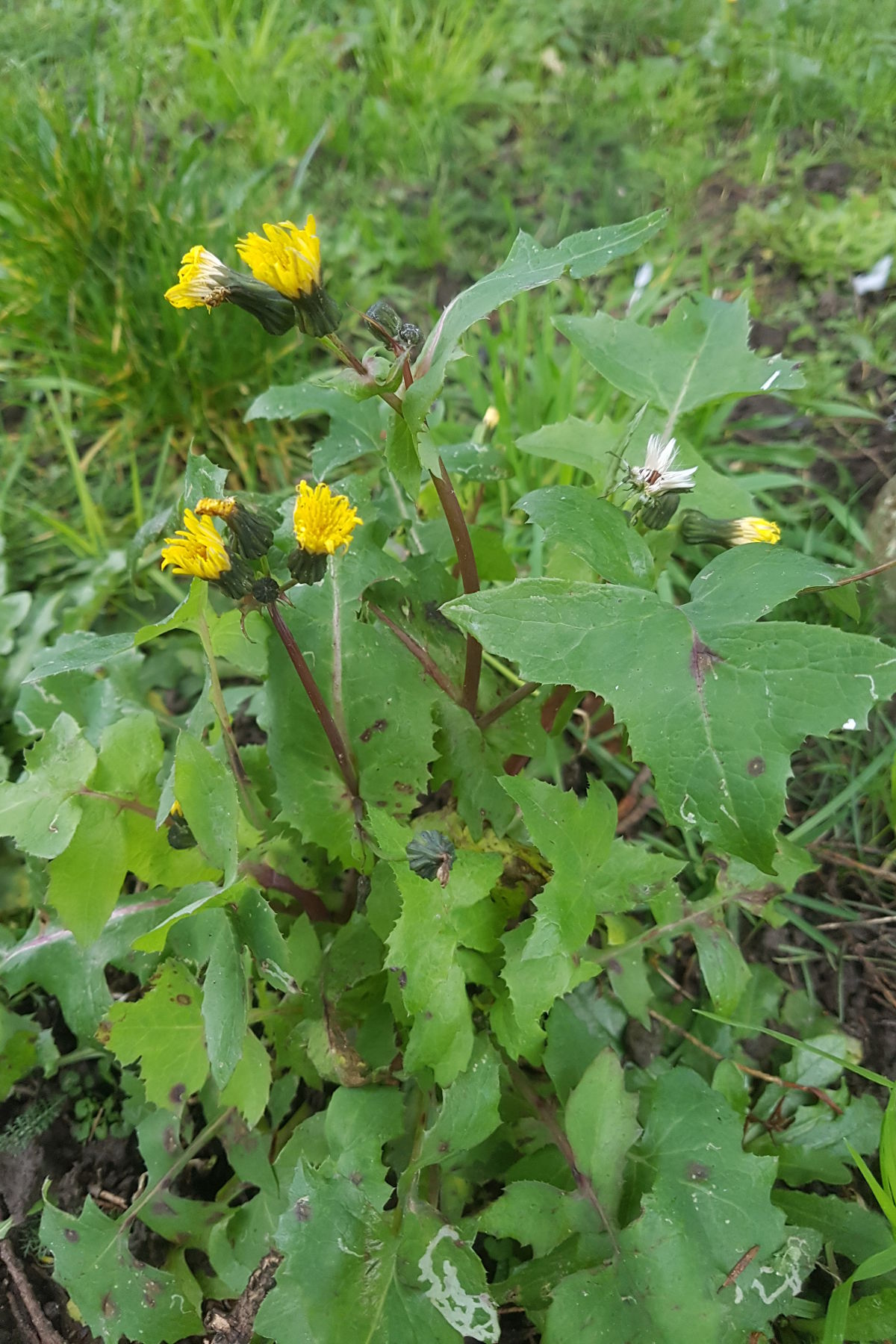
Going past the Uckfield Motor Services, I noticed flowers like little suns peeping over the wall. It was obviously a member of the dandelion family but the spear-shaped leaves running up the stems had me foxed. My books tell me it is a Hawkweed (Hieracium agg).
 |
| Winter Heliotrope (Petasites fragrans), South of the Ringles. |
There were more people moving around and I was beginning to get uneasy so I trotted up the High Street as fast as my little legs would carry me, pausing only to note a Knotgrass (Polygonum aviculare) near the cinema. I also found a stray Fennel near the top of Browns Lane. I went as far as the Winter Heliotrope (Petasites fragrans) just South of the Ringles Cross pub.
 |
| Garlic Mustard (Alliaria petiolata) |
After running and botanising for about 2 hours, I looked round the garden at home and was rewarded with the sight of the most miserable Garlic Mustard (
Alliaria petiolata) that I have ever seen. However it still had one tiny flower open, so I added it to my list.
 |
| Ivy-leaved Toadflax (Cymbalaria Muralis). |
My last find was the Ivy-leaved Toadflax (Cymbalaria Muralis) scrambling round the feed of our shed.
The science bit
Location: Uckfield (North), East Sussex. Start point: TQ478219
Total number of wild and naturalised plants in flower = 46
40 Wild Plants flowering on 1 January 2021
6 Naturalised Plants flowering on 1 January 2021