Sunday, 28 June 2020

BSBI Garden Wildflower Hunt - 5th Survey

Another 3 weeks - and a vist by the man with the lawn mower (sorry) - have sped by and it is time for another survey.

Selfheal (Prunella vulgaris) making itself at home in the border.
Last time it was all about grasses and the pea flowers such as Birds-Foot Trefoil and White Clover. As June progressed, the sprinkling of White Clover has been joined by the rich purple of Selfheal (Prunella vulgaris), which has also spread into the borders.

Broad-leaved willowherb (Epilobium montanum)
Willowherbs started appearing a few weeks ago. Last time, I was able to identify one and now Hoary Willowherb (Epilobium parviflorum) and Broad-leaved willowherb (Epilobium montanum) are mature enough to identify.  Their more glamorous relation, Large-Flowered Evening Primrose (Oenothera glazioviana) has self-sown near our front hedge.

Crested Dog's Tail (Cynosurus cristatus) 
Much to my surprise, I found a Crested Dog's Tail (Cynosurus cristatus) grass in a rough area not far from the compost heap.  I can only suppose it is because our first visit from the gardener was much later than usual due to the lockdown.

Canary Grass (Phalaris canariensis)
I also found Canary Grass (Phalaris canariensis), which may have been from bird seed spillage.

The remaining new entries include Vervain (Valerian officinalis), which first arrived some years ago and has popped up randomly ever since. We introduced Reflexed Stonecrop (Sedum rupestre) and Common Meadow Rue (Thalictrum flavum) ourselves.

Two of my favourite deliberate introductions have started flowering and attracting pollinators.

Wild Carrot (Daucus carota sspn carota)
Field Scabious (Knautia arvensis)
I sprinkled Wild Carrot (Daucus carota sspn carota) seed that I collected in Leatherhead and the Field Scabious (Knautia arvensis) I bought in as tiny plug plants some years ago.


Combining my five counts, I have recorded 103 wildflowers of which:

  • 75 probably occurred naturally in our garden
  • 28 were sown or planted.


Saturday, 6 June 2020

BSBI Garden Wildflower Hunt - 4th Survey

It's just eight weeks since I did the first Botanical Society of Britain and Ireland #GardenWildFlowerHunt.  In that time, we have gone from Wood Anemones (Wood anemone) and the first skinny little bluebells (Hyacinthoides non-scripta) to swishing grasses and pea flowers of all sorts.

Swishing grasses on the North slope.
Many of the long grasses on the North-facing slope can now be identified. The Sweet Vernal Grass (Anthoxanthum odoratum) that I saw flowering on the second survey (25th April) has been joined by Cocksfoot (Dactylis glomerata), Tufted Hair Grass (Deschampsia cespitosa), Red Fescue (Festuca rubra agg.), Yorkshire Fog (Holcus lanatus) and Smooth Meadow Grass (Poa pratensis).

White Clover (Trifolium repens)
In the back lawn, the creeping buttercups have been joined by white clovers (Trifolium repens) and the hum of bumblebees feeding on them.

Common Bird's-foot Trefoil (Lotus corniculatus).
Yellow pea flowers of all sorts have been appearing such as tiny Black Medick (Prunus spinosa) and the much showier Common Bird's-foot Trefoil (Lotus corniculatus) and Meadow Vetchling (Lathyrus pratensis).

Heath Speedwell (Veronica officinalis)
The early speedwells have given way to the the delicate, lilac Heath Speedwell (Veronica officinalis).

Corncockle (Agrostemma githago) flowers towering over modern wheat.
The flowers and grasses mentioned so far arrived under their own steam. I planted Corncockle (Agrostemma githago) seeds, given to us by a neighbour some years ago. Every year, I shake the big, heavy seeds into the garden and they have kept going ever since. This year, I added some wheat to make more of a cornfield environment for them and was amused when I realised that modern wheat was much shorter than the old varieties and so, the Corncockles just towered above them.

Combining my four counts, I have recorded 93 wildflowers of which:

  • 69 probably occurred naturally in our garden
  • 24 were sown or planted.

Sunday, 17 May 2020

BSBI Garden Wildflower Hunt - 3rd Survey

Another 3 weeks has passed since I did the second BSBI Garden Wildflower Hunt. Although the weather continues dry and warm, the pace seems to have slowed down a little.

Foxgloves (Digitalis purpurea)
We are getting to some of the bigger, showier flowers such as Foxgloves (Digitalis purpurea). I think that these were introduced.

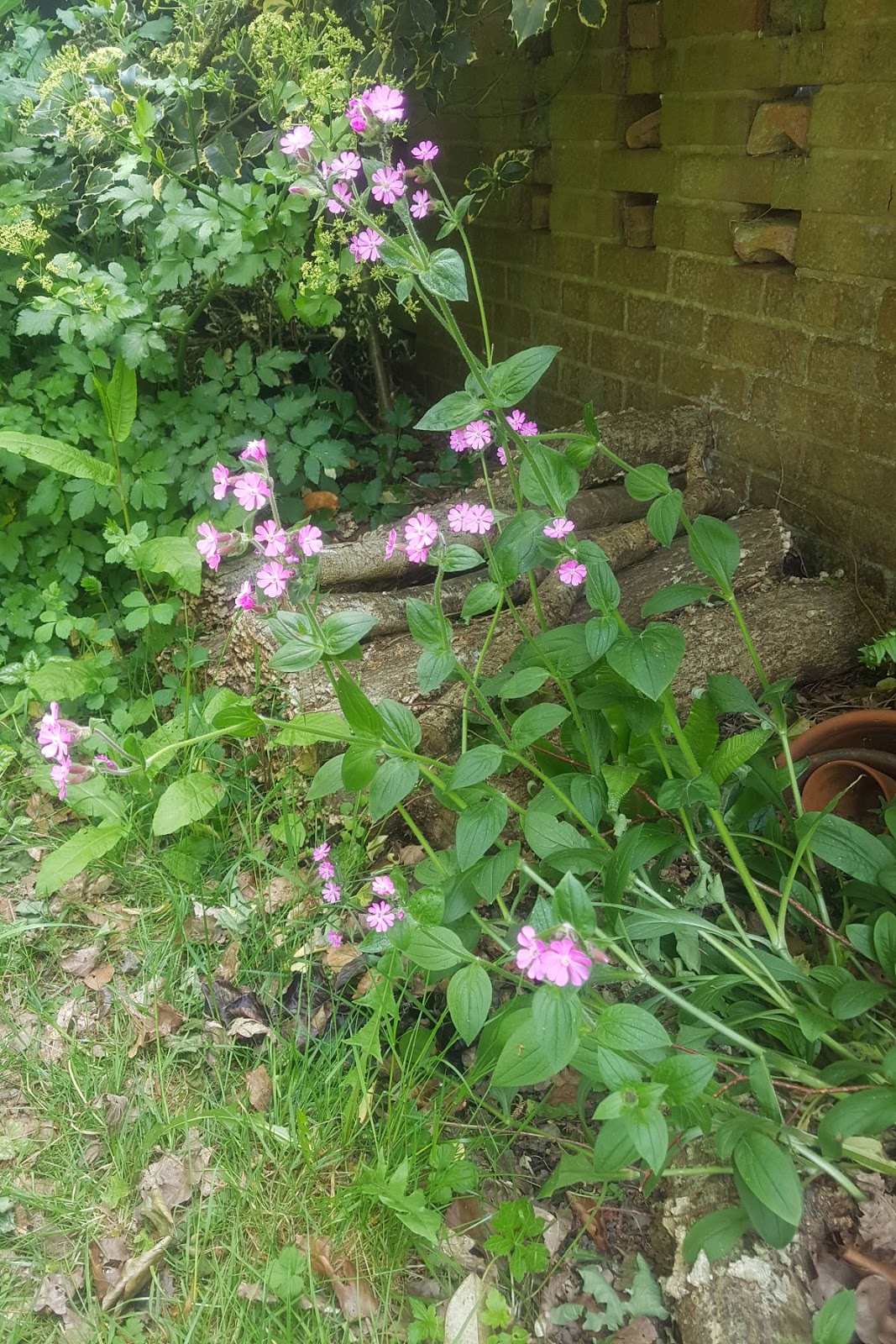
Red Campion (Silene dioica)
When my parents first arrived, there was a Red Campion (Silene dioica) already growing in the garden. Various creatures ate it and the Fallow Deer that used to visit the garden were the final straw and it expired. On an impulse, I planted replacement ones, along with some Ragged Robin (Lychnis flos-cuculi) last year.

Procumbent Yellow Sorrel (Oxalis corniculata)
There are still plenty of weeds popping up. The Procumbent Yellow Sorrel (Oxalis corniculata). This was actually introduced by gardeners by 1656 and has been spreading ever since.

Hairy Sedge (Carex hirta)
More grasses and sedges are beginning to show and become identifiable.  There were plenty that I recognised from previous years such as Barren Brome (Anisantha sterilis), Grey Sedge (Carex divlsa ss divulsa) etc.  However, there was one that was new to me, Hairy Sedge (Carex hirta).

Combining my three counts, I have recorded 77 wildflowers of which:

  • 57 probably occurred naturally in our garden
  • 20 were sown or planted.

Saturday, 25 April 2020

BSBI Garden Wildflower Hunt - 2nd Survey

It's two weeks since I did the first BSBI Garden Wildflower Hunt. Then I found 48 wild flowers (including trees, grasses and ferns).  Since then, the weather has been fine and dry, causing the Spring to race forward.

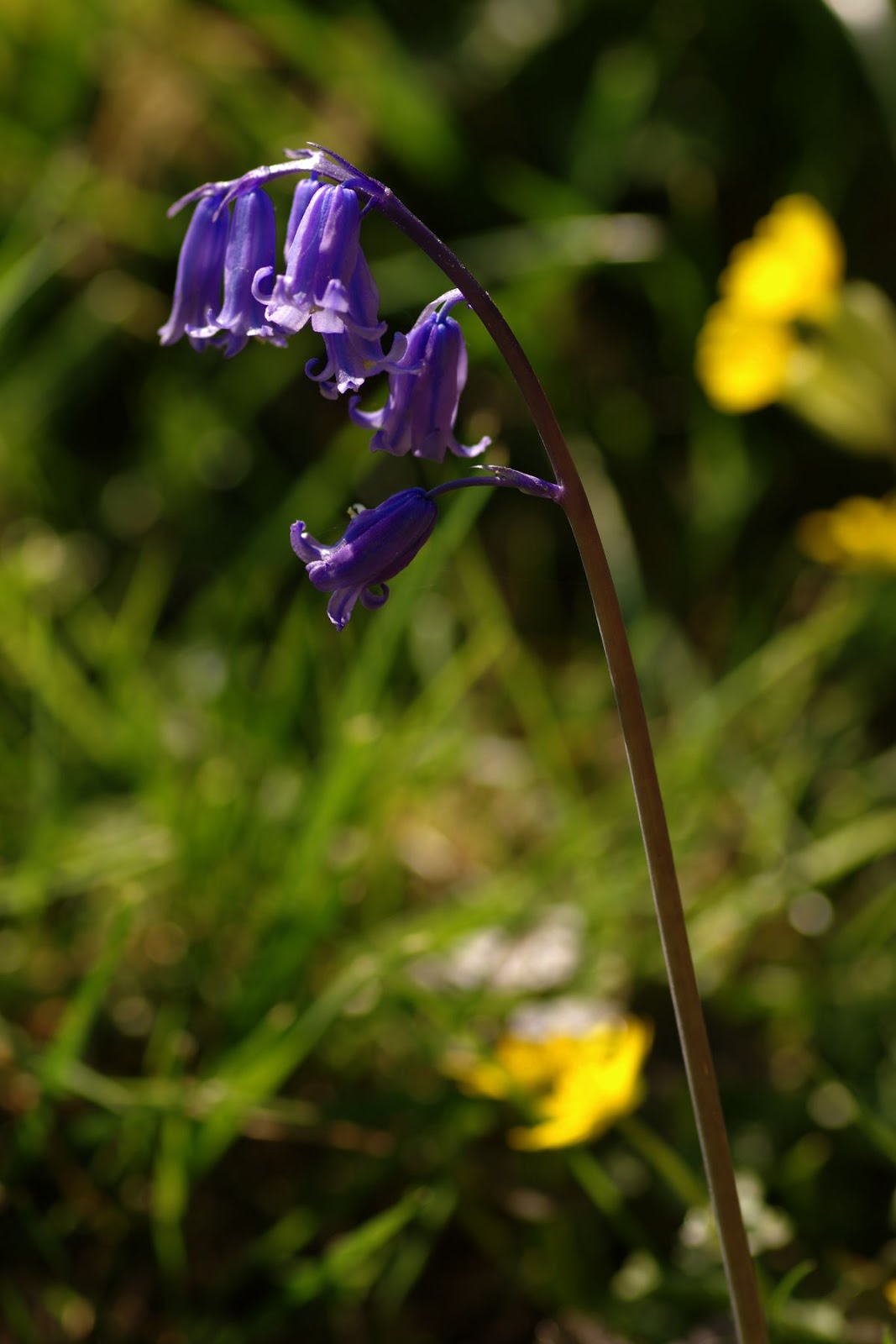
English Bluebell (Hyacinthoides non-scripta)
In my first survey, the Bluebells (Hyacinthoides non-scripta) were just beginning to come out. Now they are fully out and some are beginning to fade before we have even reached May.

Bugle (Ajuga repans) and Thyme leaved speedwell (Veronica serpyllifolia)
I haven't been mowing the grass on the slope so the previously inconspicuous wisps of Thyme leaved speedwell (Veronica serpyllifolia) have filled the grass with tiny white flowers.

Hairy-footed flower bee on Bugle (Ajuga repans) 
After some indecision, I decided that our Bugle (Ajuga repans) was a wild plant rather than the darker-leaved garden variety that we introduced. As you can see from the photo is popular with bees.

Cuckoo flowers (Cardamine pratensis)
A number of spring flowers such as Cuckoo flowers (Cardamine pratensis) and Hawthorn (Crataegus monogyna) had gone from tight buds to full flower.

Field Forget-me-not (Myosotis arvensis)
The Field Forget-me-nots (Myosotis arvensis) had progressed even faster, going from insignificant bunches of leaves to full flower in just a fortnight.

Welsh Poppy (Meconopsis cambrica)
Other plants that had made dramatic progress in the two weeks included Welsh Poppies (Meconopsis cambrica), whose ancestors came from seeds given to us by a neighbour.

Grasses and Sedges
I also found a number of grasses including Sweet Vernal Grass (Anthoxanthum odoratum) and Meadow Foxtail (Meadow foxtail).

Combining my two counts, I found 65 wildflowers of which:

  • 50 probably occurred naturally in our garden
  • 15 were sown or planted.

Saturday, 11 April 2020

BSBI Garden Wildflower Hunt

It is just a few short weeks since my last post. When we were trimming the old trees in Lime Tree Avenue, the COVID19 crisis was casting shadows across the spring. Over the last few weeks, the situation escalated. I'm very lucky that I can work at home. Even so, I am very scared of bringing the virus home with the shopping and worn out with juggling work, learning how to be effective as part of a scattered team and getting the essentials into the house. On the other hand, I have been heartened by the community response and that of our incredible "key workers" from too many roles to mention.

Setting up for the hunt
The Botanical Society of Britain and Ireland has responded to the situation by launching the #GardenWildFlowerHunt - so on Good Friday, I searched our garden for both the classic spring wild flowers and the weeds that I keep meaning to pull up. It was lovely to switch off the anxiety and focus on finding and identifying wildflowers.

Good Friday Grass (Luzula campestris)
I started by looking at the rather mossy patch of grass at the front of the house.  I found Dandelions and Catsear, as well as Field Wood Rush (Luzula campestris), otherwise known as Good Friday Grass.

Silver Birch ((Betula pendula)
I suffer from hayfever and so can't help noticing that the Silver Birch trees (Betula pendula) are flowering and shedding golden pollen.

Wood Anemones (Anemone nemorosa)
At the Birch's feet, there are lovely dainty Wood Anemones (Anemone nemorosa). Most of them are pure white but there was just one plant with pink backs to its petals and a very delicate pink flush on its face.

Primroses (Primula vulgaris) and Dog Violets (Viola riviniana)
Primroses (Primula vulgaris) occur naturally in our garden but I have added to them to get a decent "ribbon" flowing down the slope. The photo shows them mixed up with naturally occurring Dog Violets (Viola riviniana).

Cowslips (Primula veris)
Over the years, we have introduced some of the showier wild flowers. Mum scattered cowslip (Primula veris) seeds about 30 years ago and they have been romping round the garden ever since. The BSBI form allows introduced wildflowers to be marked as such.

Honesty (Lunaria annua)
Last year I made a contribution of my own by scattering Honesty (Lunaria annua) near Dad's old leaf bin.

Thyme-leaved Speedwell (Veronica serpyllifolia)
I found various "weeds" too such as the Thyme-leaved Speedwell (Veronica serpyllifolia) pictured, dandelions and many more.

English Bluebell (Hyacinthoides non-scripta)
Even though we are less than two weeks into April, the Bluebells (Hyacinthoides non-scripta) are already beginning to flower.  I have to check carefully for hybrids with the Spanish bluebell but I think that I have eliminated the few interlopers.

In total, I found 48 species of wildflower of which:

  • 38 almost certainly got to our garden under their own steam
  • 10 were sown or planted.


Sunday, 15 March 2020

Lime Tree Avenue - Snails and Song Thrushes

A couple of weeks ago, I was delighted to spot a Song Thrush in Lime Tree Avenue.  It disappeared behind one of the old trees.

One of the old Lime Trees - showing epicormic growths (suckers).
As I watched the thrush disappear, I noticed the epicormic growths around the bottom of the tree.  Over the last couple of weekends the Brighter Uckfield group have been trimming these growths away, as well as removing litter from the avenue.

I always find this a very satisfying and calming job - and with all the worry about the Corvid-19 virus, I've certainly needed to be calmed down. The word "Mindfulness" is very over used but this type of work, where you methodically remove unwanted growths and have to pay attention while doing it forces me to stay in the moment and really notice the sights and sounds of the avenue.

White-lipped Snails
I always find some tiny wildlife while working on the trees. This year, I found about a dozen White-lipped Snails while working on the three trees that I trimmed. I find that, in the garden, these nibble away dying flowers etc. unlike the bigger Common Garden Snail that makes a nice mess of some of my plants. These little snails are just the sort of thing that a hungry thrush eats.

Common Plume moth.
While clipping my way through the ruby-budded growths, I found a little T-shaped moths, a Common Plume. This moth my look delicate but it can be found during all months of the year.

My last tree - before and after.
After I finished my third and final tree, I collected some of the stems that I had pruned off so I could see the fresh, green leaves open over the next few weeks.


Sunday, 8 March 2020

Sussex Botanical Recording Society - ghosts and roses

At this time of year the Sussex Botanical Recording Society (SBRS) holds its AGM at Staplefield.

The Victory Pub, which does very nice lunches.
My first priority when I got to Staplefield,  was lunch.

Dicranoweisia cirrata (Common Pincushion) 
As there was a few minutes before the pub opened, I photographed a moss just outside, in the hope of identifying it later. Two of the more intrepid members of the Society were busy recording the plants on the village green. They joined me and we had a lovely lunch in the pub.

Treasure!
I was helping to arrange chairs in the Village Hall when treasure appeared in the form of books.  I selected a few including Walley Dod's Sussex Flora of 1937 and a big book of mosses. When I looked through Wolley Dod in the evening, the Uckfield I know was suddenly filled with the ghosts of long-gone cornfields, ponds and other places where wild plants once thrived. After the usual formalities, there were interesting and informative presentations.

I hope to go looking for roses this year.
It has been suggested that we look out for roses as many of those listed in Wolley Dod have not been re-found. We don't get that many wild roses round Uckfield and my "new" Wolley Dod doesn't mention Uckfield or the nearby villages much in this section.

Notes from Charlotte Smith talk.

Brad Scott gave a splendid talk about one of Sussex's earliest women botanists, Charlotte Smith, who was a successful writer in the 1700s. Her poetry and books give such vivid descriptions of wild plants and the places where she encountered them that I half expect to catch a glimpse of a bonnet and a long dress, the next time I go botanising.

There will be the usual photo competition:

  • close up
  • wild plant in churchyard habitat

All that remains is for me to dust off my recording sheets and get going again because "I aint afraid of no ghost!"