Showing posts with label SBRS. Show all posts

Wednesday, 28 December 2022

Botanical Survey - Hempstead Lane

 For my 2022 botanical survey, I decided to explore Hempstead Lane, Uckfield. 

  • The lane is about 2km (1 and a quarter miles) runs from the town centre, over the river and flood plain, over the railway, through ancient woodland and between fields over a relatively short distance.
  • It runs through two "tetrads" - i.e. squares on the map:
    • TQ42Q for the first two sections, nearest the town centre
    • TQ42V for the rest.
  • I wanted to get a snapshot of what's in these different habitats and I've been rewarded by finding a wonderful range of plants including some I have never encountered before and a few that don't seem to have been recorded for the relevant tetrad. 
  • I was aware that the part of the lane furthest from the town was old and runs alongside ancient woodland but I've been surprised at how close the ancient woodland species indicators come to the town. There are areas with these plants scattered along this old lane as far as Lime Tree Avenue. 
  • The Flora, referred to below, is the Sussex Botanical Recording Society's The Flora of Sussex.

I divided the lane into a number of sections and recorded what I found in each on iRecord.  A huge thank you to the people who verified my records and to those in the SBRS Facebook group who helped me with identifications.

Section 1 - Near Town Centre

From the start of Hempstead Road to Lime Tree Ave.

Common Millet - 9 Jul 2022

In this section I found 47 species, most of which were opportunistic weeds and plants/grasses on a couple of small verges.  Common Millet (Panicum miliaceum), presumably from a bird feeder, was a new species for my records and, in the Flora, had not been recorded for TQ42Q up to 2015.

Section 2 - School Boundary

From Lime Tree Avenue to the start of the shaded path.

Creeping Yellow Cress - 12 June 2022

In this section I found 73 species. On the school side of the lane, there is a wooded verge with Bluebells (Hyacinthoides non-scripta) and other ancient woodland indicators. On the other side, there are grass verges. A couple of these had "weeds" that I had not noticed before. These included Slender Trefoil (Trifolium micranthum), American Willowherb (Epilobium ciliatum), Nipplewort (Lapsana communis) and Creeping Yellow Cress (Rorippa sylvestris). According to the Flora, the latter had not been found in TQ42V between 2000 and 2015 although it was present previously.

Section 3 - Shaded Path

This part of the lane is not open to motor vehicles and is very shady. 

Wood Anemones - 26 March 2022

I found 34 species, many of which would look at home in an ancient woodland, including a Common Cow-wheat (Melampyrum pratense), Bluebells (Hyacinthoides non-scripta), Ramsons (Allium ursinum) Wood Anemone (Anemone nemorosa), and Hart's-tongue fern (Asplenium scolopendrium)

Section 4 - Between the Estates

Footpath skirting the bottom of a green area and running past the substation to Hempstead Mill.
Turkey Oak - 7 July 2022

I found 43 species - Many typical of hedgerows and I think some of these are old hedges with traditional planting such as Hawthorn (Crataegus monogyna), Blackthorn (Prunus spinosa) and even a Cherry Plum (Prunus cerasifera). The main surprise was a couple of  good-sized Turkey Oaks (Quercus cerris), one each side of the lane, near the new houses. Their history is a mystery to be solved!.

Section 5 - River and Flood Plain

From Hempstead Mill to just before the track separating the enclosed area with a big pond from the open field.

Alder - 27 February 2022

I found 40 species in this section.  The River Uck runs through the Mill's property and is associated with some wetland species such as Alder (Alnus glutinosa). The grassland, newly planted with hedge plants, is not that special but I did find Meadow Barley (Hordeum secalinum), which is a species that I have not noticed before.

Section 6 - Hedgerow

Between the hedges alongside the enclosed area with the big pond and old Horse Rescue buildings.

Upright Hedge Parsley - 31 July 2022

I found 56 species - mostly those associated with hedgerows. These included Upright Hedge Parsley (Torilis japonica), which I was particularly pleased to find because my previous favourite spot for it, right next to the railway, had spoil from railway work dumped on it, eliminating the more delicate wildflowers.

Section 7 - Railway

The trackbed and the little pieces of land immediately outside the level-crossing gates influenced by dumped "spoil" etc.
Tall Melliot - 10 Aug 2022

I found 37 species in this tiny area including some unusual weeds on the railway trackbed.  These included a new find (not in the Flora) for tetrad TQ42V - Tall Melliot (Melilotus altissimus),

Section 8 - Between Fields

From the railway to the beginning of Hempstead Wood.

Giant Horsetail - 2 June 2022
I found 41 species in this shaded and damp area. Oddly, there were more damp-loving species here than near the river. Species that I had not encountered before included Spiked Sedge (Carex spicata), Great Horsetail (Equisetum telmateia) and Square-Stalked Saint John's wort (Hypericum tetrapterum). According to the Flora, the latter has not been found in TQ42V between 2000 and 2015 although it was present previously. 

Section 9 - Alongside Hempstead Wood

Pendulous Sedge - 17 April 2022

I found 38 species along the part of the lane that borders ancient woodland. These included  plenty of ancient woodland indicators - Enchanters Nightshade (Circaea lutetiana), Field Maple, Holly (Ilex aquifolium), Red Currant (Ribes rubrum), Wild Cherry (Prunus avium), Wood Spurge (Euphorbia amygdaloides), Yellow Archangel (Lamiastrum galeobdolon )  and Pendulous Sedge (Carex pendula). The latter dominates the path area and trickles back towards the town.

Section 10 - Holloway

Between the ancient woodland and the end of the lane.

Primroses - 17 April 2022

I found 27 species in this ancient, deep trackway. Some of the species are the same as the ancient woodland with the welcome addition of Primroses (Primula vulgaris) and Broad Buckler ferns (Dryopteris dilatata).


Sunday, 8 March 2020

Sussex Botanical Recording Society - ghosts and roses

At this time of year the Sussex Botanical Recording Society (SBRS) holds its AGM at Staplefield.

The Victory Pub, which does very nice lunches.
My first priority when I got to Staplefield,  was lunch.

Dicranoweisia cirrata (Common Pincushion) 
As there was a few minutes before the pub opened, I photographed a moss just outside, in the hope of identifying it later. Two of the more intrepid members of the Society were busy recording the plants on the village green. They joined me and we had a lovely lunch in the pub.

Treasure!
I was helping to arrange chairs in the Village Hall when treasure appeared in the form of books.  I selected a few including Walley Dod's Sussex Flora of 1937 and a big book of mosses. When I looked through Wolley Dod in the evening, the Uckfield I know was suddenly filled with the ghosts of long-gone cornfields, ponds and other places where wild plants once thrived. After the usual formalities, there were interesting and informative presentations.

I hope to go looking for roses this year.
It has been suggested that we look out for roses as many of those listed in Wolley Dod have not been re-found. We don't get that many wild roses round Uckfield and my "new" Wolley Dod doesn't mention Uckfield or the nearby villages much in this section.

Notes from Charlotte Smith talk.

Brad Scott gave a splendid talk about one of Sussex's earliest women botanists, Charlotte Smith, who was a successful writer in the 1700s. Her poetry and books give such vivid descriptions of wild plants and the places where she encountered them that I half expect to catch a glimpse of a bonnet and a long dress, the next time I go botanising.

There will be the usual photo competition:

  • close up
  • wild plant in churchyard habitat

All that remains is for me to dust off my recording sheets and get going again because "I aint afraid of no ghost!"

Monday, 27 May 2019

Plants of Victoria Pleasure Grounds

Last year I did surveys of four of Uckfield's recreational areas. This year I have decided to investigate Victoria Pleasure Grounds.  I haven't explored these before but they appear large and well managed - balancing the provision of sports pitches with more natural areas. So far I have paid two visits, one at the end of April and the other at the end of May.

Daisies alongside the sports pitch - 26 April 2019
The photo above shows daisies next to a sports pitch in the original Victoria Pleasure Ground. The beacon is used when celebrating or commemorating important events such as the end of the first World War.

Hedge and bank with wild flowers at the bottom of the park - 26  April.
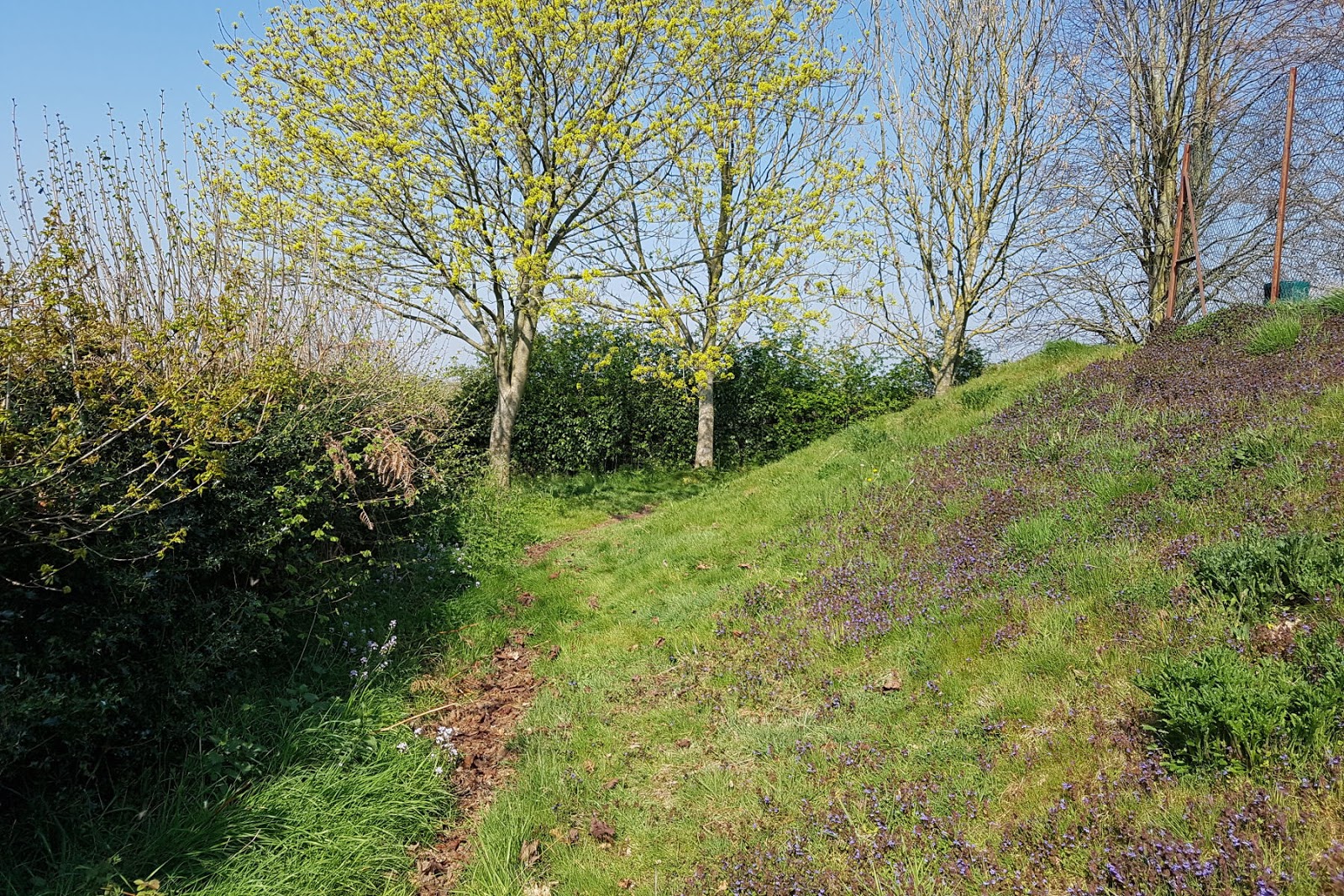
From a nature point of view, one of the most interesting features is the hedge that wraps round the bottom of both the Victoria Pleasure ground and the newer part, with the skateboarding area.  The purple you can see on the photo is Ground Ivy, which was providing a handy meal for all sorts of pollinators.  A month later and the slope is covered with Ox-eye daisies, Birds-foot-trefoil, Greater Stitchwort and many other wild flowers.  Birds were flitting in and out of the hedge, presumably catching insects for their young.

Dog Rose in hedge, 26 May 2019
Moving into May and the Hawthorn and Blackthorn blossoms have faded but the hedge is now decorated with other flowers such as Spindle and Dog Rose.  I was thrilled to find such a variety of plants as this is usually the sign of a really old hedge.

Red Campion, 26 May 2019
Following the hedge round the corner, I found a little wooded area next to the skateboard track. At the end of April, this contained bluebells and primroses. Now it has Cow Parsley and Red Campion.
The park also contains an area of Alders and runs alongside Boothland Wood, which meas that it contains a fair amount of woodland flora.

Buttercups and Yorkshire Fog grass - 26 May 2019.
The grass between the sports and recreation areas has been allowed to grow and there is an interesting variety of grasses and grassland flowers. The photo above shows buttercups growing amongst pinkish Yorkshire Fog grass.

Malachite Beetle on a buttercup - 26 May 2019.
Although I was doing a plant survey, it wasn't just about the flowers. While I was searching for flowers, I would hear a Chiff Chaff and when I was looking at the buttercups I found some beetles.  Unfortunately my photo doesn't quite capture the almost metallic "British Racing Green" of the Malachite beetle.

Tall Ramping Fumitory.
During my April visit I even managed to find a rare (for Sussex) plant. The Tall Ramping Fumitory is a rather weedy-looking thing but it has been recorded in only a few parts of Sussex. Uckfield has now been added to that list.

Wheat field - 26 May 2019.
I managed to get a photo of the crop on the other side of the hedge that I mentioned earlier. There is going to be a great deal of development nearby. However, this field doesn't appear to be included in the plans. I found myself wondering what would happen to it.

Sunday, 10 March 2019

Mosses at Henfield

The Henfield Field Meeting is way out of the Uckfield area but most of what I learnt will apply closer to home.  Brad and others generously shared their knowledge with the rest of the group and these notes cover just a few of the species of moss that we found. Identification is quite tricky but there is much to enjoy in the different shapes and textures of these tiny plants.

After gathering in the car park we crossed the London Road and headed down Cagefoot Lane.

Didymodon Insulanus (Cylindric Beard Moss)
The first stop was by a seat by a mossy area of asphalt. Surprisingly many mosses colonise this type of surface.  The Didymodon Insulanus has:

  • quite long leaves
  • an almost swirling appearance 

Homalothecium sericeum (Silky Wall Feather-moss)
Next stop was an old wall. On the opposite site of the lane was a hedge with light-coloured violets at its feet. I was fascinated by the patterns made by the shapes and patterns made by the Homalothecium sericeum on the richly textured old wall.

Bryum capillare (Capillary Thread-moss)
In complete contrast to the sprawling feather moss was the neat little cushion of Bryum capillare shown above.

Blue Plaque commemorating William Borrer
According to the Sussex Botanical Recorders Society's newletter notes:

William Borrer is one of the most important Sussex botanists, and his vascular plant records and introductions in the Henfield area are well known. Though we have some of his bryophyte records in the county, there are none for Henfield.

Hopefully today's meeting will have fixed that!

The mossy grass by the pond with Borrer's house in the background
In the mossy grass by the pond we found two common lawn mosses:

  • Calliergonella cuspidata (Pointed Spear-moss) - a feathery moss with red "stems" and spear-like ends to its branches
  • Rhytidiadelphus squarrosus (Springy Turf Moss) - it too had red stems, but its leaves were bent back, which to me, made it looked like so many pipe cleaners

Polytrichum juniperinum (Juniper Haircap)
In the grounds of a care home, there were some wonderful old trees with mossy trunks. In the grass, we found patches of Polytrichum juniperinum, whose brown-tipped leaves helped us identify it.

Then we made our way down Blackgate Lane and found a patch of asphalt that was covered in brownish Didymodon nicholsonii (Nicholson’s Beard-moss). The Nicholson of the name was a botanist from Lewes. The leaves are quite stiff and translucent and the ends are shaped like the prow of a ship.

As we made our way down lanes and paths, the buildings of the village gave way to farmland. Surprisingly, we even found mosses in fields that had been used to grow corn on the cob.

Atrichum undulatum (Catherine's Moss)
I was very pleased when I found a moss myself, even if I did totally misidentify it!. The Atrichum undulatum has wavy leaves and, as can be seen from the photo, a distinctive upright fruiting body.

Hazel catkins dancing in the wind.
We lunched in a sheltered corner and I enjoyed chatting to the others and watching the hazel catkins dancing in the wind.  After this, I and one or two others decided to go back while the rest continued with the field meeting.


Saturday, 27 October 2018

SBRS - Autumn Get Together

The Sussex Botanical Recording Society (SBRS) Autumn get together marks the end of my botonising efforts for the year.  There was a series of very interesting talks, a photo competition and much to interest and amuse.

Staplefield Village Hall, 27 October 2018

Bruce Middleton - Heaths of Sussex

Bruce talked about heathland and its species. One interesting section was about improving the habitat for invertebrates by scraping the heather turf off, forcing it to regrow.  This was actually done by golf clubs who were able to re-use the turf to create areas of heathland around their golf courses.

One thing that I had not realised is that healthland needs some disturbance to thrive. During World War II, Heathland was used for exercises, which provided some useful disturbance.

Churchyard Survey

Helen gave us an account of the Churchyard Survey including detail on a particularly good Burgess Hill churchyard.

Notable East Sussex Records 

Matt gave a very interesting talk about native and non-native plants that had been found in Sussex.  Fascinating though the natives are, it was the non-natives that got my attention. Everything from Gaura (Butterfly bush) to Datura (Angel's trumpets)

Field Bindweed

Field Bindweed, Uckfield Rugby Club, 1 July 2018
I'm sure that Mike talked about other things but it was the Field Bindweed that got my attention. Apparently there are 10 subvarieties with varying colours and patterns on the flower. For example some have a yellow middle and others additionally have a red zig-zag line round the centre.  When I surveyed the Uckfield Rugby Club field, I noticed that the Field Bindweeds had different patterns and colours but thought no more of it. .

Find of the year

One of the field trips turned up an unusual discovery. The group found Great Pignut (Bunium bulbocastanum), which has never previously been recorded in Sussex. It has been recorded in the Chilterns and Northern France but never in between.  In its normal habitat, it grows in disturbed places such as verges and as an arable week.

Distinguishing features:
  • Bracts and Bracteoles
  • Fruit has a swollen stylopolium
Arthur's questions

Arthur had made some observations in his own garden including
  • Coral root - the roots actually look like coral
  • Oxalis - leaves turn pink when ants are present (similarly bluebell flowers turn pink)
An unexpected pleasure

St Marks wall paintings.
After the meeting, while I was waiting for the car park to clear, I took a look at the church. St. Marks was built in 1847. The charming wall paintings are by the Victorian stained glass designer Charles Eamer Kempe. 

Saturday, 29 September 2018

Plants of Uckfield's Playing Fields

The Sussex Botanical Recording Society's (SBRS) members hunt for plants throughout Sussex so it can build up a picture of the flora in our county. This information has been published in The Flora of Sussex.

SBRS suggested that it would be a good idea to record the plants growing on neighbourhood greens and pitches because the turf has often been in place for decades or even longer giving time for an interesting community of plants and wildlife to build up. I chose four Uckfield playing/recreation fields and paid each site three visits to catch spring, early summer and late summer flowers.

Uckfield Rugby Club and Field Bindweed - 8 July 2018
The sites I chose were:

  • The Uckfield Rugby Club field - 80 species including trees and grasses
  • Hempstead playing fields - 69 
  • The Dene - 53 
  • Luxford Field - 49 

The Uckfield Rugby Club Field

This is a splendid community facility that is sandwiched between the estate where I live and the River Uck. It also borders onto ancient woodland. Before the playing fields were created, just over 50 years ago, it was a hop field.

The boundary of the rugby field is a man-made woodland edge, which is a very useful habitat for birds and other wildlife. On my April visit, while surveying the un-mown strip at the edge by the ancient woodland, I found bluebells, wood anemones as well as a variety of plants round the other edges. During my 3 visits, I found a total of 80 species.

Annual Beard Grass - 1 July 2018.
One of the most surprising was Annual Beard Grass (Polypogon monspeliensis), which is a pretty little grass with a very fluffy head.  I looked it up in my lovely new Flora of Sussex … and … oh dear.  No sign of it near Uckfield. However, a more experienced member of the society confirmed that I had identified it correctly and so we have a new dot on the map.

Hempstead Playing Fields

This playing field slopes down from Hempstead Lane to some damp ground near the river. Looking at a 1947 aerial photo, I can see a checkerboard pattern that suggests allotments.

Common Fleabane - 25 August 2918.
I found a total of 69 plant species including quite a few damp-loving flowers and trees at the bottom of the field. These included the sweet-smelling Meadowsweet (Filipendula ulmaria) and Common Fleabane (Pulicaria dysenterica).

Bog Stitchwort - 13 July 2018.
While doing these surveys, I have been noticing plants that I must have walked by dozens of times.  One of these was Bog Stitchwort (Stellaria uliginosa). Unfortunately my photo doesn't do justice to its exquisite delicacy.

The Dene

A covenant that protects The Dene dates to the 1930s, which shows that its use for recreation long pre-dates the Manor Park estate that surrounds it.

Cuckoo flower - 5 May 2018.
In my three visits, I found 53 different species of plant. In my opinion, the prettiest botanical feature is the lovely sweep of Cuckoo flowers (Cardamine pratensis) just below the Plane tree on Browns Lane.

Hawthorn - 5 May 2018.
The clumps of shrubs on the Browns Lane edge include garden escapees such as Cotoneaster as well as natives like Hawthorn and Ivy.  These provide a wonderful food source for pollinators and birds. I still remember the flock of colourful Waxwings that fed on the Cotoneaster berries in February 2009.  When I did my 15 minute Big Butterfly Count on The Dene this year, it scored higher than any of the other recreation areas I surveyed with 11 butterflies. The medium-length grass supports Gatekeepers and Meadow Browns whose caterpillars depend on grass. Docks and Sorrels in the grass feed the caterpillars of the Small Copper butterflies that I sometimes see on The Dene.

Luxford Field

To be honest, I didn't expect to find much in Luxford field because, quite rightly, the grass is kept close trimmed to allow for games and events.  However, when I looked at it more closely, I found two stretches of hedge as well as an interesting selection of trees.  These features bumped my total up to 49 species.

Common Mallow - 21 July
The brightest bloom was Common Mallow (Malva sylvestris), which was defying the odds to blossom near a litter bin.

Hoverfly on Shepherd's purse - 21 July 2018.
Tiny flowers, such as the Shepherd's purse (Capsella bursa-pastoris) pictured, at the edge of the grass were providing nectar for even tinier insects.


Saturday, 17 February 2018

Biological Recorders' Seminar 2018 - Sussex Biodiversity

After a stressful week it was good to take a pause in Oathall Community College's kitchen garden and listen to the birds singing and the cows mooing before going into the Adastra wildlife recording seminar.

Inside, there was a sale of "The natural history books of Heather Monie and Bunny Bull." with proceeds going to the Sussex Wildlife Trust. It was very poignant to see the books being sold off but I had a strong sense of lives well lived.

Heather and Bunny's books.

I gathered up a few treasures and moved on to the Sussex Botanical Recording Society's stand where the much anticipated The Flora of Sussex was arriving.  I had a quick chat with society members, one or two of whom kindly said that they liked the sketch-notes about keying plants that I had put on the Facebook page. As there were a lot of boxes of books to shift, I brought a box in from the car and then claimed my own copy.

Once again, the talks that followed were full of fascinating information so here is a quick round up.

Record Centre Update - Clare Blencowe

Clare outlined the many developments this year including how various bodies are working together to try and get the local Wildlife Site system running again. Local Wildlife Sites (previously Sites of Nature Conservation Importance - SNCIs) are non-statutory sites of nature conservation value such as Uckfield's West Park and Snatts Road Cemetery.  There is more information on their new website, which includes a recording events calendar.

The Secret Life of Flies - Erica McAlister

Erica gave a very lively talk on flies and their, quite frankly, disgusting habits.  She will definitely be worth following on Twitter @flygirlNHM.  She mentioned bee flies such as the one photographed in Uckfield's West Park Local Nature Reserve, below.

Dark-edged Bee Fly (Bombylius major) - 25 March 2017
I already knew that they flicked their eggs into bee burrows but had no idea that they wrapped them in gravel to make that possible. Also, I didn't know that the larvae then had two distinct growth phases: in the first they are very active until they find a host; then they slow right down, just feeding on it.

Pan-species Listing the Sussex Wildlife Trust Reserves - Graeme Lyons

This is about listing all the species found in the reserves. Graeme announced that the number of species recorded was now over 10,000 and that James McCulloch (known as @My_Wild_Life on Twitter) added the 10,000th species.  The 10,000 included some historic records, one of which was a Little Bustard shot in 1846!  The largest group was beetles with 1874 species.

Graeme also showed the spreadsheet used to record the species information, which now supports work in the reserves.   The format is a list of species down the left-hand side and sites across the top. The cells are completed with the year of the most recent sighting.

Flora of Sussex - Nick Sturt

This was about the book I bought earlier. It is very clearly the labour of love of a very dedicated team and I am looking forward to exploring it. The maps are based on tetrads (2km by 2km squares).

  • The average number of taxa in a tetrad was 336.
  • The highest number was 818 in part of Brighton.
  • The next highest number was 598 in Amberley.
  • The lowest was 33, near the Kent border.

There was a lovely slide showing a 1920s and 2017 group of botanists at Chailey Common. To my surprise, I was in the latter group.

Sussex Seas - Sarah Ward

Sarah outlined the two main surveys that, together, form the Living Seas project:

Knepp Wildland - Penny Green

Penny described Knepp's change from an intensively farmed estate, which was not reliably profitable, to a rewilded landscape. Part of the inspiration was the Oostvaardersplassen nature reserve in the Netherlands, where a variety of large herbivores with different eating habits maintain and improve the ecosystem. Any ecosystem needs an apex predator to prevent the herbivores eating themselves out of a home. The words that echo in my mind are "We are the wolf", which is how Penny explained humans' role in removing excess herbivores (to sell as meat) from the rewilded area. .

They rely on recording to monitor what is happening. One of the big successes is the reappearance of the Purple Emperor butterfly, which needs sallows, which in turn needed the environment created by the Tamworth pigs rooting around. Others included the reappearance of Turtle Doves and Nightingales.

Fritillaries for the Future - Neil Hume

Neil described the work being done to try and revive the fortunes of the:
  • Pearl-Bordered Fritillary - 3 sites in Sussex, extinct in Kent and Surrey
  • Small Pearl-Bordered Fritillary - extinct in SE England East of the New Forest.

Both species need Dog Violets for their caterpillars. Ever since I found out that some of the more common Fritillary caterpillars use Dog Violets as a food plant, I've been baffled by their absence from my local area where there are plenty of Dog Violets.  Neil's talk about the rarities explained more about the butterflies' complex needs. His words wove a vivid picture of Fritillaries roosting in the canopies of Oak trees and then, as the sun warms the ground, them dropping down to visit the flowers in woodland glades and rides. He went on to explain the specific needs of the rarities.

For example, the Pearl-Bordered Fritillary also needs bare ground to enable the caterpillars to absorb warmth from the spring sunshine.  This means that they need woods to be managed in a particular way with coppicing providing a cycle of shade and sunlit ground.  Wide 'rides' enable provide corridors that enable the butterflies to move from one coppiced area to another.  The decline in these butterflies may be down to lack of such management over decades allowing woods to become too dark.

Latest on Sussex Lessers - Ken Smith


Lesser-Spotted Woodpecker
Ken described the work being done to record Lesser-spotted woodpeckers. This work is described on the website.  Recording these birds is important because there has been a big decline in numbers.  Ken explained that:

  • Birds such as the Lesser-Spotted Woodpecker are helped by the type of woodland management that would help butterflies such as Fritillaries - i.e. coppicing, providing rides and glades.
  • Greater Spotted Woodpeckers drum in short, hard bursts whereas Lessers drum in longer, softer bursts.

Stands

My nature watch: a super project in which a Raspberry-Pi is used to create a trail camera.
West Weald Fungi: promising because it covers the Leatherhead area as well as Sussex.

Takeaways (apart from a car-load of books!)
  • That time spent studying and recording nature is part of a life well lived.
  • It would be interesting to pick some Uckfield Tetrads for more thorough recording.
  • I could 'borrow' some of Graeme's spreadsheet methods to make better use of iRecord information
  • I now understand more about how the Woodland Trust's management of Views (Williams) Wood benefits birds and insects as well as flowers.
  • We are the wolf that stops herbivores eating themselves out of a home.
I also attended and made notes about the seminar last year. This year there was more emphasis on joining volunteer sessions and less on providing the type of information that would enable people to operate independently.

Saturday, 29 April 2017

Churchyard Plant Survey - End of April

This weekend, I was back in Holy Cross Churchyard. At the beginning of April, Helen of the Sussex Botanical Recording Society, got me going. This time I was back - and needed to be able to identify the plants on my own. 

Ferns and flowers by the smartly painted door.
The instructions for the Churchyard Survey recommend ...

Three visits per year in Spring, mid and late summer would be ideal for ... plant recording.

I've decided to add in another visit, four weeks after my first, to see some of the plants that Helen pointed out, before I forgot too much.  At the beginning of the month we saw bluebells just beginning to flower. Now both the English and Spanish varieties are in full bloom.

Honeybee on Spanish Bluebell (possibly hybrid) - notice the bluish pollen
English Bluebells showing creamy-coloured pollen.
There are some lovely clumps of English bluebells (‎Hyacinthoides non-scripta) alongside some touching modern-day memorials along the East Wall.

English Bluebells by touching wall memorials.
Slightly nearer the church, a gravestone from the late 1700s reminded me just how old the Holy Cross churchyard is.

E.B. 1765 and J. B. 1779.
The Caring For God's Acre website - A2 Caring for Grassland tells us:

Apart from grave digging, the grassland will have been relatively undisturbed, re-seeding naturally for hundreds if not thousands of years. ...

A benefit of this continuity of management over a very long time is a diversity of beautiful grasses and flowers and associated animals, some of which may now be uncommon or rare in Britain.

A tiny (6mm) Red-Girdled Mining Bee on Germander Speedwell.
Have you ever wondered what pollinates the tiny flowers in the grass? For this Germander Speedwell (Veronica chamaedrys), the answer is tiny bees. While I was photographing the plant, a bee landed on the sapphire-blue flowers. Thanks to Ryan Clark and Stuart Roberts of the UK Bees, Wasps and Ants Facebook group, I now know that this is a Red-Girdled Mining Bee (Andrena labiata). My Field Guide to Bees, by Steven Falk, says that  this little pollinator lives in unimproved grasslands, feeds on  Germander Speedwell and Forget-me-nots, nests in short or sparse vegetation and is "scarce".

It seems that the old turf of Holy Cross church is just the place for this little bee. It has escaped the fertilizers and weedkillers intended to "improve" grass but end up driving out wildflowers and the pollinators that depend on them.

Of course I was in the churchyard to find more plants that I could add to my list. I was able to identify about 10 more ranging from a humble Common Chickweed to Ash Trees that make up part of the hedge.

Large Red Damsel Fly - only about an inch long!
The hedge is a valuable habitat too. While looking for more plants, I found a damsel fly, who had found sanctuary from the cold wind, amongst its leaves.

Black Bryony
Black Bryony has sprung up very rapidly. On our first visit there were only old stems and one, shrivelled fruit. 4 weeks later the stems are carrying the shiny, exotic-looking, leaves up round railings and other supports. Soon, the dainty white flowers will open.

Pellitory-by-the-Wall.
A little plant growing in the wall had me stumped. Fortunately, Mum came to the rescue by telling me that it is Pellitory-by-the-Wall (Parietaria Judaica).

Pellitory-by-the-wall - tiny female flowers
Pellitory-by-the-Wall has miniature, wind-pollinated flowers. The plant that I found has female flowers. I wonder if there is a male somewhere nearby?

Blackbird - making it clear to a rival who owns this patch.
My couple of hours searching for plants had flown by. As I was completing my survey, a glossy male Blackbird was fending off another, whose presence was clearly unwelcome. The brown female, was nearby and there may well be a nest. I left and hoped that the intruding Blackbird had the good sense to do likewise.