Saturday, 11 April 2020

BSBI Garden Wildflower Hunt

It is just a few short weeks since my last post. When we were trimming the old trees in Lime Tree Avenue, the COVID19 crisis was casting shadows across the spring. Over the last few weeks, the situation escalated. I'm very lucky that I can work at home. Even so, I am very scared of bringing the virus home with the shopping and worn out with juggling work, learning how to be effective as part of a scattered team and getting the essentials into the house. On the other hand, I have been heartened by the community response and that of our incredible "key workers" from too many roles to mention.

Setting up for the hunt
The Botanical Society of Britain and Ireland has responded to the situation by launching the #GardenWildFlowerHunt - so on Good Friday, I searched our garden for both the classic spring wild flowers and the weeds that I keep meaning to pull up. It was lovely to switch off the anxiety and focus on finding and identifying wildflowers.

Good Friday Grass (Luzula campestris)
I started by looking at the rather mossy patch of grass at the front of the house.  I found Dandelions and Catsear, as well as Field Wood Rush (Luzula campestris), otherwise known as Good Friday Grass.

Silver Birch ((Betula pendula)
I suffer from hayfever and so can't help noticing that the Silver Birch trees (Betula pendula) are flowering and shedding golden pollen.

Wood Anemones (Anemone nemorosa)
At the Birch's feet, there are lovely dainty Wood Anemones (Anemone nemorosa). Most of them are pure white but there was just one plant with pink backs to its petals and a very delicate pink flush on its face.

Primroses (Primula vulgarisand Dog Violets (Viola riviniana)
Primroses (Primula vulgaris) occur naturally in our garden but I have added to them to get a decent "ribbon" flowing down the slope. The photo shows them mixed up with naturally occurring Dog Violets (Viola riviniana).

Cowslips (Primula veris)
Over the years, we have introduced some of the showier wild flowers. Mum scattered cowslip (Primula veris) seeds about 30 years ago and they have been romping round the garden ever since. The BSBI form allows introduced wildflowers to be marked as such.

Honesty (Lunaria annua)
Last year I made a contribution of my own by scattering Honesty (Lunaria annua) near Dad's old leaf bin.

Thyme-leaved Speedwell (Veronica serpyllifolia)
I found various "weeds" too such as the Thyme-leaved Speedwell (Veronica serpyllifolia) pictured, dandelions and many more.

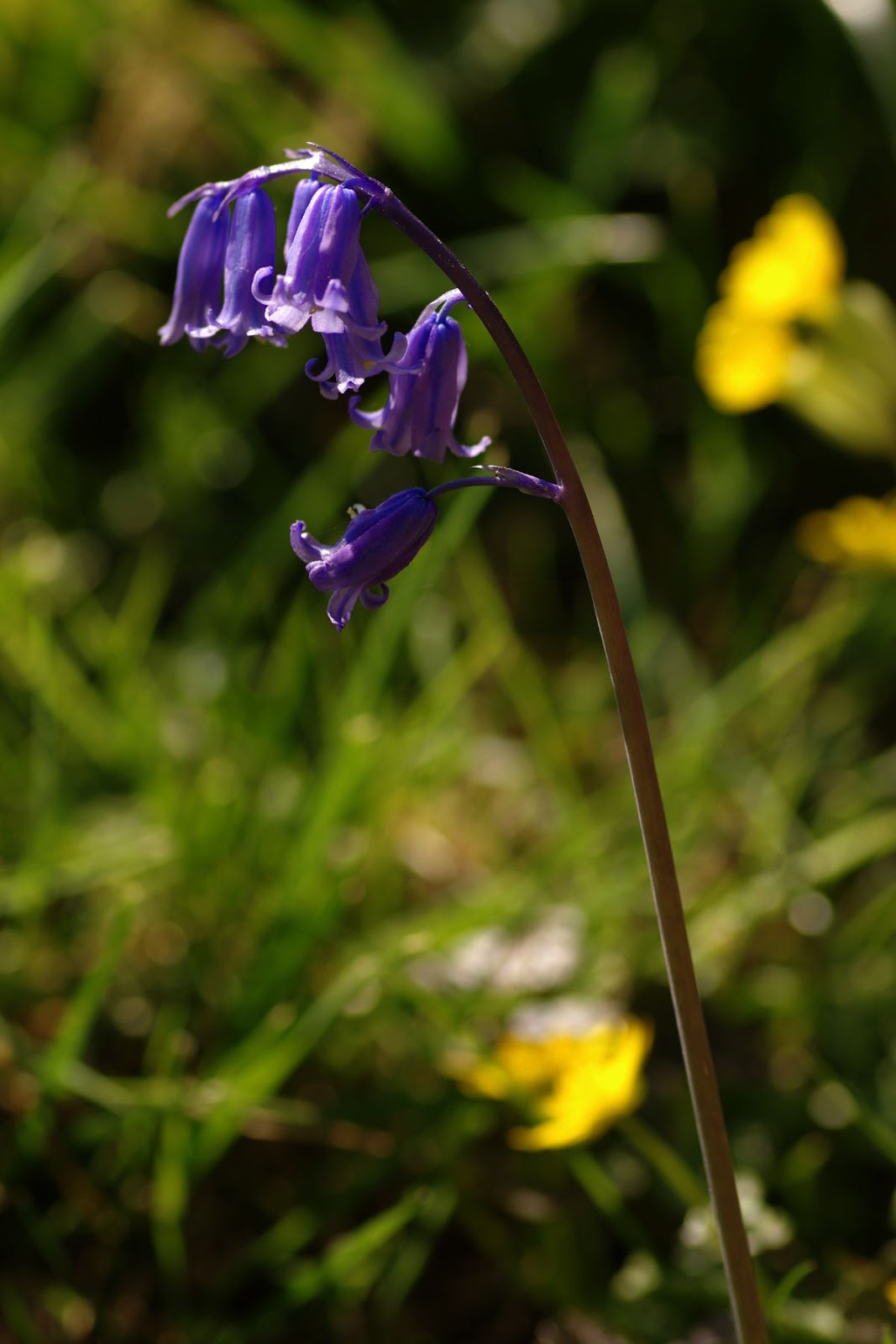
English Bluebell (Hyacinthoides non-scripta)
Even though we are less than two weeks into April, the Bluebells (Hyacinthoides non-scripta) are already beginning to flower.  I have to check carefully for hybrids with the Spanish bluebell but I think that I have eliminated the few interlopers.

In total, I found 48 species of wildflower of which:

  • 38 almost certainly got to our garden under their own steam
  • 10 were sown or planted.


Sunday, 15 March 2020

Lime Tree Avenue - Snails and Song Thrushes

A couple of weeks ago, I was delighted to spot a Song Thrush in Lime Tree Avenue.  It disappeared behind one of the old trees.

One of the old Lime Trees - showing epicormic growths (suckers).
As I watched the thrush disappear, I noticed the epicormic growths around the bottom of the tree.  Over the last couple of weekends the Brighter Uckfield group have been trimming these growths away, as well as removing litter from the avenue.

I always find this a very satisfying and calming job - and with all the worry about the Corvid-19 virus, I've certainly needed to be calmed down. The word "Mindfulness" is very over used but this type of work, where you methodically remove unwanted growths and have to pay attention while doing it forces me to stay in the moment and really notice the sights and sounds of the avenue.

White-lipped Snails
I always find some tiny wildlife while working on the trees. This year, I found about a dozen White-lipped Snails while working on the three trees that I trimmed. I find that, in the garden, these nibble away dying flowers etc. unlike the bigger Common Garden Snail that makes a nice mess of some of my plants. These little snails are just the sort of thing that a hungry thrush eats.

Common Plume moth.
While clipping my way through the ruby-budded growths, I found a little T-shaped moths, a Common Plume. This moth my look delicate but it can be found during all months of the year.

My last tree - before and after.
After I finished my third and final tree, I collected some of the stems that I had pruned off so I could see the fresh, green leaves open over the next few weeks.


Sunday, 8 March 2020

Sussex Botanical Recording Society - ghosts and roses

At this time of year the Sussex Botanical Recording Society (SBRS) holds its AGM at Staplefield.

The Victory Pub, which does very nice lunches.
My first priority when I got to Staplefield,  was lunch.

Dicranoweisia cirrata (Common Pincushion) 
As there was a few minutes before the pub opened, I photographed a moss just outside, in the hope of identifying it later. Two of the more intrepid members of the Society were busy recording the plants on the village green. They joined me and we had a lovely lunch in the pub.

Treasure!
I was helping to arrange chairs in the Village Hall when treasure appeared in the form of books.  I selected a few including Walley Dod's Sussex Flora of 1937 and a big book of mosses. When I looked through Wolley Dod in the evening, the Uckfield I know was suddenly filled with the ghosts of long-gone cornfields, ponds and other places where wild plants once thrived. After the usual formalities, there were interesting and informative presentations.

I hope to go looking for roses this year.
It has been suggested that we look out for roses as many of those listed in Wolley Dod have not been re-found. We don't get that many wild roses round Uckfield and my "new" Wolley Dod doesn't mention Uckfield or the nearby villages much in this section.

Notes from Charlotte Smith talk.

Brad Scott gave a splendid talk about one of Sussex's earliest women botanists, Charlotte Smith, who was a successful writer in the 1700s. Her poetry and books give such vivid descriptions of wild plants and the places where she encountered them that I half expect to catch a glimpse of a bonnet and a long dress, the next time I go botanising.

There will be the usual photo competition:

  • close up
  • wild plant in churchyard habitat

All that remains is for me to dust off my recording sheets and get going again because "I aint afraid of no ghost!"

Saturday, 15 February 2020

Biological Recorders' Seminar 2020 - Sussex Biodiversity

As Storm Dennis started lashing the country with rain, I was heading towards Sussex Biodiversity's 2020 Biological Recorder's Seminar.

Fixing and Linking Our Wetlands


Last weekend, I had been exploring an old Uckfield Tithe map and noticed just how many ponds there were in the area back in the 1840s.  Coincidentally, my first conversation was with a representative of the Fixing and Linking Our Wetlands (FLOW) initiative. She had also been looking at old tithe maps to find out where ponds had been so they could restore them.  She has been receiving communications from landowners whose ponds have been restored saying that they are not experiencing flooding even though it has been an exceptionally wet year.

Highlights of wildlife recording in 2019


Many of the highlights are explained in Adastra 2019.

Tall Ramping Fumitory - Victoria Pleasure Grounds
A couple of items relevant to Uckfield and the local area are:

  • In the Freshwater Fish report (page 29) a report about Dace in the Uck (not far from the bypass). They spawn in March/April and you might be lucky enough to see a silver flash as they jump over obstacles or try to catch a fly.
  • In Amphibians and Reptiles (page 32) they thanked the Uckfield toad patrol "for their continued effort to protect toads crossing roads, to and from their breeding ponds.
  • Vascular Plants (page 12) mentioned the new site for Tall Ramping Fumitory that I found during my survey of Victoria Pleasure Grounds, undertaken for the SBRS Village Green and Recreation Grounds project.

A couple that really struck a chord were:
Soil Biodiversity


This is a truly fascinating area,  I was aware of microrhizal fungi but there is so much more going on down there. Natural England had set up microscopes so we could see live millipedes, springtails and even a Tardigrade.

Ouse and Uck

At the first break, I stumbled on the stand for the Ouse and Adur Rivers Trust and bought some copies of their new book, "Ouse and Uck, sketch of a Sussex Catchment."


There was also a stand about the River Ouse Project comprising a poster (available from their reports page) with a wealth of information about Meadows.

Potters on the Heath


I very much enjoyed John Walters talk, illustrated with his wonderful photographs and drawings about potter wasps.

Notable Sussex Bees

James Power of Sussex Bees and Wasps Recording Group gave brief descriptions of 10 notable Sussex bees and wasps.
  1. Macropis europaea - Yellow Loose-strife Bee
  2. Ammophila pubescens - Heath sand wasp
  3. Anthophora retusa - Potter Flower Bee - Seaford Head
  4. Halictus eurygnathus - Downland Furrow bee - Lewes, Slindon
  5. Andrena vaga - Gray-backed Mining Bee - Dungeoness, Rye Harbour
  6. Cerceris quinquefasciata - The Five Banded Tailed Digger Wasp - High and Over
  7. Nomada zonata - Variable Nomad Bee - becoming WIDESPREAD
  8. Colletes cunicularius - Early Colletes - attracted to Willow
  9. Bombus muscorum - Moss Carder Bee - flower rich grassland
  10. Osmia bicolor - Red Tailed Mason Bee - downs, nests in abandoned snail shells

I haven't met any of these bees yet but I live in hope.

Botanical Recording in Sussex Churchyards

Girdled Mining Bee - Holy Cross - 27 April 2017
Helen gave a lovely talk on this, which featured one of my bee photos, taken in Uckfield's Holy Cross Churchyard. I wrote posts on my Early April, Late April, June and August 2018 surveys

One unexpected point was that, for finding unimproved grassland plants, Victorian churches were the best. Medieval ones were not so good.

National Bat Monitoring Programme


Philip Briggs outlined bat recording schemes and some of the results.

The Spiders of Sussex


Graham Lyons outlined highlights of 2019 intensive spider recording.

Back home


After all the talk of ponds and rivers, I decided to check our own pond. As I approached, there was a splash and a glimpse of a webbed foot. Our frogs have arrived and are spawning.

Saturday, 1 February 2020

Revving up a Buff-tailed Bumblebee

Late this afternoon, the temperature was dropping and the washing clearly wasn't going to dry any more. So I went out, started gathering getting stuff off the lines and ... spotted a little black body in the grass.  I looked closer and saw that it was a Buff-tailed Bumblebee. I feared that (1) it had died and (2) it was 'our' big queen who has been visiting the garden since Christmas Day.

Buff-tailed Bumblebee Queen - 25 Dec 2019
As I carefully parted the grass to take a closer look, I realised that this Queen was smaller and a leg raised to warn off the annoying human told me that she was very much alive.

A different Buff-tailed Bumblebee Queen - 01 Feb 2020
I didn't like the idea of leaving her in the clammy grass where she could be trodden on so I picked a hellebore flower and scooped her up. As I raised her into the the warmer air, her wings started quivering.

Bumblebee after transfer to a warmer spot - 1 Feb 2020.
I carried her and her flower to a warmer, safer spot and put them down. She started feeding and I left them to it.  I was intrigued by the way in which she vibrated her wings and did a little Googling. According to a clip from the BBC's life in the Undergrowth, it is normal for bumblebees to cool right down in the night but, when they need to warm up, they can vibrate their wings until they are warm enough to fly.

Sunday, 26 January 2020

Big Garden Birdwatch - 2020

It appears that normal service has been resumed for the RSPB's Big Garden Birdwatch. The feeders are topped up, I've prepared my recording sheet, binoculars are to hand and the birds have vanished like snow in summer.  I can only suppose that the damp, mildish weather has allowed the birds to feed up in the countryside and they don't need to visit our gardens so much.

Female Blackbird with grapes.

Finally, I managed to entice our first visitor, a male Blackbird, with some grapes.  Naturally, he hid behind a garden ornament to eat them so here is a photo of the missus.  A little later, a Carrion Crow perched in our Oak.

Robin - one of a pair
I was charmed to see a pair of Robins dancing in and out of the twigs of our Acer and Buddleia trees. This pair have been around for a while now, and I hope they will nest somewhere nearby.

Blue Tit on Winter Sweet
My favourites were the three Blue Tits searching for insects amongst our yellow Winter Sweet and Witchhazel flowers.  A pair have already been checking out our old nest box - maybe they will decide it's still good enough to use.

Male House Sparrow on Crab Apple tree.
The RSPB results (at the time of writing - evening of 26 Jan) shows that the House Sparrow is the most widely spotted bird. I only got one male, which perched briefly in our wonky crab apple tree. My most common bird, with six individuals, was Woodpigeon.


We usually get about eight or nine Starlings fighting over the food on the bird table but only two appeared during my bird count, along with one rather nervous Magpie.

Here is my results list.

Results for 2020
This graph shows the ups and downs of my bird watches since 2011.  This year I got fewer birds (18 from 8 species) than last year (35 from 12).

This year's results were a little below average.

Wednesday, 1 January 2020

New Year Plant Hunt 2020 - Uckfield (2020)

This is my sixth year doing the Botanical Society of the British and Ireland's New Year Plant Hunt. After last year's high score, the number of wild or naturalised plants in flower has settled down to a more usual level. The scores for the last few years are:

  • 2015 - 21 species of which 2 were naturalised garden plants that had 'jumped the fence'
  • 2016 - 34 species of which 4 were naturalised
  • 2017 - 23 species of which 2 were naturalised
  • 2018 - 28 species of which 3 were naturalised
  • 2019 - 45 species of which 4 were naturalised
  • 2020 - 36 species of which 4 were naturalised

The first flowering plants I found were the simple weeds of grass and gardens: Petty Spurge, Daisies, Dandelions etc.

Winter Heliotrope - Just South of the Ringles
A few days previously, I had driven along the London Road and was really excited to find a strip filled with pinkish, fluffy flowers. It is Winter Heliotrope.


Sweet Violet
I visited the little courtyard in front of what used to be Parade Radio. I've often found Sweet Violets (Viola odorata) and several were blooming.  I made my way through the churchyard and along Belmont Lane. Towards the end of the lane, I found a hazel whose catkins had lengthened and could therefore be added to my list.

Gorse, Bellbrook Industrial Estate
In the Industrial Estate I found the ever reliable Gorse (Ulex europaeus) in bloom.

Common Chickweed, Bellbrook Industrial Estate
I was amused by a cheeky Common Chickweed (Stellaria media) growing in artificial turf. Nature always finds a way.

Wild carrot, Bellbrook Industrial Estate
There were some unexpected and rather nice wild flowers outside Barney's Play. I hope the visiting children enjoy seeing them. The "Nervous Botanist" kindly identified the first as Wild Carrot with pretty, lacy flowers. I have always associated Wild Carrot with the more alkali soils around Leatherhead so I was surprised to find it there.

Field Penny-cress, Bellbrook Industrial Estate
The other was a Field Penny-cress (Thlaspi arvense), with strange "penny" seed heads. When I held a piece up to the light, I could see four seeds inside each "penny". Joshua Styles kindly confirmed. Looking at the map in The Flora of Sussex, this appears to be a new species for our "Square".

A quick break in the Station pub!
After a quick break in the Station pub, I checked the Hawthorn hedge alongside the allotments. There was none blooming.

Scentless Mayweed, Manor Park
I made my way back home through Lime Tree Avenue and Manor Park.  The most unexpected find was a Scentless Mayweed (Tripleurospermum inodorum).  My last find was a Dog Violet (Viola riviniana) alongside our garden path.

The Science Bit

Location: Uckfield (North), East Sussex.  Start point: TQ478219

41 Wild Plants Flowering on 1 January 2020

Scientific name Common name
Achillea millefolium Yarrow
Bellis perennis Daisy
Capsella bursa-pastoris Shepherd's Purse
Cardamine hirsuta Hairy Bittercress
Cerastium fontanum Common Mouseear
Conyza sumatrensis Guernsey fleabane
Corylus avellana Hazel
Crepis capillaris Smooth Hawk's-beard
Daucus carota Wild Carrot
Erigeron canadensis Canadian Fleabane
Euphorbia peplus Petty Spurge
Fumaria bastardii Tall Ramping Fumitory
Hedera helix  Ivy
Lamium album White Dead-nettle
Lamium purpureum Red Dead-nettle
Parietaria judaica Pellitory-of-the-wall
Petasites pyrenaicus  Winter Heliotrope
Poa annua  Annual Meadow Grass
Polypogon viridis Water Bent
Ranunculus acris Meadow buttercup
Senecio jacobaea Common Ragwort
Senecio vulgaris  Groundsel
Sonchus oleraceus Smooth Sow-thistle
Stellaria media Common Chickweed
Taraxacum officinale Dandelion
Thlaspi arvense Field Penny-cress
Tripleurospermum inodorum Scentless Mayweed
Ulex europaeus Gorse
Urtica dioica Common nettle
Veronica persica Common Field Speedwell
Viola odorata Sweet Violet
Viola riviniana Dog Violet

4 Naturalised Plants flowering on 1 January 2020

Scientific name Common name
Bergenia cordifolia  Elephants ears
Campanula poscharskyana Trailing Bellflower
Centranthus ruber  Red Valerian
Corydalis lutea Yellow Corydalis