Showing posts with label goldfinch. Show all posts

Saturday, 28 January 2023

Big Garden Birdwatch 2023

I did this year's Big Garden Birdwatch from 8:20 to 9:20 am. The weather was cold (about 1-2 C) and dull.  The big difference this year is that I've been using feeders much more.  Previously we had one feeder for fatballs, a bird table and scattered some food on the paving or grass.  However due to increasing numbers of Pigeons monopolizing the supplies, I've more-or-less stopped using the bird table and ground and now have a total of four feeders:

  • The original, with fat balls, in the Magnolia
  • Mealworms in the Lilac at the front
  • Sunflower hearts in the Crab Apple at the back
  • Suet pellets in the Cornus Mass.

I imagined that this would encourage more birds into the garden and make them easier to spot.  However, during the count, I observed that most species come and go to the feeders quite quickly whereas before they would spend more time looking for morsels in our unruly garden.  

During the count, I recorded a total of 31 individuals from 11 species.

My Big Garden Bird Count scores.
Some results stood out. For example, the were two Goldfinches and one Coal tit.  Although these species have occasionally graced my count, their visits have be very irregular and fleeting, with the Goldfinches usually flying high above the garden and not landing (which means I can't include them in the count). Over the last few weeks these have become reliable visitors, coming to our feeders every day. 

Big Garden Bird Watch - How counts have changed since 2011

I did get more individuals than the last couple of years. It doesn't necessarily mean much because numbers have gone up and down so much over since I started doing the count.  However, the main boost was a group 12 of House Sparrows that spent a little time squabbling over the sunflower hearts and suet. 

Hopefully as we enter the hungry period when the birds have eaten most of the naturally occurring berries and seeds, the feeders will help keep our feathered friends going until Spring. 

Sunday, 29 January 2017

Big Garden Birdwatch - 2017

As I settled down for this year's RSPB Big Garden Birdwatch, I kicked myself for not doing it in yesterday's beautiful sunshine. At 9am the light was so murky that I was afraid that I wouldn't be able to see the birds, let alone identify them.

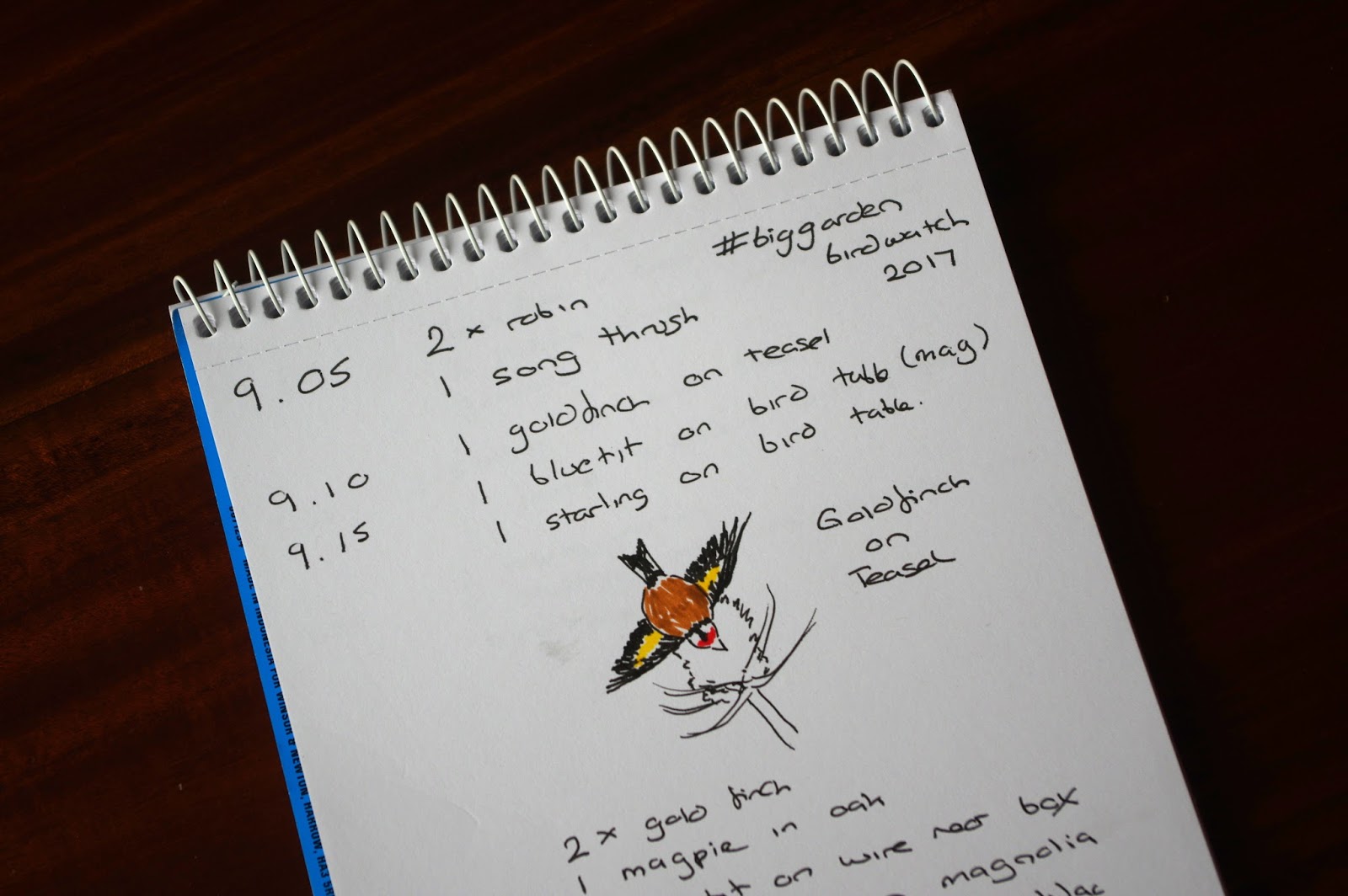
Then two cheeky Robins flitted into the trees at the front of our garden.  As I watched their boisterous progress through the branches, I noticed a Song Thrush sitting quietly in the Robinia.

Notes from my Birdwatch.

Looking out at the back I noticed a Goldfinch on the old teasel seedheads.  In the next quarter of an hour, several different types of birds appeared in the garden. Great tits, Blue Tits, Robins and Starlings were all attracted by the food I had put on the  bird tables. 


Woodpigeon feeding on tiny crab apples.
Perhaps the most bizarre sight was a Woodpigeon tying itself in knots while gathering up the last of the crab apples.  When it finished, it stared glumly at the empty branch.

At about 9:35 a Jackdraw, a first for my birdwatch list, perched briefly on a conifer. I found myself glaring at a Herring Gull that seemed to be glued to my neighbour's roof and couldn't be counted.  My hour was rounded off by the reappearance of the robins.

One of our pair of Robins.
The final score was 17 individuals from 11 different species. Strangely many of the birds that usually come as a flock appeared in ones, twos or threes.  I didn't positively identify House Sparrows but there was a group of birds that I couldn't see properly in the poor light and wasn't able to include in the count.

2017 Great Garden Bird Watch Results.
Compared to previous years, the variety of birds was good. It has only been better in 2011, the first year I did the birdwatch. However the number of individuals counted, at 17, was well below the average of 21.  Results of this and previous years' counts are shown below.

  2011 2012 2013 2014 2015 2016 2017
No of species 12 11 10 6 11 7 11
No of individuals 30 26 15 20 28 12 17
Blue tit 3 3 2 3 2 2 1
Blackbird 2 2 3 3 2 2 2
Collared Dove 2 1 1   1   1
Goldfinch     1   7   2
Great tit   1         1
Jackdaw             1
Magpie 2 2 2 2 1 1 2
Robin 1 1 1 2 3 1 2
Song Thrush 2   1   1   1
Starling 8 9 2 8 5 2 3
Woodpigeon 1   1 2 2 2 1
Chaffinch 2       2    
Coal Tit   1          
Carrion Crow           1  
Dunnock 3 1          
House Sparrow 3 4     1    
Pied Wagtail 1 1 1        
  Saturday, 29 Jan Sunday, 29 Jan Saturday, 26 Jan Saturday, 25 Jan Sunday, 25 Jan Saturday, 30 Jan Sunday
29 Jan
Start time 8.45 am 8.45 am 9.07am 8.50 am 8.45 am 8.55 am 9:05am
Weather dull, icy   cold, bright damp, misty bright, cold dull, mild damp, mild

Saturday, 30 March 2013

Big Garden Birdwatch - where are my sparrows?

At the end of January I took part in the RSPB's Big Garden bird watch. I wrote an account of my experiences in my Big Garden Birdwatch post. Now the RSPB have collated the results from over half a million people. The table below shows the top ten birds in East Sussex.

Rank in East Sussex Species Average per East Sussex garden In my garden
1 House Sparrow 3.4 None
2 Blue tit 3.3 2
3 Starling 2.6 2
4 Blackbird 2.6 3
5 Woodpigeon 2 1
6 Great tit 1.4 None
7 Chaffinch 1.4 None
8 Robin 1.3 1
9 Collared Dove 1.2 1
10 Magpie 1.1 2

We also got 1 goldfinch (19th in East Sussex), 1 pied wagtail (30th), 1 song thrush (22nd). Our scores for the top 10 birds are a little less than average, which is surprising since we have a big garden with plenty of trees. That said, the trees and bushes allow the birds to stay out of sight and I didn't include any that I couldn't positively identify from a tantalising glimpse of a shape or a tail.

We do have one gaping gap right at the top of the table - no house sparrows. On previous years we've had a few but this year - none. For me, this is a particularly sad omission. I grew up in the London area and the cheeky sparrow was very much a bird of my childhood. Every time we threw crumbs out in the garden - no posh RSPB food then - dozens of squabbling sparrows would descend to enjoy our scraps. I didn't really notice them going. I had moved around, gone to university in Sheffield and then moved to Sussex. Now seeing or hearing this lively little bird has become a special treat rather than a part of every day life.

If it was only our garden that is missing sparrows, it wouldn't matter, but - although house sparrows are the most common bird in our counts - the RSPB say "Numbers of house sparrows, also on the red-list, dropped by 17 per cent in gardens compared to 2012 ..."

On their Red, amber and green explained page the RSPB tell us that "Red is the highest conservation priority, with species needing urgent action."

Kate Vincent completed a PhD Investigating the causes of the decline of the house sparrow in Britain and the associated web site has some information on What you can do. Her suggestions include:
  • provide seed all the year round - especially sunflower hearts
  • provide mealworms in summer, to help the fledglings
  • provide a good mixture of shrubs in the garden
  • leave some grass long
  • provide a well topped-up bird bath all the year round.


Sunday, 27 January 2013

Big Garden Birdwatch

The last weekend of January I take part in the RSPB's Big Garden Birdwatch. Would I see the special visitors that we have been enjoying since the cold weather started? We had a fieldfare on Thursday and a bullfinch on Friday.  I shouldn't ask silly questions. The birds seen to know when the nation is scrutinising their every visit to the garden and stay away, or land tantalisingly in a neighbour's patch, or fly overhead. In short they do anything rather than land in the garden and be counted.

A rook that perched precariously on the telephone wire just outside our garden and a female blackbird that sat sunning itself in our oak for most of the hour.
I did my birdwatch from 9.07 to 10.07 Saturday morning. At the end of my hour the scores on the doors were:
  • Blackbird: 3
  • Blue tit: 2
  • Collared dove: 1
  • Goldfinch: 1
  • Magpie : 2
  • Pied Wagtail: 1
  • Robin: 1
  • Song thrush: 1
  • Starling: 2
  • Woodpigeon: 1
We often see birds in the garden but devoting a whole hour to watching them is different. I found I was noting behaviour that I never usually see: the amusing antics of a rook trying to balance on a thin telephone wire; a female blackbird sunning itself in a tree and a cheeky wagtail stealing food from under the beaks of squabbling starlings. The two magpies were plucking twigs from our oak tree. It seems strange that they take the trouble to do this when there are so many lying on the ground.

Our bird count was lower this year: no sparrows, only two starlings, no great or coal tits. On the up side, we got a song thrush and a goldfinch.

If you are reading this on the day I wrote it, you can still fit your hour in. Just spend an hour noting the birds that land in your garden or other patch of ground and submit your results using the link at the top of this post.