Sunday, 30 January 2022

Big Garden Birdwatch - 2022

I did this morning's #BigGardenBirdwatch from 8:20 to 9:20am. It was bright but cold. I melted the ice in the bird bath, put some seed on the bird table and got going.  I didn't even wait to get inside, I heard the 'teacher, teacher' cry of the Great Tit and spotted a bunch of fat Woodpigeons dozing in the Oak and got recording.

Woodpigeons dozing and preening.

Then some small brown jobs are tumbling through our hedge - 3 cheeky House Sparrows. Scanning carefully with my binoculars I found a Dunnock. Far above, at the top of one of our birches, a Magpie. Then, for a long time, it seemed to go quiet.

Where are all the birds?

I prowled round the house, straining to see movement outside. Nothing around except the pigeons.  A movement in our birches caught my eye. Three little balls of yellow fluff - Bluetits - had appeared amongst the stunning black and white branches and trunks. They were soon joined by the Great Tit that I had already counted. Even so, I took a moment to admire its smart plumage against the white trunks and blue sky.

I moved to the back of the house to see if there was anything there.  A few starlings on the phone wires - but I can't count those. Then one drifted down into the Magnolia tree. The rest stayed stubbornly on the wire. A charm of Goldfinches flew straight past our garden into our neighbour's. A strong throbbing song from the top of our conifer drew my attention to a Robin. One of our usually reliably greedy Blackbirds had finally appeared to claim one of the grapes we had scattered outside earlier.

With the end of the hour coming into view, a shape appears in the Robinia and promptly disappeared behind a thick branch. Another pigeon? Then a pointed beak appeared followed by a bright blue eye. I added the Jackdaw to my list.

I give the Oak tree one more look - and found a Jay perching close to the group of Woodpigeons.  It has been visiting the garden for sometime.  In the Autumn, I spotted it caching acorns, so maybe it is back for a snack.

The final score.
I saw 20 birds from 11 species - very slightly more than last year.


Sunday, 2 January 2022

New Year Plant Hunt 2022 - Uckfield North

 Last year I started my post about the BSBI New Year Plant Hunt by saying "I was in two minds about doing the BSBI's New Year Plant Hunt this year. Covid-19 levels are running high and there is a new, more infectious strain around." I could have started this year's post with the same two sentences. However both Mum and I have had our vaccinations and boosters and we understand more about transmission so being amongst people outside is less worrying than a year ago. On the botanical side, I wondered what effect the relentless rain had had on the flowers I was hoping to find.

Winter Heliotrope, London Road side of Manor Park

I rushed to London Road (a bit South of the Ringles) to note the Winter Heliotrope (Petasites fragrans) that grows on the London Road side of Manor Park.  On the way, I saw many of the usual weeds such as Groundsel (Senecio vulgaris), Daisy (Bellis perennis) etc. 

Pellitory-of-the-wall, corner of Regency Close
I headed directly down the High Street, recording species as I went. At the corner of Regency Close, I found Pellitory-of-the-wall (Parietaria judaica), a plant for which the word non-descript could have been invented.
Pellitory-of-the-wall closeup
I had to use a hand lens to reveal the tiny flowers. A quick nose round Holy Cross's churchyard gave me a Yellow Corydalis (Corydalis lutea).
Bush Vetch, Belmont Road
Belmont Road is a lovely old lane leading from the Church to the Oast House and allotments. It was a real pleasure to see the Bush Vetch (Vicia sepium) blooming for the third time since I started doing the New Year Plant Hunt in 2015.
Dandelion, Uckfield Fire Station
I checked the hedge round the allotments but, in spite of the Hawthorn having buds, there wasn't a single flower. However there was a cheeky Dandelion (Taraxacum officinale) near the Fire Station. 
Lesser Celandine
As I headed along the path towards the Meads, I spotted a Lesser Celandine, my first since 2018. 
Hazel, star-shaped female flower top left, male catkins just lengthening

At first, I thought that the Hazel (Corylus avellana) in the strip between path and bypass was going to let me down but I went and had a closer look.  Just a few of the male catkins were lengthening and one tiny female flower enabled me to add Hazel to my list. The fact I was knee-deep in brambles peering into a bush also attracted some friendly curiosity. We chatted about which flowers I had found and shared a smile when a Robin decided to check us out.

Gorse, Bellbrook Business Park
They say "When gorse is out of bloom, kissing is out of season." and sure enough, I found Gorse (Ulex europaeus) blooming on Bellbrook Business Park. 

Annual Mercury, Bellbrook Business Park
Just round the corner, I found a number of Annual Mercury (Mercurialis annua) plants not far from when I found it in 2017.

Fools Parsley, Bellbrook Business Park,
A little further along, there were some Alder trees with lengthening, pollen-laden catkins. While I noted these down I noticed a miserable-looking plant at their feet. I couldn't make anything of it at the time and had to take a piece home for proper identification.  After much peering at books and keys, I ended up with Fools Parsley (Aethusa cynapium). Tim Rich of the Sussex Botanical Recording Society and Moira O'Donnell of the BSBI 2022 #NewYearPlantHunt team kindly confirmed this.  

At this point the clouds began to roll over and, conscious that my three hours was nearly up, I made for home and set about untangling my results.

2022 - 45 species of which 5 were naturalised garden plants that had 'jumped the fence'

2021 - 46 species of which 6 were naturalised 

2020 - 36 species of which 4 were naturalised

2019 - 45 species of which 4 were naturalised

2018 - 28 species of which 3 were naturalised

2017 - 23 species of which 2 were naturalised

2016 - 34 species of which 4 were naturalised

2015 - 21 species of which 2 were naturalised 

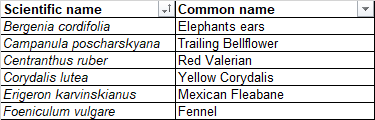
Species found in bloom - Wildflowers


Species found in bloom- naturalised


Friday, 31 December 2021

2021 - Adding New Species to my List

 As we reach the end of 2021, I'm looking over my wildlife observations and seeing what is new. I went a little further afield this year than last year. Even so, most of my sightings were within walking or running distance of my home.  Numbers of new species were a little down from last year but I was busier with work and other things, so that's not surprising.  At the end of the year the numbers of new species found were:

  • 37 species new to my records
  • of which, 23 were new to me. 

Hawkweed (1 Jan 2021)

As usual, my wildlife recording year started with the BSBI's New Year Plant Hunt. As well as the usual daisies and other opportunistic weeds I saw a Hawkweed (Hieracium), which has large, showy dandelion like flowers on tall stems.

Pyramidal Orchid, 4 July 2021

Another, and more exciting, botanical find was a Pyramidal Orchid (Anacamptis pyramidalis). It is supposed to prefer an alkali soil like the chalk downs but had not read the book!

Barn Owl, 2 April, 2021

One of my most exciting records was a Barn Owl (Tyto alba) that I disturbed while running through Buxted Park. The bird flew up from ground level and then settled on a post for a few precious seconds while I looked at it. Then it flew over my head towards the copse in the middle of the wild flower meadow. I have seen a Barn Owl before but not since I started my wildlife records.

Long-winged Conehead (14 Aug 2021)
As part of a Sussex Botanical Recorders Society Project, I surveyed the the recreation area at Harlands, home to Uckfield's famous toads. In the grassy area near the pond, I found Bulbous Buttercups (Ranunculus bulbosus) and many different sorts of insects including striking Long-winged Conehead (Conocephalus fuscus).

Opposite-Leaved Saxifrage (3 July 2021)

In the strip of alder trees and bluebells, I found an Opposite-Leaved Saxifrage (Chrysosplenium oppositifolium).  It wasn't in flower but the leaves are a pretty shape and it was a nice little find.

Hornbeam seedheads, 17 Oct 2021

Another plant that I found in this area was Hornbeam (Carpinus betulus).  Although it is a common plant round here, I have had failed to notice and record it.  Hempstead Wood is full of Hornbeams. The one photographed is in the strip of trees between the Meads and the bypass. These trees are much more tolerant of our heavy, clay soil than many other species.

Field Rose, 27 June 2021

On the way to Hempstead Wood, I pass some rather lovely hedgerows. Recently, I have taken the time to look at the wild roses more closely and found there are two types.  As well as the usual, pink, Dog Roses (Rosa canina), there are dainty, cream-coloured Field Roses (Field Rose). 

Lesser Broad-bordered Yellow Underwing, 10 Aug 2021

I love the subtle colours of the Lesser Broad-bordered Yellow Underwing (Noctua janthe) moth. which was hiding in our ivy. I've often found its larger, brasher cousin the Large Yellow Underwing (Noctua pronuba) everywhere from nooks and crannies in our own garden to a bar in Birmingham!

Golden Argent, 24 July 2021

Other garden moths included the tiny Gold Argent moth (Argyresthia brockeella) shown above and the much less welcome Box Moth.

Acorn Weevil, 5 June 2021

Our English Oak supports a great deal of life including the Acorn Weevil (Curculio glandium) shown. 

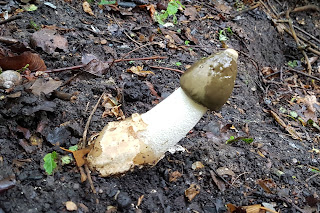
Stinkhorn, 20 June 2021

As I ran down Hempstead Lane, I noticed a Stinkhorn (Phallus impudicus). They are pretty unmissable. I'm told that it really lives up to its name so I'm glad that I didn't sniff it!

Four-barred Knapweed Gall Fly, 24 July 2021

I saw this Four-barred Knapweed Gall Fly (Urophora quadrifasciata) in July. There are two generations, one of which overwinters in Knapweed seed heads.

Long Hoverfly, 29 Aug 2021

Hoverflies are useful pollinators and I was delighted to find three species that I had not noticed before including the Long Hoverfly (Sphaerophoria scripta).

So, if all goes according to plan, on New Year's day, I will start all over again. I wonder what I will find in 2022?

Sunday, 25 July 2021

How a heatwave affects our bees, butterflies and flies

 My interest in how the heatwave would affect our bees, butterflies and other insects was sparked by Roger Morris's post (16 July 2021) in the UK Hoverflies Facebook group.  He suggested that anyone interested could do a survey to help see how the heatwave would affect numbers of insects as follows:

"Chose a consistent route around your garden ... Walk the route and count the numbers of insects you see on an hourly or bi-hourly basis from as early as possible. Breaking numbers down into bees and wasps/Flies/butterflies and moths/Beetles/true bugs would help but lets start simple this weekend. For each trip record the numbers or if nothing was seen."

I did this on Sunday (July 18th) and then repeated the survey on Saturday the 24th to see what the numbers looked like on a more normal day.

A "normal" summer day

With the English weather, deciding "normal" is tricky but, for my purposes, a dull, damp start drifting into a sunny but not hot afternoon will do just fine.  

6-spot Burnet moth (Zygaena filipendulae) at 8am

I did my first count at 8am and found a total of 25 insects, mostly hoverflies with a few moths and one honey bee.  

Picture Fly - Urophora quadrifasciata

As the day wore one numbers increased until about 4pm the garden was loud with the buzzing of bees and hoverflies. I counted a total of 91 insects and nearly half of these were bees.

Insect numbers over a "Normal" day - 24 July 2021

Heatwave

So how did numbers change during the heatwave?

Wool carder bee (Anthidium manicatum) - archive photo

There was a faster start with more bees already active - a total of 33 insects compared to 25 on the "normal day". Wool carder bees were already active around our lambs ears plant, the males tussling for prime position in case a female turned up.

Insect numbers over a Heatwave day - 18 July 2021

Numbers peaked early, at 10am with 63 insects, after this numbers drifted slowly downwards.  Although there were insects around in the afternoon, there was no "summer buzz". At 4pm there were only 53 insects compare to 91 on the "normal" day.

Impact of the heat

So the main differences were that on the heatwave day:

  • Total insect numbers were reduced from 353 to 315, about 10% down
  • There were more insects at 8am - 35 compared to 25
  • The peak was much earlier - 10am rather than 4pm
  • The balance between bees and flies had changed - from slightly more flies to slightly more bees
  • Although numbers of insects were otherwise depressed, numbers of butterflies and moths rose by about 20%.

What was missing?

During both counts, there were:

  • very few beetles - I would expect to find a number of ladybirds and some Common Soldier beetles
  • no bugs - I was surprised not to see any shield bugs as they are usually common in our garden
  • very few craneflies - they were not in the official count but I only saw one, on the "normal" day - Mum has remarked that, in the past, we had been unable to keep windows open during heatwaves due to the sheer number of craneflies that used to come in.

Saturday, 2 January 2021

New Year Plant Hunt 2021 - Uckfield North

 I was in two minds about doing the BSBI's New Year Plant Hunt this year. Covid-19 levels are running high and there is a new, more infectious strain around. I wondered if I could do the hunt without taking unnecessary risks, or even if it was allowed by the Tier 4 rules. In the end, I did it as early as possible on New Year's Day and ran round much of my route so it definitely countered as exercise as well as getting me home before numbers of people started getting out and about.  

I did this year's New Year Plant Hunt at a trot!

The numbers of wild and naturalised flowers that I have found over the last few years are:

2015 - 21 species of which 2 were naturalised garden plants that had 'jumped the fence'

2016 - 34 species of which 4 were naturalised

2017 - 23 species of which 2 were naturalised

2018 - 28 species of which 3 were naturalised

2019 - 45 species of which 4 were naturalised

2020 - 36 species of which 4 were naturalised

2021 - 46 species of which 6 were naturalised - this hunt got a mention in the BSBI Summary of Day 1.


The first plant I encountered was Shepherd's Purse (Capsella bursa-pastoris) as I ran along Browns Lane. Pausing to post some letters, I saw some Red Dead Nettle (Lamium purpureum) near the bottom of the post box. As I trotted though the Manor Park twittens, I saw all the usual weeds including Groundsel (Senecio vulgaris), Bristly Ox-Tongue (Picris echioides) etc. Then through Lime Tree Avenue, where I found some Cow Parsley (Cow Parsley) in bloom.

Tall Ramping Fumitory (Tall Ramping Fumitory)

I visited the grassy bank at the top of the town and found the Tall Ramping Fumitory (Fumaria bastardii) that was there last year. 

Yellow Corydalis at the top of the town (Corydalis lutea)

As usual, the lovely old walls at the top of the town are studded with the gold flowers of Yellow Corydalis (Corydalis lutea). 

Smooth Sow Thistle (Sonchus oleraceus)

I slowed down to go through the grounds of Holy Cross and found a patch, sheltered by one of the Yew Trees, that was still full of Cat's-Ear (Hypochaeris radicata), which in my mind is a real summer flower. There was also Smooth Sow Thistle (Sonchus oleraceus) and Annual Meadow Grass (Annual Meadow Grass). 

Bush Vetch (Bush Vetch) in Belmont Lane

One of my favourite finds was the Bush Vetch (Bush Vetch)  in Belmont Lane. This partly sunken lane, with hedges each side and an Oast House at the end seems like a remnant of old Sussex tucked behind our usually bustling high street. 

Ox-eye daisy (Leucanthemum vulgare) on the bypass

Beyond the Oast House the illusion is swiftly shattered by the presence of the modern bypass with a petrol station and industrial estate on the other side. However year-after-year the patch near the fire station is the gift that keeps on giving. 2021 was no exception with Hawthorn (Crataegus monogyna) in blossom in the allotment hedge, an optimistic Ox-eye daisy (Leucanthemum vulgare) at the curb and lengthening Hazel (Corylus avellana) catkins nearby.  There were even some battered Bramble (Rubus fruticosus) blossoms.

Yarrow (Achillea millefolium) near Greens DIY.

After some worrying Government announcements about the second Covid vaccination, I looked at the Meads Medical Centre to see if there were any notices. There weren't, so I crossed the road to the Bellbrook Business Park where I found a number of Yarrow (Achillea millefolium) near Greens DIY.

White Ramping Fumitory

I looked over a low wall and found another fumitory. At first, I thought it was the same species that I found at the top of the town but something about the flowers made me take another look. An indignant wren shot out. The fumitory flowers were subtly different to the one at the top of the town. They were more densely packed and were a clear white and crimson rather than washed out pinks. I took a sample for closer inspection when I got home.  It turned out to be White Ramping Fumitory (Fumaria capreolata). 

Canadian Fleabane (Erigeron canadensis)

Across the road there was Canadian Fleabane (Erigeron canadensis), its tiny - usually nondescript - flowers glowing in the low, slanting sun.

A cheeky Common Chickweed (Stellaria media) in artificial turf.

Running through the industrial estate, I was amused to see a cheeky Common Chickweed (Stellaria media) growing in artificial turf. Nature always finds a way.

Hawkweed (Hieracium agg)

Going past the Uckfield Motor Services, I noticed flowers like little suns peeping over the wall. It was obviously a member of the dandelion family but the spear-shaped leaves running up the stems had me foxed.  My books tell me it is a Hawkweed (Hieracium agg).

Winter Heliotrope (Petasites fragrans), South of the Ringles.

There were more people moving around and I was beginning to get uneasy so I trotted up the High Street as fast as my little legs would carry me, pausing only to note a Knotgrass (Polygonum aviculare) near the cinema. I also found a stray Fennel near the top of Browns Lane. I went as far as the Winter Heliotrope (Petasites fragrans) just South of the Ringles Cross pub.

Garlic Mustard (Alliaria petiolata)

After running and botanising for about 2 hours, I looked round the garden at home and was rewarded with the sight of the most miserable Garlic Mustard (Alliaria petiolata) that I have ever seen. However it still had one tiny flower open, so I added it to my list.


Ivy-leaved Toadflax (Cymbalaria Muralis).

 My last find was the Ivy-leaved Toadflax (Cymbalaria Muralis) scrambling round the feed of our shed.

The science bit

Location: Uckfield (North), East Sussex.  Start point: TQ478219
Total number of wild and naturalised plants in flower = 46

40 Wild Plants flowering on 1 January 2021

For accessible version of the plant list, use the link under "The science bit"

6 Naturalised Plants flowering on 1 January 2021

For accessible version of the plant list, use the link under "The science bit"


Thursday, 31 December 2020

2020 - Adding New Species to my List

I will certainly be glad to see the back of 2020 - the year of Covid 19. I have not recorded as many plants and creatures as usual as I have not been going out any more than I have to. Even in our own garden, I don't want to hang around or handle things more than necessary. However, I have managed to add 53 new species to my lists. Of these, 25 are species that I have not seen before.  Here are some of them.
 
Field Penny Cress
Field Penny Cress - 1 Jan, Uckfield

The year started normally, with the now traditional BSBI New Year Plant hunt. I found a few plants in flower outside Barney's Play Barn. Not only was the Field Penny Cress (Thlaspi arvense) new to my personal species list but it was new for Uckfield's "square" on the map.  

Winter Heliotrope - 1 Jan, Uckfield

Another new entry was Winter Heliotrope (Petasites fragrans). For the first time, I noticed the great mass of it on the London Road, just South of the Ringles. 

Lecidella elaeochroma - 16 Feb, Uckfield

February winds often blow branches down, bringing lichens to my level. The one shown is Lecidella elaeochroma, with its distinctive black fruiting bodies.

Common Pincushion moss - 7 March, Staplefield

At the beginning of March, I went to the Sussex Botanical Recording Society meeting at Staplefield. For those that don't remember the "before times", a meeting is when loads of people get together to discuss matters of common interest. In this case it also entailed a visit to a "pub" where a group of botanists shared a convivial meal. On a wall at its entrance, I found a species of moss that I had not noticed before, the Common Pincushion (Dicranoweisia cirrata).

Canary Grass - 7 June, Uckfield

A week or two after this, Covid 19 started spreading across the country and the Government directed us to "lockdown". A few weeks later, the Botanical Society of Britain and Ireland responded by asking people to do the BSBI Garden Wildflower Hunt. Between April and September, I found over a hundred species including a couple that I have never encountered before. I suspect that the Canary Grass (Phalaris canariensis) shown is from some stray bird seed. It even won me a little prize in a photo competition.

Spotted Longhorn beetle - 14 Jun, Uckfield

Summer brought all manor of flying insects to the garden including the Spotted Longhorn beetle (Rutpela maculata).

Tawny Longhorn beetle - 12 July, Uckfield

In the first few months of the pandemic, I wasn't happy about the gardener coming to mow the grass. Although I mowed it myself, I left more of the flowers, including the Yarrow (Achillea millefolium), to bloom. As a reward, I was treated to visits from a Tawny Longhorn beetle (Paracorymbia fulva).

Orange Swift - 15 Aug, our kitchen

As we moved into summer, moths started to appear. Mum found one of our new species, an Orange Swift (Triodia sylvina) in our kitchen. 

Broom Fork-moss - 14 Sept, Ashdown Forest

In September, Mum and I finally managed a proper outing, to Ashdown Forest. After enjoying the views and catching a glimpse of what might have been a Red Kite, I noticed this little Broom Fork-moss (Dicranum scoparium) growing by the path back to the car park.

Upright Corel fungus - 13 Oct, Uckfield

While hanging around waiting for Mum to come out her podiatrist appointment, I found an Upright Corel (Ramaria stricta) fungus at the bottom of a hedge.

Dog's vomit slime mould - 21 Nov, Uckfield
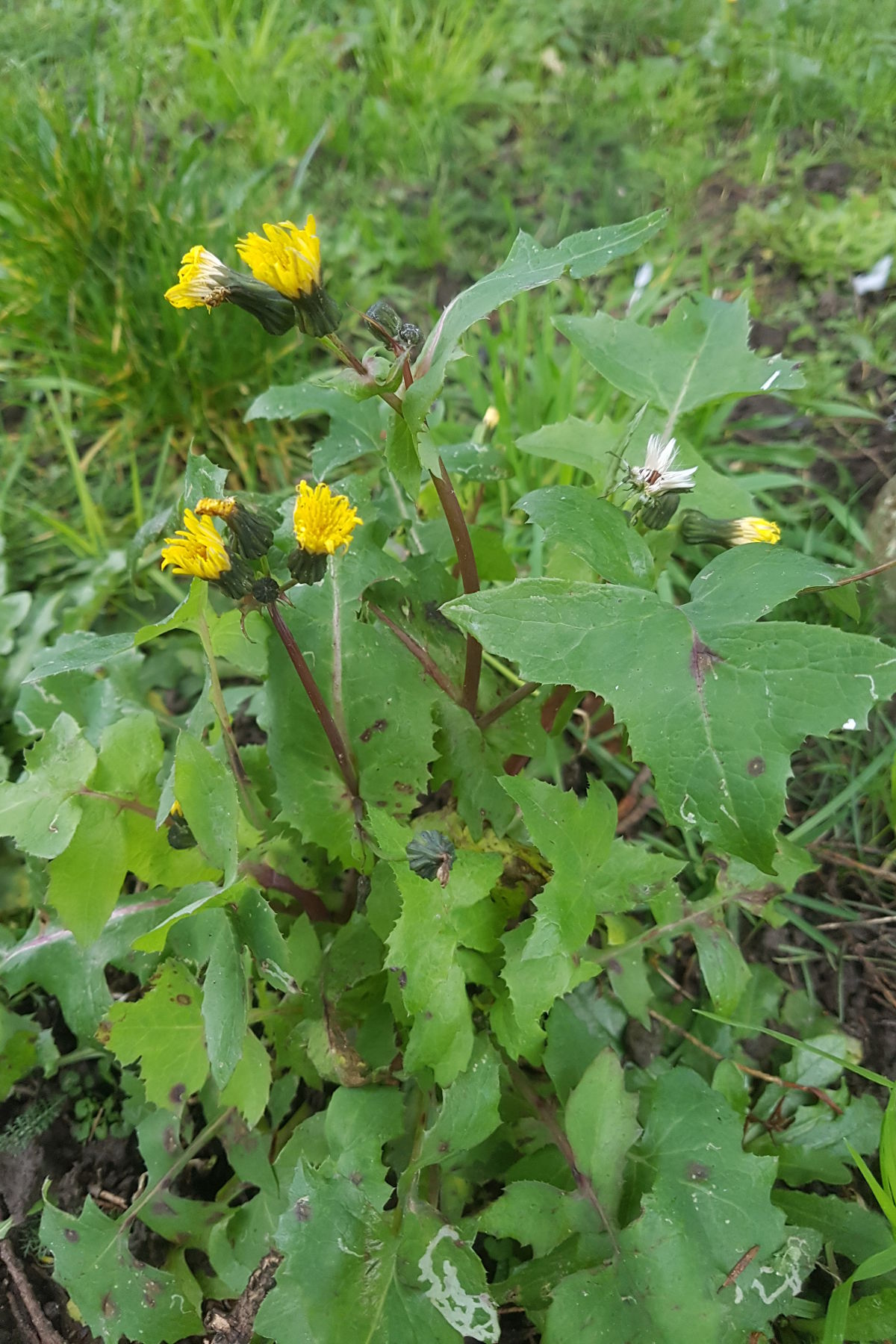
After doing a run, I cut across the Dene to avoid some people on the path and found the revoltingly named Dog's vomit slime mould (Mucilago crustacea).


Witches butter - 26 Dec, Uckfield

In the last few days of the year, I had a look round the garden to see what I could find. The strange yellow blob that appeared on one of our old oak logs is Witches butter (Tremella aurantia), which grows on other fungi.

I am already planning my next New Year Plant Hunt. This time, it's not about timing my arrival at The Station pub to coincide with opening. Instead, it is about how to find some flowers without encountering too many people.