Friday, 17 June 2016

#30DaysWild Drawing Breath

It's Friday, which is as good a time as any to draw breath and round up my Wildlife Trusts' #30DaysWild moments.

It's been a week of grim news, starting with the appalling gun attack on a gay nightclub in Orlando, USA and ending with the murder of Jo Cox, an MP who had campaigned for the most vulnerable people on the planet. It was a relief to be able to dip into the #30DaysWild Twitter stream, which is full of cheerful pictures of wildlife and people engaging with nature.  For more, see MyWildLife, where bloggers describe their #30DaysWild adventures.

Day 10 - Taking advantage

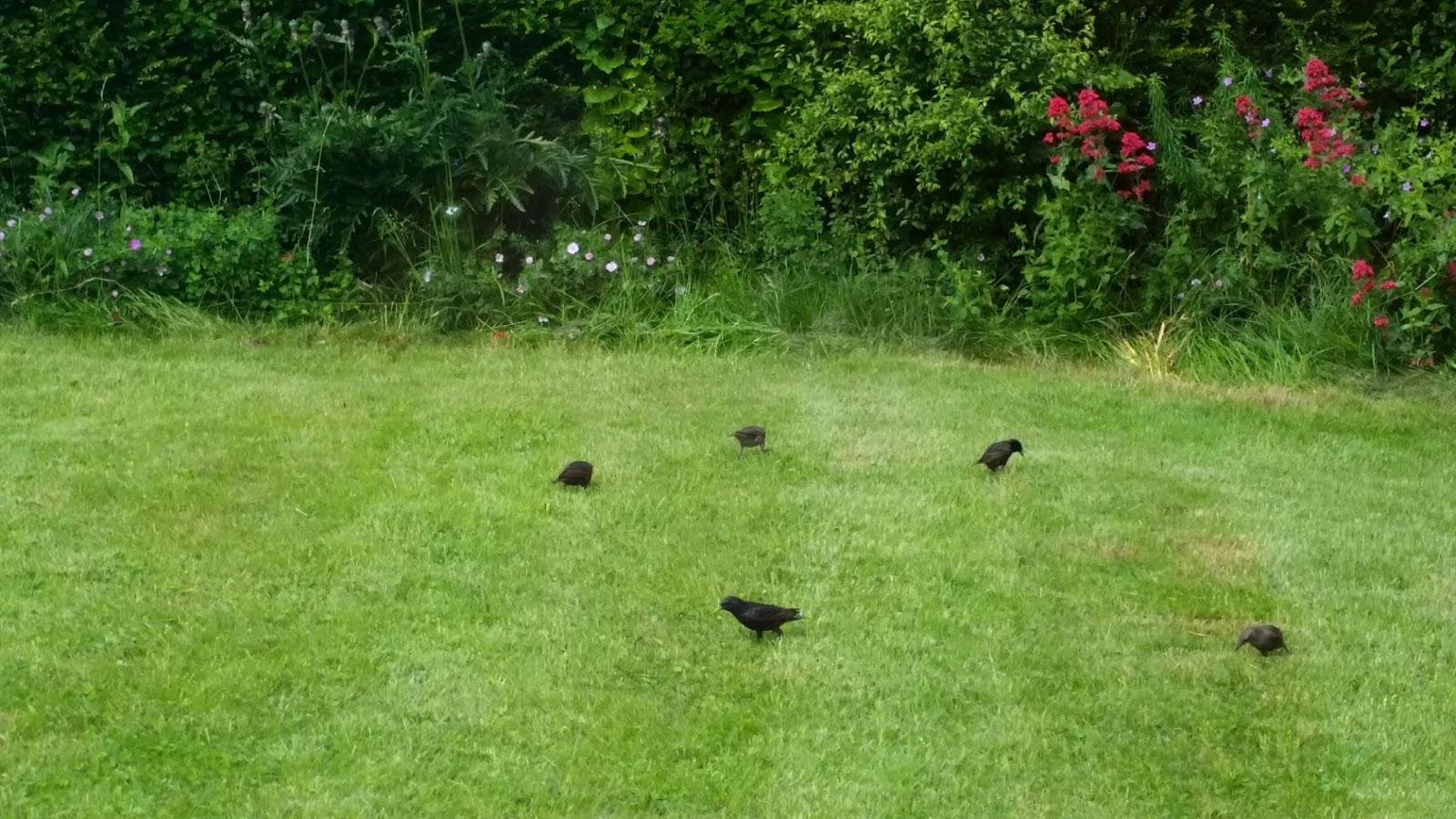
Starlings taking advantage of the short grass - Uckfield garden.
I was a little sad, when our grass was cut, to lose the buttercups and pretty grass-heads but our local starlings were quick to take advantage, searching the ground for leather jackets and other treats.

Frothy white blossom of Robinia - Uckfield garden.
Later in the day, I took advantage of a spare moment to listen to the buzzing bees and look up at the frothy white blossom of our Robinia tree, which is now at its best.

Three-cornered leek - destined for a salad.
After work, I foraged in the garden and took revenge on a garden invader.

I wrote about Day 11 in my post about my visit to the Hempstead Meadow Nature Reserve.

Day 12 - A rainy Sunday

Early in the day, I was looking out over the garden, when I heard the laughing call of a green woodpecker.
 
laughing woodpecker
flies under darkening skies
to feed hungry brood

As it was raining for much of the morning, I spent some time going over my Bioblitz results.  I was surprised by how much I had found out by simply observing the creatures in my garden and then looking for identifications in Facebook groups etc.

Day 13 - More Rain

Water gurgling into the water butt.
Monday I grabbed a moment to put my head out of the front door and listen to birds singing in the rain and water gurgling into the water butt. 

Day 14 - Flowers on the way to Birmingham

Spotted Orchids by the side of the road. 
The previous evening, I had become concerned about articles and letters in the local press complaining about the unmown verges. I dashed off a letter to the local paper praising the mowing regime that had preserved Orchids and other flowers. The sight of them brightened a dull morning.

Fern and a glimpse of bunting from the Queen's birthday celebrations.
I also found wall bellflower, yellow corydalis and ferns clinging to the town's old walls.

Ox-eye daisies at Ashurst Station.
I travelled up to Birmingham, running in and out of the rain.  Looking up from my work, I saw many wild flowers from ox-eye daisies at Ashurst station to purple Fox gloves smothering embankments.  Shortly before Coventry, I glimpsed a field full of red poppies.

Monday, 13 June 2016

Garden BioBlitz 2016 - What did I find out?

Earlier, I wrote about doing my Garden BioBlitz in which I found as many wild plants and creatures in my garden as possible. This was Day 4 and 5 of #30DaysWild. Now, I have identified as much as I can and logged them in iRecord.

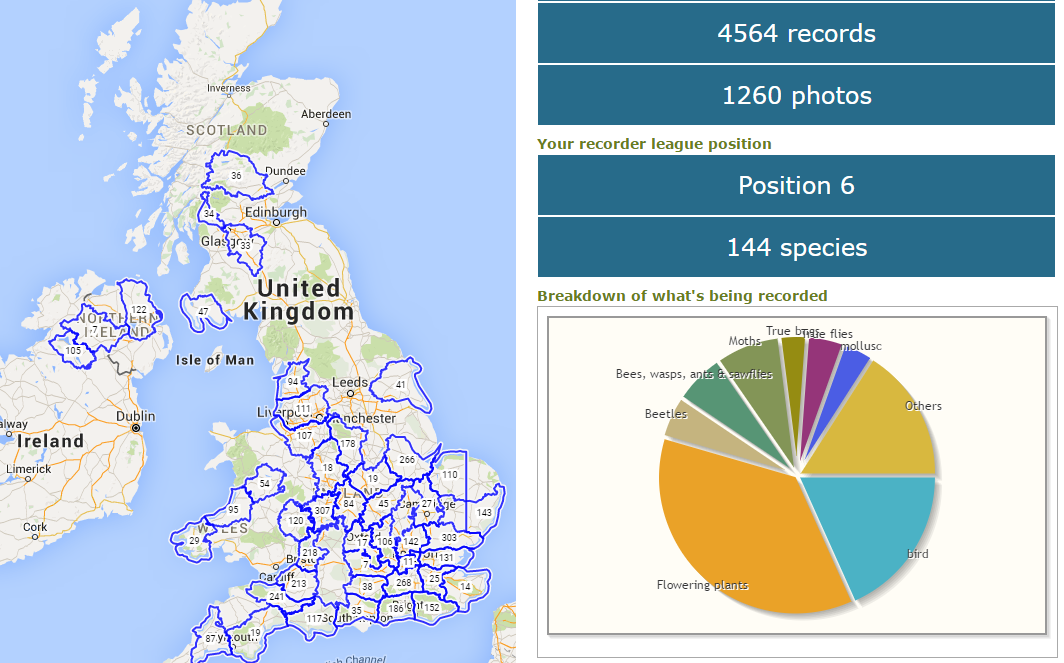
To start with, my records were not included with the BioBlitz totals. This was because I hadn't set up the Garden BioBlitz 2016 activity in iRecord. The kind person running the GardenBioBlitz Twitter account untangled my error and my results appeared with the rest.  This is how the national summary looked when I finished putting in my results on June the 10th.


National Results on June the 10th - 152 species for East Sussex.
The pie diagram shows what sort of wild things people were finding. The big orange sector represents flowering plants, aqua is birds etc.  So how does mine compare?
Breakdown of my 144 Species.

Moths and Birds - Must Try Harder!

Compared to the National breakdown, my bird and moth counts are low. My bird list seemed reasonable for our garden but I can probably do better. However I haven't been paying attention to moths, so maybe that's something to look at over the coming year.

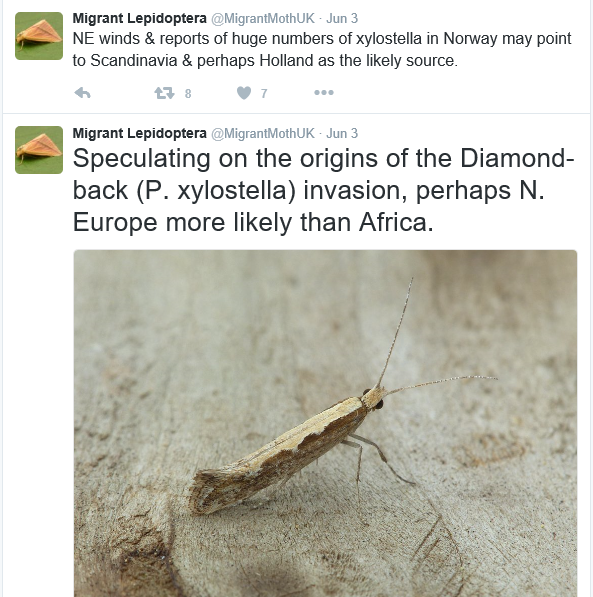
Diamondback moth (Plutella xylostella)
One moth I did see - and in some numbers - was the tiny Diamondback moth. You are likely to have seen them but without magnification they look like white lines about 1cm long. Every time I walked through the long grass in our garden, they sprang out from under my feet.


Since the beginning of June, the @MigrantMothUK Twitter account has been retweeting reports of thousands being found all over the country. They suggest that they may have been come from Scandinavia. Maybe they were carried on the cold North winds we experienced at the end of May. This is bad news for vegetable growers as their caterpillars eat brassicas (cabbage family).

While I am talking about moths, I must mention the Moths UK & Europe Facebook group who have kindly helped to identify a small, brown but intricately patterned Common Marble (Celypha lacunana) moth.

Common Marble (Celypha lacunana)
Bees, Wasps, Ants and Sawflies - Finding out more

My pie chart shows that I am doing quite well in terms of numbers for Bees, Wasps, Ants and Sawflies and I am gaining a better understanding of the differences between the main groups.  Every now and again I make really idiotic errors but I am quite pleased with my progress.  This is really down to the kindness and patience of the iRecord verifiers and members of the UK Bees, Wasps and Ants Facebook group who have been patiently verifying my results and tactfully correcting my errors.

Small Garden Bumblebee on foxglove (sorry - a bit blurred).
Facebook groups like this also help me understand the behaviour of the creatures in my garden. While doing the BioBlitz, I realised that bees pollinating Foxgloves were making a loud high-pitched buzz, In a UK Bees, Wasps and Ants Facebook group post, David Norton explained "Buzz Foraging" as follows:

It's called "buzz foraging" in flowers with abundant pollen like this poppy the bee vibrates its wing muscles without moving the wings, this creates an intense vibration, the pollen flies off the flower onto the bee which then grooms it off and onto the pollen basket. 

Matt Smith then confirmed that they also did it in Foxgloves.

I am beginning to get my head round the main groups of solitary bees, thanks to Ryan Clark's Guide to Solitary Bees in Britain.

If you are scared of spiders, look away now!

Another fascinating if rather gross insight came from the British Spider Identification Facebook group (I think).  Unfortunately, I can't find the post now but it showed a black Spider Eating (Auplopus) wasp removing the legs from a Sac Spider (Clubiona).  Once this is done, the wasp would fly off, carrying the spider to feed its young.  I found both in my BioBlitz and am pleased to find out how they fit into the garden food web.

Predator - Spider Eating Wasp (Auplopus)

Prey - Sac Spider (Clubiona)
2016 vs 2015

I found more species (144) this year than last (129). There was a fair amount of 'churn'. I 'lost' 26 species but gained 35:
  • I lost some birds, which regularly visit the garden, by missing the 'early shift'.
  • I lost some flowering plants - due to our own tidying and browsing by a Fallow buck.  I am quite indignant that the deer, having eaten some of my total, didn't do the decent thing and turn up on BioBlitz day.
  • A notable absence was spangle galls on the oak - last year there were thousands.
  • We've lost the liverwort from a damp area.
Green Shield Bugs.
However, I have added many new species. Maybe some, such as the Shield Bugs and Butterflies appeared due to the lovely sunshine that appeared halfway through my count.  Others such as ground beetles and centipedes were included because I focussed more effort at ground level.

Looking forward

Things will consider focussing on next year include:
  • A better organised set up - due to being in Birmingham the previous week, I didn't prepare very well.
  • More Moths - maybe I'll try a simple trap to catch some night flyers.
  • More ground level creatures - I had some success with my beetle traps especially those by the wall, so I will try these again next year.
  • An early shift to catch our garden birds.
  • Maybe moss and lichen.
And ... of course ... I will keep on learning about the web of life in our garden.

Saturday, 11 June 2016

Footballers in Hempstead Meadow Nature Reserve and Fields

It been a busy and rather stressful week and I've seen squeezing my #30DaysWild encounters into little bits of time, here and there.

Day 11 Visiting a Local Nature Reserve

As it has been such a tiring week, I left celebrations of the Queen's 90th Birthday and the anxious wait for England's first game in Euro 2016 to others.  Instead, Mum and I visited Hempstead Meadow Nature Reserve, which is run by Uckfield Town Council. 

I love the way this reserve is snuggled into the bottom of the town, between Waitrose and the station. When I travel on the train, I often look over it to see what's happening.

Sea of Hemlock Water Dropwort
At this time of year, it is dominated by a sea of white flowers and the gentle hum of pollinators. 

One of many Honey Bees on the Hemlock Water Dropwort
The flowers are Hemlock Water Dropwort and many of the insects pollinating it are Honey Bees.  As we walked along the boardwalk, a small mammal ran up the bank into the bushes. I think it was a vole of some sort - as its size was between that of a rat and a mouse, it was 'blunt' and its tail wasn't very long.

Greater Tussock Sedge.
Dotted around the reserve are ancient-looking Greater Tussock Sedges.  In winter and spring, these sedges raised on pedestals of their own old growth, stand proud. Now they are submerged in the wildflowers.

Flag Irises, sedge and other flowers.
In one of the clearer areas of water I spotted whirligig beetles, pond skaters and a little fish - probably a Stickleback. Once past 'Stickleback Bridge' the vegetation begins to change with more-and-more grasses mixed with buttercups, brambles, geraniums and other wild flowers.

Train going into Uckfield Station.
We rested on a seat for a while and our local train tiptoed into the station.  There was birdsong all around us - including a Chiff-chaff. Several people passed on their way to or from the town.

Sketch of view along path. The gate leads to Waitrose car park.
I spent a few minutes sketching the scene and then wandered round the meadow.  I saw damselflies with dark wings, probably Beautiful Demoselles - a male and a female.

Meadow Cranesbill.
Common Blue.
The meadow was full of insect life. As well as bees there were butterflies, Swollen-Thighed Beatles and - I think - a bright red Cardinal Beetle that was a little too quick for me.

Watching the Bees and Hoverflies.
On the way back, I paused at Stickleback Bridge to watch the Bees and Hoverflies that were settling on the flowers.

The Footballer (NOT!) - Hoverfly.
CORRECTION: I've just been told that this is Parhelophilus sp NOT Helophilus pendulus, which is the one known as The Footballer.

As England's Euro 2016 campaign opens today, it is apt that one of the Hoverflies I saw appears to be wearing a striped jersey, like a footballer.  After we left the nature reserve, it was a pleasure to see families playing and relaxing in Hempstead Fields. Some little ones were enjoying the new equipment at the top. One group was first persuaded to try the big slide by their parents and then couldn't be torn away from it. Sweetest of all was a tiny footballer who, far from being a boy in his favourite team's kit was a little girl in a pink dress with flowers on her shoes.  Maybe one day, we'll see her playing for England.

Oh - and while I was writing this - the Red Arrows flew over. Happy Birthday Your Majesty!

Friday, 10 June 2016

#30DaysWild - Paying Attention

After the excitement of the Garden Bioblitz, it's back to squeezing my #30DaysWild into bits and pieces of time.  Having guiltily stolen time last week, I feel more entitled to spend time this week. It is only a few minutes here-and-there and helps steady my mind and so I can really focus on what I need to do.

These days, there is much talk about mindfulness (paying attention to the present moment and your sensations) and its mental health benefits. With these #30DaysWild moments, I am doing something similar - taking a tiny amount of time out to focus on something and my own reactions to it. Then I return to my daily tasks with a fresher mind.

Day 6 - Patterns in a fern

Sunlit Fern in our Uckfield Garden
Another busy day. Grabbed a couple of minutes away from the laptop and found sunlit ferns - I was fascinated by the way the sunlight picks out the patterns in the leaves.

I spent some of the evening identifying members of the 'awkward squad' from the Garden BioBlitz.

Day 7 - Wine and orchids

Tickerage sparkling wine and birdsong.
Between the end of the working day and going to an Uckfield Neighbourhood Plan meeting, I took my drink outside. I was serenaded by birdsong whilst enjoying locally produced wine. Truly a moment to savour.

Spotted Orchids on the way into town.
On the way to the meeting, I knelt amongst the wildflowers at the roadside and marvelled at the intricate patterns on the tiny orchid flowers. As an aside - a big thank you to East Sussex council for not mowing these down.

Day 8 - Busy bees

Tree Bumble Bee on ceonothus
After getting the newspaper first thing, I watched bees hard doing their work before getting on with mine. A definite fellow feeling there.

Honey Bee.

Day 9 - A little Alchemist

Water drops on Alchemilla Mollis.
Alchemists used drops of water, which they believed to be very pure, from the leaves of this plant. Hence its name, Alchemilla Mollis.


Buttercups rescued from the mower.
Mid-afternoon we got a call saying the man with the mower was coming to deal with our grass. I shot out and picked buttercups.

As well as looking at my own wildlife, I have been dipping into the #30DaysWild Twitter stream. Because others have kindly helped me with identification, I am trying to pay it back by helping others identify their bugs and flowers.  There are more #30DaysWild blogs at the Wildlife Trusts' MyWildLife page.

Wednesday, 8 June 2016

#30DaysWild - Stolen Moments with Nature

While I was in Birmingham, I visited a buttercup field and found Ragged Robin on a ragged verge.

However, once I am home, it can be hard to find time during the working week to do anything other than meet work and other commitments. It is fortunately that others doing the Wildlife Trusts' #30DaysWild challenge are teaching me how to steal moments from my day and give them to nature.

I'm also going to confess to a blogging sin - my posts are out of order. I wrote up my Day 4/5 BioBlitz before this post about Day 2 and 3.

Day 2 - Beetles at the Watford Junction

Sitting next to wildflowers while waiting for the train.
On Day 2, I travelled home from Birmingham to Uckfield. At Watford Junction, while I was waiting for the train, I sat on a low wall next to some wildflowers.

Oedemera Lurida at Watford Junction.
A couple of long, narrow Oedemera Lurida beetles jumped onto my bag and I had to carefully return them to their flowers.  I love the way nature finds its way into the unlikeliest places.

Day 3 - Taking a moment from the laptop

Foxgloves, Uckfield Sussex
Friday was exceptionally busy. I took a moment away from the laptop to admire self-sown foxgloves in our garden.

Looking forward to the Garden BioBlitz

Due to dull weather we haven't had many bees but during the next day's Garden BioBlitz, I would see nine different species including a number going in-and-out of the Foxglove bells.

 
Red Mason Bee (Osmia bicornis) - from the next weekend's BioBlitz
I used Ryan Clark's-easy-to understand guide to solitary bees on the Wildlfe Trusts website to help me understand the different types including the Mason bees, who store their pollen on the underside of their abdomen as shown in the photo and large Wool carder bee (Anthidium maculatum), which lead me a merry dance on BioBlitz day. So a big thank you to Ryan for his wonderful guide and also to the patient and hard working verifiers on iRecord, who verified my sightings and tactfully corrected my errors.

Monday, 6 June 2016

Garden Bio Blitz 2016

It's the first weekend of June and it's time to record as many species as I can for the Garden BioBlitz.  I really needed to go into town on Saturday morning and fine weather was forecast for Sunday, so my 24 hours ran from 2:15pm on Saturday to the same time on Sunday. 

Because I have just started doing the WildLifeTrust's #30DaysWild, this has been a very wild-life intensive few days.  Although I had a pleasant visit to a buttercup field in Birmingham, I was disappointed that the bluetits that nested in the box on the side of the house had gone before I came back to Uckfield.

BioBlitzing our garden - A lovely Sunday morning.
Before I started, I set myself some objectives:
  • To record more species than I saw last year (127)
  • To pay more attention to ground-level minibeasts and get a centipede onto my list.
  • To detect a bat with the detector I got for Christmas.
Blackbird sunbathing.
My first BioBlitz sighting for 2016 was a pair of blackbirds sunning themselves. The female was on the grass and the male had spread himself out along one of the branches of our conifer.

Germander Speedwell in an uncultivated corner.
I did a quick round of the whole garden, ticking off flowers from my 2015 list. I hadn't particularly noticed during the year but we have had some casualties, probably due to our own tidying, which is 'assisted' by a visiting fallow deer.  On the other hand, I have recorded two self-sown trees, beech and rowen, for the first time.

Common Carder Bee feeding on Iris Sibirica
After this, I started looking at the minibeasts, particularly pollinators, that land on the flowers and leaves in the garden. I found myself fascinated by a Common Carder Bee feeding on an Iris Sibirica, its weight opening and closing the flower as it climbed in and out of its petals.

Western Yellow Centipede (Stigmatogaster subterranean)
It was only about 5pm when the light started dropping. It was time to find a centipede. I dug around in the "ready-to-use" compost from our heap and found a wriggling orange ribbon. I flicked it into a little pot, figured out which end was the head, took a photo and returned it to its home. 

After setting up beetle traps,  it was time to go indoors and start processing results.  by the end of the evening, I had identified 102 species had about 15 photos of unidentified creatures.

The Bushnell 'traps' a fox while I sleep off the day's efforts.
At 9:45pm I was outside again, bat detector in hand. I always get stupidly excited when detecting - waiting for those click-slap-click noises that herald the arrival of a bat. I waited and waited. Then just before 10pm, few weak squelchy clicks. My excitement mounted as I tried to pinpoint the direction. The clicks got stronger and louder and - there it was! A Common Pipistrelle, fluttering in the gloom - the perfect end to the first few hours of my Garden BioBlitz. It was time to leave the garden to the creatures of the night.

Beetle trap with Nebria Brevicallis in pot.
Sunday morning was bright and, having slept like a log, started a little later than I intended so I missed the early shift. I focussed my efforts at ground level and found black beetles in my beetle traps, slugs under paving slabs, and woodlice under garden ornaments.

Swollen-Thighed Beetle
Some beetles live a sunnier life. Amongst our flowers, I found several shiny green Swollen-Thighed Beetles. Whilst searching, I could hear the "dee-dee-dee" of bluetits calling each other. I kept looking up but, frustratingly, didn't see anything in our thick trees.

Hawthorn Shieldbug rocking 80's-style shoulder pads.
As I searched round shrubs and trees in the garden, I found three different species of shield bugs. The Hawthorn Shieldbug's block colours and pointed shoulders always remind me of the daft fashions we wore in the eighties. I tried shaking the trees but only the tiniest of insects came down.

Baby blue tit well disguised in the dappled light and birch leaves.
I was in the last stages, just mopping up the last few wild plants, when I heard "dee-dee-dee" and saw a flicker of movement in our birch trees. There was an adult bird finding insects where the clumsy human had failed and then ... two little balls of fluff emerged to be fed. I'm assuming that this is our bird box family and I was delighted to see them.

I've managed to meet my objectives having:
  • identified 131 species with more to come - however finding them took more effort this year
  • used beetle traps and dug around in the compost heap to find ground-level creatures including an implausibly long centipede
  • detected and watched a bat.
There are more details about the results in Garden BioBlitz 2016 - What did I find out?

I've also enjoyed a day "playing in the garden" - making beetle traps and dipping ponds. I exchanged photos and IDs with others across the country who were BioBlitzing their own gardens or taking part in #30DaysWild. I've learnt to identify some more of the creatures with whom I share the garden and greeted some who I thought had left without saying goodbye.  Quite simply, a lovely way to spend 24 hours in June.

There are plenty more #30DaysWild blogs at MyWildLife.