Showing posts with label churchyard survey. Show all posts

Saturday, 15 February 2020

Biological Recorders' Seminar 2020 - Sussex Biodiversity

As Storm Dennis started lashing the country with rain, I was heading towards Sussex Biodiversity's 2020 Biological Recorder's Seminar.

Fixing and Linking Our Wetlands


Last weekend, I had been exploring an old Uckfield Tithe map and noticed just how many ponds there were in the area back in the 1840s.  Coincidentally, my first conversation was with a representative of the Fixing and Linking Our Wetlands (FLOW) initiative. She had also been looking at old tithe maps to find out where ponds had been so they could restore them.  She has been receiving communications from landowners whose ponds have been restored saying that they are not experiencing flooding even though it has been an exceptionally wet year.

Highlights of wildlife recording in 2019


Many of the highlights are explained in Adastra 2019.

Tall Ramping Fumitory - Victoria Pleasure Grounds
A couple of items relevant to Uckfield and the local area are:

  • In the Freshwater Fish report (page 29) a report about Dace in the Uck (not far from the bypass). They spawn in March/April and you might be lucky enough to see a silver flash as they jump over obstacles or try to catch a fly.
  • In Amphibians and Reptiles (page 32) they thanked the Uckfield toad patrol "for their continued effort to protect toads crossing roads, to and from their breeding ponds.
  • Vascular Plants (page 12) mentioned the new site for Tall Ramping Fumitory that I found during my survey of Victoria Pleasure Grounds, undertaken for the SBRS Village Green and Recreation Grounds project.

A couple that really struck a chord were:
Soil Biodiversity


This is a truly fascinating area,  I was aware of microrhizal fungi but there is so much more going on down there. Natural England had set up microscopes so we could see live millipedes, springtails and even a Tardigrade.

Ouse and Uck

At the first break, I stumbled on the stand for the Ouse and Adur Rivers Trust and bought some copies of their new book, "Ouse and Uck, sketch of a Sussex Catchment."


There was also a stand about the River Ouse Project comprising a poster (available from their reports page) with a wealth of information about Meadows.

Potters on the Heath


I very much enjoyed John Walters talk, illustrated with his wonderful photographs and drawings about potter wasps.

Notable Sussex Bees

James Power of Sussex Bees and Wasps Recording Group gave brief descriptions of 10 notable Sussex bees and wasps.
  1. Macropis europaea - Yellow Loose-strife Bee
  2. Ammophila pubescens - Heath sand wasp
  3. Anthophora retusa - Potter Flower Bee - Seaford Head
  4. Halictus eurygnathus - Downland Furrow bee - Lewes, Slindon
  5. Andrena vaga - Gray-backed Mining Bee - Dungeoness, Rye Harbour
  6. Cerceris quinquefasciata - The Five Banded Tailed Digger Wasp - High and Over
  7. Nomada zonata - Variable Nomad Bee - becoming WIDESPREAD
  8. Colletes cunicularius - Early Colletes - attracted to Willow
  9. Bombus muscorum - Moss Carder Bee - flower rich grassland
  10. Osmia bicolor - Red Tailed Mason Bee - downs, nests in abandoned snail shells

I haven't met any of these bees yet but I live in hope.

Botanical Recording in Sussex Churchyards

Girdled Mining Bee - Holy Cross - 27 April 2017
Helen gave a lovely talk on this, which featured one of my bee photos, taken in Uckfield's Holy Cross Churchyard. I wrote posts on my Early April, Late April, June and August 2018 surveys

One unexpected point was that, for finding unimproved grassland plants, Victorian churches were the best. Medieval ones were not so good.

National Bat Monitoring Programme


Philip Briggs outlined bat recording schemes and some of the results.

The Spiders of Sussex


Graham Lyons outlined highlights of 2019 intensive spider recording.

Back home


After all the talk of ponds and rivers, I decided to check our own pond. As I approached, there was a splash and a glimpse of a webbed foot. Our frogs have arrived and are spawning.

Saturday, 27 October 2018

SBRS - Autumn Get Together

The Sussex Botanical Recording Society (SBRS) Autumn get together marks the end of my botonising efforts for the year.  There was a series of very interesting talks, a photo competition and much to interest and amuse.

Staplefield Village Hall, 27 October 2018

Bruce Middleton - Heaths of Sussex

Bruce talked about heathland and its species. One interesting section was about improving the habitat for invertebrates by scraping the heather turf off, forcing it to regrow.  This was actually done by golf clubs who were able to re-use the turf to create areas of heathland around their golf courses.

One thing that I had not realised is that healthland needs some disturbance to thrive. During World War II, Heathland was used for exercises, which provided some useful disturbance.

Churchyard Survey

Helen gave us an account of the Churchyard Survey including detail on a particularly good Burgess Hill churchyard.

Notable East Sussex Records 

Matt gave a very interesting talk about native and non-native plants that had been found in Sussex.  Fascinating though the natives are, it was the non-natives that got my attention. Everything from Gaura (Butterfly bush) to Datura (Angel's trumpets)

Field Bindweed

Field Bindweed, Uckfield Rugby Club, 1 July 2018
I'm sure that Mike talked about other things but it was the Field Bindweed that got my attention. Apparently there are 10 subvarieties with varying colours and patterns on the flower. For example some have a yellow middle and others additionally have a red zig-zag line round the centre.  When I surveyed the Uckfield Rugby Club field, I noticed that the Field Bindweeds had different patterns and colours but thought no more of it. .

Find of the year

One of the field trips turned up an unusual discovery. The group found Great Pignut (Bunium bulbocastanum), which has never previously been recorded in Sussex. It has been recorded in the Chilterns and Northern France but never in between.  In its normal habitat, it grows in disturbed places such as verges and as an arable week.

Distinguishing features:
  • Bracts and Bracteoles
  • Fruit has a swollen stylopolium
Arthur's questions

Arthur had made some observations in his own garden including
  • Coral root - the roots actually look like coral
  • Oxalis - leaves turn pink when ants are present (similarly bluebell flowers turn pink)
An unexpected pleasure

St Marks wall paintings.
After the meeting, while I was waiting for the car park to clear, I took a look at the church. St. Marks was built in 1847. The charming wall paintings are by the Victorian stained glass designer Charles Eamer Kempe. 

Sunday, 31 December 2017

2017 - Adding New Species to my List

I like to record the wild plants and insects that I encounter using tools such as iRecord.  This year I recorded approximately 350 species of which nearly 100 were new to my lists.  This compares well with last year's 290 (with about 80 new).  This post is going to focus on the species that are new to my lists this year.  I have seen some of these before but this is the first time I've recorded them.

Some of the new entries are the result of me working in Leatherhead where I explored a new riverside habitat but many were much closer to home. Two species that I saw in both Leatherhead and Uckfield were the Beautiful Demoiselle (Calopteryx virgo) and Banded Demoiselle (Calopteryx splendens).

Female Beautiful Demoiselle - near Lime Tree Avenue - May
Uckfield's Banded Demoiselles were rather camera shy but I did get some photos of the Leatherhead ones. The two males below were part of a group (over 16) that roosted overnight in a clump of strappy leaves near the river. There must be similar roosts near the Uck. Has anyone seen one?

Male Banded Demoiselles - Leatherhead - June
My recorded year started with more humble species. I did the BSBI's New Year Plant Hunt, which meant that I needed to hunt out any wild or naturalised plant that was in flower. The plants that are most likely to be blooming are the hardy, versatile weeds that grow in supermarket car parks, industrial estates etc. A new one for me was Annual Mercury (Mercurialis annua).

Annual Mercury - Bellbrook Industrial Estate - January
This year, I paid a number of visits to Holy Cross churchyard to identify the plants there for the Sussex Botanical Recording Society churchyard survey.  While I was investigating the plants I found a number of species of both plants and insects that I had not encountered before.  The Girdled Mining bee (Andrena labiata) is "scarce" and relies on "unimproved" grassland - i.e. grassland that has not been fertilised etc. Our old churchyards often have this type of ancient grass.

Girdled Mining Bee - Holy Cross Churchyard - April 2017
Cockspur (Echinochloa crus-galli) - Holy Cross Churchyard - August 2017
In early June, I did a Bioblitz of our garden. This means finding as many different species of wild plants and animals as possible. I found over a dozen that were new to me including:

Cantharis livida - No-mow zone - June 
Rhopalus subrufus - Flower bed - June
Selimus vittatus with her egg case - Oak tree - June
One of the highlights of the year was joining the Uckfield Local Nature Reserves Supporters Group. We went on a number of bird song/bug walks and a fungi hunt. I also did a little exploring of my own.  I am fairly familiar with Hempstead Meadows Local Nature Reserve (LNR) and found a few new bugs and beasties including:

Devil's Coach Horse (Ocypus olens) - Hempstead Meadows LNR - August
Notostira elongata - Hempstead Meadows LNR - August
West Park LNR is less familiar and enjoyed exploring it with the group. In November, we went on a fungi hunt and found a good variety of fungi. Beware that I got in a bit of a muddle trying to identify them and it will be a while before they are verified. They included:

Blushing Bracket (Daedaleopsis confragosa) - West Park LNR - November
Witches' Butter (Exidia glandulosa) - West Park LNR - November

It's not all about surveys and special expeditions. I saw the Beautiful Demoiselle on the way to the town. Mum showed me this dear little 10-spot ladybird (Adalia decempunctata) that she found while gardening.

10-spot ladybird - Found in our own garden.
This Large Garden bumblebee (Bombus ruderatus) bumbled into a patch of garden I was sorting out, sending me scurrying into the house for my camera.

Large Garden Bumblebee - my gardening is constantly interrupted by bees!
In Uckfield, we are lucky that we have plenty of green spaces and paths that we can follow as we go about our daily lives. I've been amazed at just how many creatures and wildflowers I see by looking out while going about my day-to-day shopping trips etc. If you ever see a woman in a red beret peering into her phone, it could be me recording wildlife on the run.

Sunday, 27 August 2017

Holy Cross Churchyard Plant Survey - End of August

On the 26th of August, I did the fourth and final visit of the Sussex Botanical Recording Society's Churchyard survey. Although Fuchsia is a cultivated plant and doesn't count for this survey, it was lovely to see the bright red flowers dripping over the side of the Churchyard wall and buzzing with honeybees.

Holy Cross Church, Uckfield
One of many honeybees on the Fuchsia
As I went in I heard sounds overhead and looked up at a group of House Martins dipping and diving as they hunted their insect prey. Going into the churchyard itself, I noticed that it was loud with birdsong.  The star of this little show was a Robin that seemed to follow me around as I looked for plants.

After the previous Sunday's service Mum had brought home a piece of unusual-looking grass for me to identify.  After 20 minutes scrabbling through books and Googling, I identified it as Cockspur (Echinochloa crus-galli)

Cockspur, between the old and new brick paths.
I found dozens of plants, lining both sides of the lovely old brick path that goes from East to West across the churchyard.

Detail of Cockspur flower head.
Towards the South end of the Churchyard I found a beautifully carved headstone.

1880 headstone.
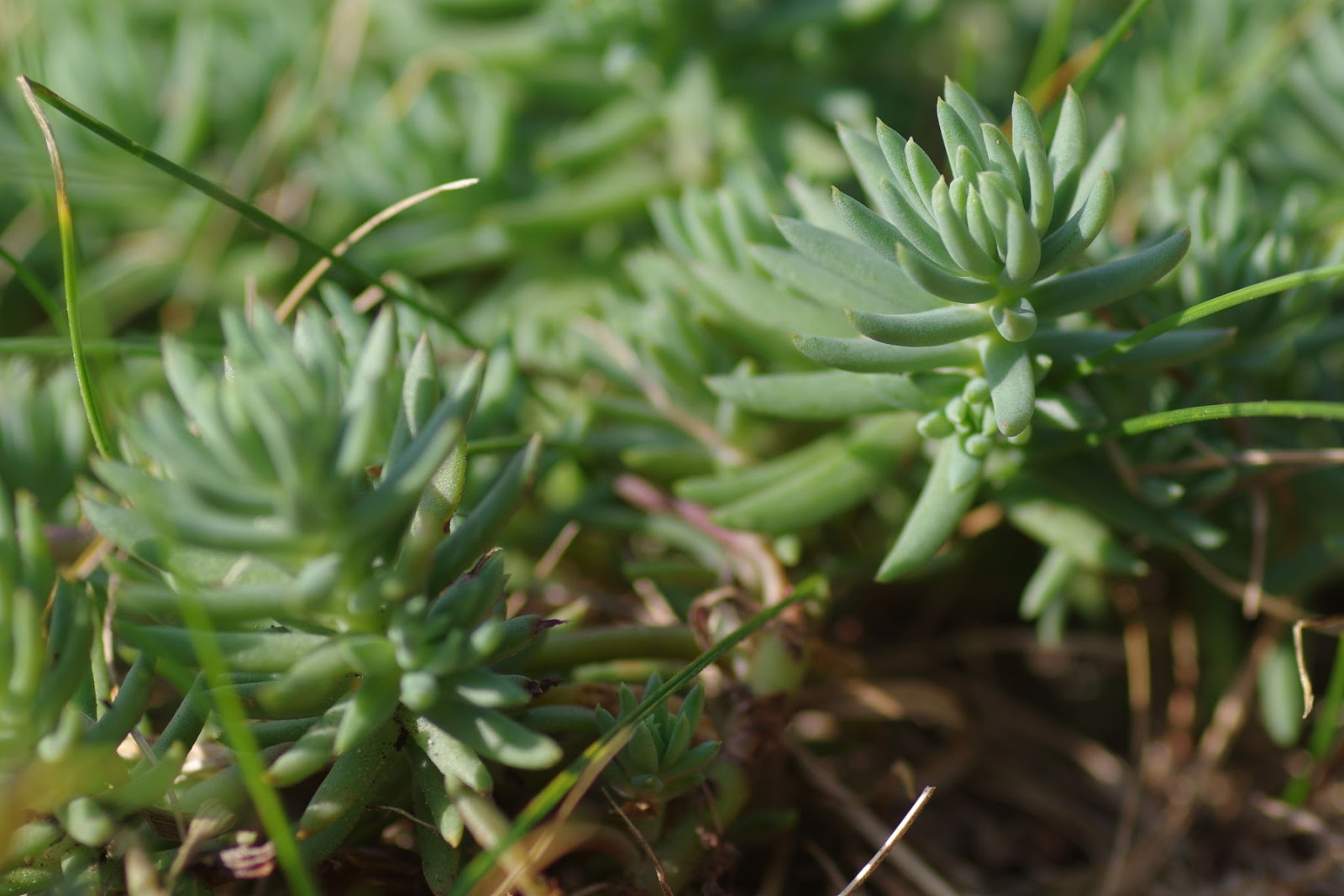
On one of the old graves, I found a clump of Reflexed Stonecrop (Sedum rupestra).

Reflexed Stonecrop.
The ever-irrepressible Dandelion (Taraxacum) flowers held their heads high above the neatly mown grass, providing a feast for pollinators such as Hoverflies.

Two different species of Hoverfly on one Dandelion flower.
In the miniature world of the short grass, I found another new species for my list.

Small Flowered Cranesbill (Geranium pusillum).
While I was trying to identify this, a lady stopped and asked what I was doing. I told her about the survey and we chatted about wildflowers and walks, then she went on her way. 

I found my last 'new entry' near the war memorial. It is Canadian Fleabane (Conyza Canadensis). The tiny petals have a slight lilac tinge.

Canadian Fleabane
Canadian Fleabane - tiny petals tinged with lilac.
It is a strange and poignant coincidence that the Canadian Fleabane should appear next to the War Memorial. During the Second World War, the 1st Battalion Argyll and Sutherlands Highlanders of Canada was stationed in Uckfield for about a year.  The BBC article, Lorne - The Canadian Soldier, tells Peter Hunter's personal account of one of the soldiers. Another of the Canadian soldiers, Private Lyall Wright Wotton, married a local girl and is remembered in Uckfield's roll of honour.

Saturday, 5 August 2017

Holy Cross Churchyard Plant Survey - End of June

On the 24th of June, I recorded the plants in Uckfield's Holy Cross Churchyard for the Sussex Botanical Recording Society's Churchyard survey. As the weather was miserable on the day I did the survey I returned on the 1st of July to check some IDs and take some photos. This is my third visit, the first two being at the beginning and end of April

I've already recorded over 80 species and it was good to see some properly out in flower, like the Bird's Foot Trefoil (Lotus corniculatus) shown below.

Bird's Foot Trefoil.
I heard a buzzing and took a closer look at the bee pollinating the flowers.

Common Carder Bee on Bird's Foot Trefoil.
I was intrigued by the writing on the gravestone. The weather-worn letters were difficult to read but I could make out ...
 
THOMAS BROOKE ...
.... Uckfield ...
 
WHO DIED FEBRUARY 3rd 1876
....
Blessed are the pure in heart
... shall see god.

Thomas Brooke may have been a tailor on Uckfield High Street or one of his family.

Nearby a White-Tailed Bumblebee was foraging in the hedge alongside the churchyard.

White-tailed Bumblebee on bramble flowers.
Some of the plants I recorded are those little weeds that are so familiar that we hardly even see them. Identifying them obliged me to take a proper look at them.


Distinguishing between Willowherbs by comparing the share of the stigma (central female part).
The Collins Wild Flower Guide has keys that help me pick my way through different types of similar flower. The two Willowherbs I found were:
  • on the left, with an undivided stigma, is Square Stalked Willowherb (Epilobium Tetragonum)
  • on the right, stigma has four lobes, is Hoary willowherb (Epilobium Parviflorum).
The big, showy Evening Primrose flowers are a complete contrast to the dainty little willowherbs. Surprisingly, there are members of the same family.

Large Evening Primrose.
I thought that an evening primrose would be straightforward to identify but, again, there are several different species.

Red speckles on Evening Primrose stem.
The red speckles on the stem and other details helped me identify the plant as Large Evening Primrose (Oenothera glazioviana).

Yellow seems to be the colour of June. Another yellow flower that I added to the list was Smooth Hawkweed (Crepis capillaris)

Smooth Hawkweed.

Another plant we take for granted is grasses. I found a few more to add to my list including some that had escaped the mower because they are inside the metal railings around plots.

False Oat grass (Arrhenatherum elatius)
I'm sure that the Goldfinches and House Sparrows that I have seen in the churchyard will appreciate the seeds.

I finally managed to identify the large fern by the door as a Male Fern (Dryopteris filix-mas). I find ferns very difficult to identify. This time, my trusty plant guide directed me to inspect the spores and the edges of the leaves.

Male Fern - underside of leaf showing spores.
One of my favourites this time was Yellow Fumitory (Corydalis lutea).

Yellow Fumitory growing on the church walls.
After this it was time to leave the memorials, birds and flowers behind and visit the Farmer Market.

Saturday, 29 April 2017

Churchyard Plant Survey - End of April

This weekend, I was back in Holy Cross Churchyard. At the beginning of April, Helen of the Sussex Botanical Recording Society, got me going. This time I was back - and needed to be able to identify the plants on my own. 

Ferns and flowers by the smartly painted door.
The instructions for the Churchyard Survey recommend ...

Three visits per year in Spring, mid and late summer would be ideal for ... plant recording.

I've decided to add in another visit, four weeks after my first, to see some of the plants that Helen pointed out, before I forgot too much.  At the beginning of the month we saw bluebells just beginning to flower. Now both the English and Spanish varieties are in full bloom.

Honeybee on Spanish Bluebell (possibly hybrid) - notice the bluish pollen
English Bluebells showing creamy-coloured pollen.
There are some lovely clumps of English bluebells (‎Hyacinthoides non-scripta) alongside some touching modern-day memorials along the East Wall.

English Bluebells by touching wall memorials.
Slightly nearer the church, a gravestone from the late 1700s reminded me just how old the Holy Cross churchyard is.

E.B. 1765 and J. B. 1779.
The Caring For God's Acre website - A2 Caring for Grassland tells us:

Apart from grave digging, the grassland will have been relatively undisturbed, re-seeding naturally for hundreds if not thousands of years. ...

A benefit of this continuity of management over a very long time is a diversity of beautiful grasses and flowers and associated animals, some of which may now be uncommon or rare in Britain.

A tiny (6mm) Red-Girdled Mining Bee on Germander Speedwell.
Have you ever wondered what pollinates the tiny flowers in the grass? For this Germander Speedwell (Veronica chamaedrys), the answer is tiny bees. While I was photographing the plant, a bee landed on the sapphire-blue flowers. Thanks to Ryan Clark and Stuart Roberts of the UK Bees, Wasps and Ants Facebook group, I now know that this is a Red-Girdled Mining Bee (Andrena labiata). My Field Guide to Bees, by Steven Falk, says that  this little pollinator lives in unimproved grasslands, feeds on  Germander Speedwell and Forget-me-nots, nests in short or sparse vegetation and is "scarce".

It seems that the old turf of Holy Cross church is just the place for this little bee. It has escaped the fertilizers and weedkillers intended to "improve" grass but end up driving out wildflowers and the pollinators that depend on them.

Of course I was in the churchyard to find more plants that I could add to my list. I was able to identify about 10 more ranging from a humble Common Chickweed to Ash Trees that make up part of the hedge.

Large Red Damsel Fly - only about an inch long!
The hedge is a valuable habitat too. While looking for more plants, I found a damsel fly, who had found sanctuary from the cold wind, amongst its leaves.

Black Bryony
Black Bryony has sprung up very rapidly. On our first visit there were only old stems and one, shrivelled fruit. 4 weeks later the stems are carrying the shiny, exotic-looking, leaves up round railings and other supports. Soon, the dainty white flowers will open.

Pellitory-by-the-Wall.
A little plant growing in the wall had me stumped. Fortunately, Mum came to the rescue by telling me that it is Pellitory-by-the-Wall (Parietaria Judaica).

Pellitory-by-the-wall - tiny female flowers
Pellitory-by-the-Wall has miniature, wind-pollinated flowers. The plant that I found has female flowers. I wonder if there is a male somewhere nearby?

Blackbird - making it clear to a rival who owns this patch.
My couple of hours searching for plants had flown by. As I was completing my survey, a glossy male Blackbird was fending off another, whose presence was clearly unwelcome. The brown female, was nearby and there may well be a nest. I left and hoped that the intruding Blackbird had the good sense to do likewise.