This weekend, I was back in Holy Cross Churchyard. At the
beginning of April, Helen of the
Sussex Botanical Recording Society, got me going. This time I was back - and needed to be able to identify the plants on my own.
 |
| Ferns and flowers by the smartly painted door. |
The instructions for the Churchyard Survey recommend ...
Three visits per year in Spring, mid and late summer would be ideal for ... plant recording.
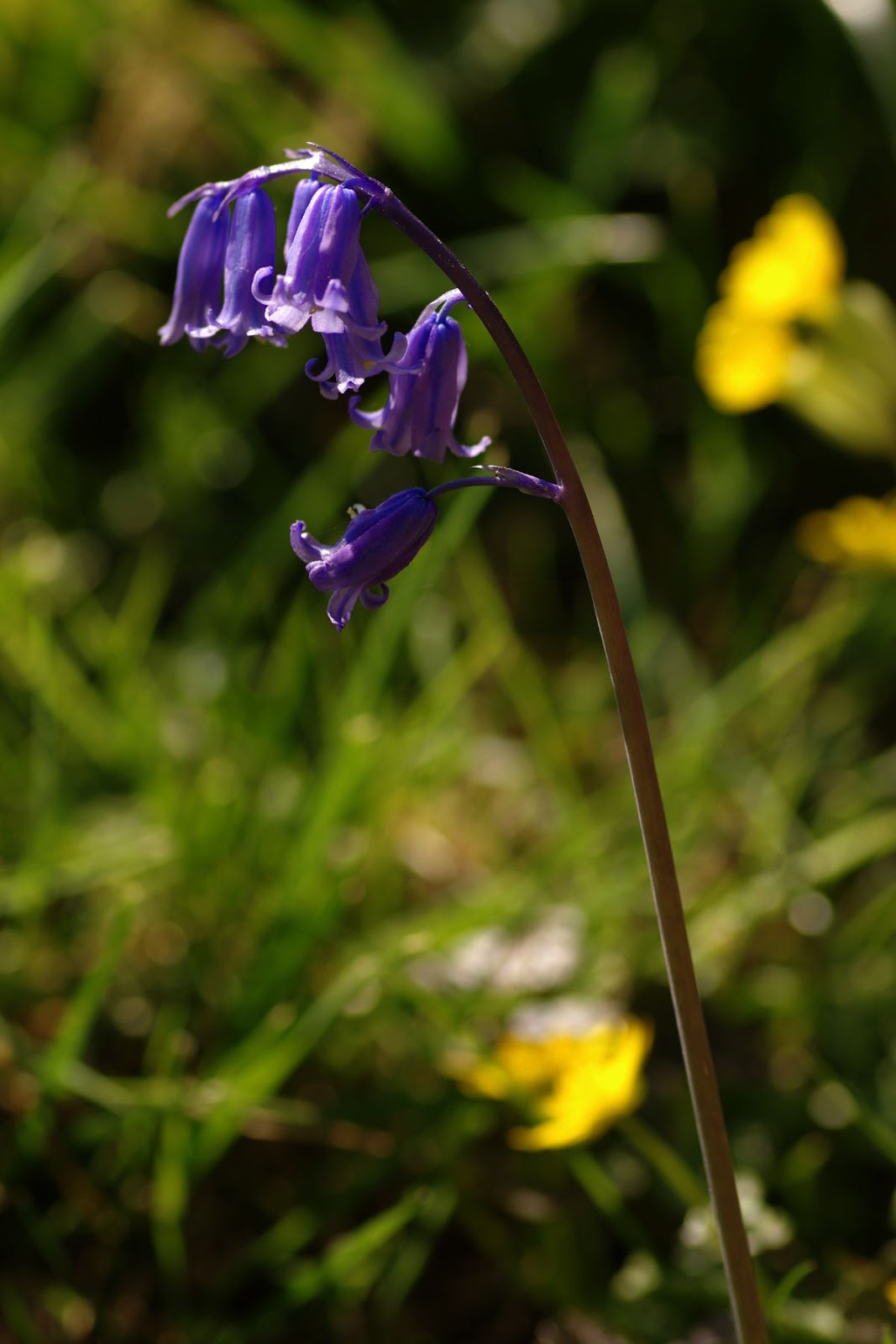
I've decided to add in another visit, four weeks after my first, to see some of the plants that Helen pointed out, before I forgot too much. At the beginning of the month we saw bluebells just beginning to flower. Now both the English and Spanish varieties are in full bloom.
 |
| Honeybee on Spanish Bluebell (possibly hybrid) - notice the bluish pollen |
 |
| English Bluebells showing creamy-coloured pollen. |
There are some lovely clumps of English bluebells (Hyacinthoides non-scripta) alongside some touching modern-day memorials along the East Wall.
 |
| English Bluebells by touching wall memorials. |
Slightly nearer the church, a gravestone from the late 1700s reminded me just how old the Holy Cross churchyard is.
 |
| E.B. 1765 and J. B. 1779. |
The
Caring For God's Acre website - A2 Caring for Grassland tells us:
Apart from grave digging, the grassland will have been relatively undisturbed, re-seeding naturally for hundreds if not thousands of years. ...
A benefit of this continuity of management over a very long time is a diversity of beautiful grasses and flowers and associated animals, some of which may now be uncommon or rare in Britain.
 |
| A tiny (6mm) Red-Girdled Mining Bee on Germander Speedwell. |
Have you ever wondered what pollinates the tiny flowers in the grass? For this Germander Speedwell (
Veronica chamaedrys), the answer is tiny bees. While I was photographing the plant, a bee landed on the sapphire-blue flowers. Thanks to Ryan Clark and Stuart Roberts of the
UK Bees, Wasps and Ants Facebook group, I now know that this is a Red-Girdled Mining Bee (
Andrena labiata). My
Field Guide to Bees, by Steven Falk, says that this little pollinator lives in unimproved grasslands, feeds on Germander Speedwell and Forget-me-nots, nests in short or sparse vegetation and is "scarce".
It seems that the old turf of Holy Cross church is just the place for this little bee. It has escaped the fertilizers and weedkillers intended to "improve" grass but end up driving out wildflowers and the pollinators that depend on them.
Of course I was in the churchyard to find more plants that I could add to my list. I was able to identify about 10 more ranging from a humble Common Chickweed to Ash Trees that make up part of the hedge.
 |
| Large Red Damsel Fly - only about an inch long! |
The hedge is a valuable habitat too. While looking for more plants, I found a damsel fly, who had found sanctuary from the cold wind, amongst its leaves.
 |
| Black Bryony |
Black Bryony has sprung up very rapidly. On our first visit there were only old stems and one, shrivelled fruit. 4 weeks later the stems are carrying the shiny, exotic-looking, leaves up round railings and other supports. Soon, the dainty white flowers will open.
 |
| Pellitory-by-the-Wall. |
A little plant growing in the wall had me stumped. Fortunately, Mum came to the rescue by telling me that it is Pellitory-by-the-Wall (
Parietaria Judaica).
 |
| Pellitory-by-the-wall - tiny female flowers |
Pellitory-by-the-Wall has miniature, wind-pollinated flowers. The plant that I found has female flowers. I wonder if there is a male somewhere nearby?
 |
| Blackbird - making it clear to a rival who owns this patch. |
My couple of hours searching for plants had flown by. As I was completing my survey, a glossy male Blackbird was fending off another, whose presence was clearly unwelcome. The brown female, was nearby and there may well be a nest. I left and hoped that the intruding Blackbird had the good sense to do likewise.