Sunday, 4 January 2026

Botanical Survey 2025 - Buxted

For 2025, I decided to continue "square bashing" - finding all the wild plant species I can in two "tetrads", which are 2km squares on the ordnance survey map. My squares are

  • TQ42W, which covers Buxted Park
  • TQ52B, which includes Buxted Village

I did my surveys on 36 runs, covering 257 km (159 miles). I ran through Buxted Park, which is a Site of Scientific Interest, and explored the village, farmland and woodland.

Optimistically searching for plants in the frost.

I compared the species I found to the BSBI lists for the tetrads so I could see if/when they had been recorded and verified previously. Below, I will mention some of those that were not previously listed and those that had an old listing (1966). I think this represents a range of recording from 1966 to 1999. Either way, it is at least a quarter of a century since the species has been recorded in the tetrad.

Manor Park Estate

As always, the twittens and roadside paths of the Manor Park estate could be relied on to yield some unexpected treasure:
  • Malva sylvestris (Common Mallow) - 1966 listing
  • Verbena officinalis (Vervain) - Not previously listed
Malva sylvestris (Common Mallow)

Views wood

The wood lies between the Manor Park estate and Buxted Park. I found:
  • Lysimachia nemorum (Yellow Pimpernel) - 1966 listing

Stream between Views Wood and Buxted Park (TQ42W)

There is a stream and damp area between the Wood and the Park. The banks of the stream contain various treasures such as Common Valerian as well as:

  • Blechnum spicant (Hard Fern) - 1966 listing
  • Dryopteris affinis (Scaly Male Fern) - not previously listed


Dryopteris affinis (Scaly Male Fern) 

Buxted park

Buxted Park has many splendid trees including some non-natives that are new to the list.

  • Pinus nigra (Corsican Pine) - not previously listed 
  • Quercus rubra (Red Oak) - not previously listed

Pinus nigra (Corsican Pine) 

I also found:

  • Barbarea vulgaris (Wintercress) - 1966 listing
  • Nymphaea alba  (White Waterlily) - not previously listed 

Hurstwood Road and surroundings

The Hurstwood Road opposite the Buxted Park entrance leads to farmland. One field had many wild flowers as well as nesting Yellowhammers.

  • Fumaria officinalis (Common Fumitory) -  1966 listing
  • Sinapis arvensis (Charlock) - not previously listed
Fumaria officinalis (Common Fumitory)

Church Road and surroundings

Nearer to the village, Church Road has many interesting buildings including an Oast house. At the roadside I found:
  • Viola reichenbachiana (Early dog violet) - not previously listed
  • Erophila verna (Common Whitlowgrass) - not previously listed 
Erophila verna (Common Whitlowgrass)

Buxted Road/Station/High Street

The road that bounds the North side of Buxted Park and leads into the village gave me a number of firsts.
  • Barbarea vulgaris (Wintercress) - 1966 listing
  • Malva sylvestris (Common Mallow) - 1966 listing
  • Fallopia baldschuanica (Russian Vine) - not previously listed 
  • Avena satvia (Oat) - not previously listed
  • Viola odorata (Sweet Violet) - not previously listed
  • Medicago arabica (Spotted Medick) - not previously listed

Viola odorata (Sweet Violet) 

Pound Green area 

For some reason Comm Orache is missing from many local lists but I managed to find it in a few sites in and around Buxted including one at the furthest edge of one of my tetrads.
  • Atriplex patula (Common orache) - not previously listed

Atriplex patula (Common orache) 

Lanes

The lanes to the South of Buxted included my most exciting find.

  • Gnaphalium lutoalbum (Jersey Cudweed) - Neville Hutchinson noted that this is a "new tetrad record and 18th this century for East Sussex!"

Gnaphalium lutoalbum (Jersey Cudweed) 

Tickerage Stream and Woodland

There is a lovely little area of woodland, with the Tickerage Stream running through. It contains all sorts of wild flowers such as Wood Anemones, Bluebells and Red Campions. 

  • Lysimachia nemorum (Yellow Pimpernel) - 1966 listing
  • Ranunculus auricomus (Goldilocks Buttercup) - 1966 listing

Ranunculus auricomus (Goldilocks Buttercup) 

Finally

The impact of Monad recording

This time, the Sussex Botanical Recording Society asked us to record the species in each 1km square (monads). To be honest, the change caught me on the hop so rather than planning to do monads from the start, I crudely adapted my tetrad (2km square) plans so that I recorded in 8 small squares rather than 2 big ones.

I can't directly compare numbers of species ticked off per square with last year because of the change from tetrads to monads but:

  • In 2025, I ticked off an average of 83 species per square (8 monads), total = 667, average per km = 2.5
  • In 2024, I ticked off an average of 225 species per square (2 tetrads), total = 451, average per km = 3.8

The "efficiency" in terms of average per km is easily explained by me needing to go further to get into all four quarters of a tetrad rather than just cherry-picking the parts closest to home. To be honest, I bit off more than I could chew with 8 monads. The effect was that I focussed on the most easily found and identified plants. So the promises that I made to myself about learning more about identification of grasses, docks and willowherbs fell by the wayside. I also found it difficult to recall what I had seen where even with the help of my trusty spreadsheet.

In 2026, I intend to give myself space to learn more about my awkward squad by reducing the number of monads to about 5.

Finding "new" species

These tables show the number of species I found in each monad, how many were new to the square and how many were recorded for the first time since "1966"

Buxted Park TQ42W


Buxted village TQ52B 


This year, I have fewer species new to the tetrad or not recorded since 1966. 

Thursday, 1 January 2026

New Year Plant Hunt 2026 - Uckfield North

 This is the third year in a row in which my BSBI New Year Plant Hunt number of species has been kept low (35 wild species in flower) by large amounts of rain reducing many of the plants I am hunting for to mush. This contrasts with some of the preceding years in which an unusually mild Autumn and early Winter has led to species counts in the 40s. The object of the hunt is to find how many wild plants are in flower in the days surrounding the new year.  

It was minus 6 overnight and freezing temperatures continued as I started my hunt just after 9 am. The first few plants that I found were covered in frost.

Pineapple Weed (Matricaria discoidea)
As I scoured the area around Tesco Express, I found myself envying Oscar who was curled up in the warmth of the shop.
Oscar in Tesco Express

On the way up to the town found the usual little weeds and then a summer flower - Hypochaeris radicata (Cat's-ear).
Cat's-ear (Hypochaeris radicata)

The walls around Holy Cross church yielded some finds such as Pellitory-of-the-wall (Parietaria judaica), which has tiny fuzzy little flowers.
Pellitory-of-the-wall (Parietaria judaica)
Trees were playing their part too. Near Bell Farm Road and on the Bellbrook Industrial Estate, Hazel (Corylus avellana) and Alder (Alnus glutinosa) catkins had lengthened and could be included in the count.
Alnus glutinosa (Hazel)

One of my favourite finds was a large patch of Sweet Violet (Viola odorata) with a scattering of flowers.
Viola odorata (Sweet Violet)

I worked my way through the Industrial Estate and then headed back through the town. I finished by checking out the Winter Heliotropes (Petasites fragrans) alongside Manor Park, not far from the Ringles Cross Pub.

Petasites fragrans (Winter Heliotrope)
By the time I finished, the sun had come out but it was cold enough to make me glad that I was heading home.
Nearly home.


At the time of writing:


Sunday, 29 December 2024

New Year Plant Hunt 2025 - Uckfield North

I introduced last year's account of the BSBI New Year Plant Hunt by saying "Recently the weather has been very wet, turning many little weedy plants that were hanging on from the summer to mush." It has been exactly the same this year and the results were quite similar - I got 35 species compared to 36 last year.

Sometimes the number of species found doesn't tell the whole story. For some species that I usually expect to find easily, I had to search really hard to find one or two blooms. For example: Dandelion (Taraxacum officinale), Yarrow (Achillea millefolium), Ivy (Hedera helix) and Red Dead-nettle (Lamium purpureum).

A battered Herb Bennet (Geum Urbanum)

My first find, on the public path just outside our hedge was a very miserable Herb Bennet (Geum Urbanum). Then the usual "weeds" - a lot of Daisies (Bellis perennis) and the odd Dandelion (Taraxacum officinale) etc. A quick visit to the Winter Heliotropes (Petasites fragrans) near Ringles Cross showed that there were far fewer of the pink fluffy flowers than last year.

Yellow Corydalis (Corydalis lutea) at Holy Cross

I meandered through the town to the church and found a lovely group of Yellow Corydalis (Corydalis lutea) on the Holy Cross Church wall.

Holly (Ilex aquifolium)

The Holly (Ilex aquifolium) in Belmont road had a lovely scattering of dainty white flowers. The Hawthorn (Crataegus monogyna) was a little trickier - there were quite a few flowerheads with buds but the one open flower took a lot of finding.

Yarrow (Achillea millefolium) at the Fire Station

Another usually reliable New Year flower that was hard to find was Yarrow (Achillea millefolium). I found a rather scrappy specimen outside the fire station.

Gorse (Ulex europaeus) on Bellbrook Industrial Estate

The Bellbrook Industrial Estate gave me Gorse (Ulex europaeus) and some battered little weeds. 

White Melilot (Melitotus Albus)

Back in November, I found a White Melilot (Melitotus Albus) flowering in the Station car park. It seemed impossible to believe that it's delicate white pea flowers would still be blooming but they were.

White Deadnettle (Lamium album) at the Mill

On the other side of the road, I found some White Deadnettle (Lamium album) while a friendly German Shepherd investigated my bags.

The last Ivy (Hedera helix) flowers in town

Down to my last half-hour, I scurried home, conscious that I had not seen any Ivy (Hedera helix) flowers - there had been plenty of fruit on the plants round the town but not a single flower. I examined the Ivy at the top of the Dene, while discussing the plant hunt with a neighbour. I checked about three quarters of the heads when I found one that was still blooming. After this, I headed home for a much needed hot coffee.

At the time of writing:

  • the Uckfield results are available from Uckfield
  • all results are available from Results.

Friday, 27 December 2024

Botanical Survey - Framfield and Tickerage

For 2024, I decided to continue "square bashing" - finding all the wild plant species I can in two "tetrads", which are 2km squares on the ordnance survey map. My squares are:

  • TQ42V, which contains Framfield, Hempstead and part of the Manor Park Estate, Uckfield 
  • TQ52A, which contains Tickerage.

I did my surveys on 26 runs, covering 119 km (74 miles). It is a fun and fairly productive way of maintaining my fitness and exploring the lanes and footpaths running through villages, farmland and woodland.  

1st Jan 2024 - Wendy with Petasites fragrans (Winter Heliotrope)

I compared the species I found to the BSBI lists for the tetrads so I could see if/when they had been recorded and verified previously. Below, I will mention some of those that were not listed and those that had an old listing (1966). I think this represents a range of recording from 1966 to 1999. Either way, it is at least a quarter of a century since the species has been recorded in the tetrad.

The Uck's floodplain and old horse rescue (TQ42V)

When I head out, I often take the Weald Way across the floodplain and the old horse rescue. As you might expect, the floodplain gave me plenty of moisture-loving species such including:
  • Carex leporina (Oval Sedge) - not listed
  • Juncus articulatus (Jointed Rush) - 1966 listing
  • Gnaphalium uliginosum (Marsh cudweed) - not listed
11 May - Barbarea vulgaris (Winter-cress)
Moving from the floodplain through the upper fields I found:
  • Barbarea vulgaris (Winter-cress) - 1966 listing
  • Jacobaea erucifolium (Hoary Ragwort ) - 1966 listing 
  • Linaria vulgaris (Common Toadflax)  - not listed

The Railway (TQ42V)

22 June - Reseda luteola (Weld)

An alternative route out takes me over the level crossing gives me unusual finds, perhaps due to the limestone trackbed. This year has been no exception, giving me:
  • Reseda luteola (Weld) - 1966 listing

Hempsted Wood (TQ42V)

21 July - Dryopteris affinis agg. (Scaly Male Fern) 
I can then run through a wonderful bluebell wood, where I spotted a Male fern that looked a bit "off". Closer inspection gave me:
  • Dryopteris affinis agg. (Scaly Male Fern) - not listed

Hammonds Green (TQ42V)

3 Feb - Asplenium adiantum-nigrum (Black Spleenwort)

Veering South towards Framfield, takes me through a shady, sunken lane. Here I found various ferns including:

  • Asplenium adiantum-nigrum (Black Spleenwort) - not listed

Framfield village (TQ42V)

27 July Rorippa palustris (Marsh Yellow-cress)

This is a pretty village, but I spurned the charms of the wisteria and hollyhock filled gardens in favour of the drain outside the pub, a path behind the houses and a traffic island, which gave me the following treasures:

  • Rorippa palustris (Marsh Yellow-cress)  - not listed
  • Viola reichenbachiana (Early dog violet) - not listed
  • Torilis nodosa (Knotted Hedge-Parsley)  - not listed

Gatehouse Green Farm (TQ42V)

29 June - Jacobaea aquatica (Marsh Ragwort)

North of the village, we have Conybury Wood and Gatehouse Farm. Below the wood there is an area of marshy pasture. As I came out of the wood, I noticed a splash of yellow in an area of rushes. It looked brighter, less upright and "looser" than normal Ragwort. It was:
  • Jacobaea aquatica (Marsh Ragwort) - not listed

Scantling Farm and surroundings (TQ52A)

29 June - Lepidium coronopus (Swinecress)

I remember Scantlings Farm for a buttercup field providing pasture for two lovely horses. In the lanes nearby there were many flowers and field entrances, particularly to one Potato field, were a happy hunting ground.
  • Lolium multiflorum (Italian Rye Grass) - 1966 listing
  • Arctium lappa (Greater Burdock)  - not listed
  • Lepidium coronopus (Swinecress) - 1966 listing

Tickerage and surroundings (TQ52A)

22 June - Umbilicus rupestris (Navelwort)

At the heart of this area is a bluebell wood, and Tickerage Mill where I chatted with a lovely lady about the film star who once lived there. In nearby lanes where I found:
  • Umbilicus rupestris (Navelwort) - not listed
  • Odontites vernus (Red Bartsia)  - not listed
  • Succisa pratensis (Devil's-bit scabious) - 1966 listing

Finally

For the two tetrads, I recorded:
  • TQ42V, 248 species including 19 not previously listed and 7 with a 1966 listing
  • TQ52A, 203 including 18 not previously listed and 7 with a 1966 listing.
I've found that botanising on the run is a great way of finding plants but the disadvantage is that I can't take my books with me. This means that I am relying more on photos and memorising key differences between similar plants. Lessons learnt for next year are:
  • mostly, the species are inconspicuous or similar to a commoner species so I need to:
    • look carefully
    • pay close attention to familiar plants that look a bit "off"
  • when using the phone app, to double-check each entry prior to upload as sometimes my species selection has not been as intended. I do check them but changes don't always stick
  • learn more about identification of:
    • grasses
    • docks
    • willowherbs.


Saturday, 6 January 2024

2023 - Adding New Species to my List

 As we have reached the end of 2023, I'm looking over my wildlife observations for the year and seeing what is new.  Most of my sightings were within walking or running distance of my home - i.e. in and around Uckfield. Again, numbers of species new to me has increased. This time, I have been doing botanical runs to Five Ash Down and Maresfield, which has added quite a few new plants to my lists. Part of the increase is the addition of a "species suggestion" feature on the iRecord app, which points me in the right direction for species that I previously found too difficult.

At the end of the year the number of new species found were:

  • 85 Species new to my records
  • of which, 46 were new to me.

Here is a selection of species that are new to me or my records.

Lesser Redpoll, 28 Jan, our Uckfield garden

Finding my first new species was a ridiculous stroke of luck. I was actually trying to photograph Goldfinches and House Sparrows on our feeder in preparation for the Big Garden Bird Watch.  It was only when I examined my photos later I found that some of my "Sparrows" had a little red smudge on their heads - making them Lesser Redpolls (Acanthis cabaret).

Harvest Mouse winter nest (9 March)
When I was tidying the garden in early March, I found a nest, which was beautifully constructed from strips of Iris leaf. After some online discussion and some email ping-pong with a Sussex Wildlife Trust Expert, we decided it was a Harvest Mouse's winter nest. I was charmed that one of these tiny creatures had found a home in our garden.

Early Dog-Violet in Nursery Lane, Maresfield
While trotting around the Maresfield area, a neater than usual Dog Violet caught my eye. The spur behind the flower was a little darker than the flower itself - it was an Early Dog-Violet (Viola reichenbachiana).

Early Purple Orchid in woodland
In contrast to my modest little Early Dog-Violet were some rather glamorous-looking Early Purple Orchids (Orchis mascula) that I found while running through a woodland.

Knotted Hedge-parsley, 22 July, London Road, Uckfield

Corn Parsley, 20 Aug, Manor Park Estate and later on bypass
I found two rather scrappy-looking Parsley type plants - Knotted Hedge-parsley (Torilis nodosa) and Corn Parsley (Petroselinum segetum) that, according to the Sussex Flora, have not been previously recorded in our "Hectad" (a 10km x 10km square). Generally, they are found near the coast. Maybe their seeds have been swept along by vehicles.

Goldenrod, 2 Sept, London Road, Uckfield
One of my most delightful finds was a wild Goldenrod, which is a much more delicate version of the ones that can be found in gardens. It was on the woodland edge by the London Road

Soft Shield Fern, 30 July, Maresfield High Street, 
I found a cluster of unusual ferns, including the Soft Shield Fern (Polystichum setiferum) shown, alongside Maresfield High Street. .I particularly like it almost knitted appearance.

Brown Argus, 30 July, The Dene
Unusually, I also had a new butterfly - a Brown Argus (Aricia agestis). The photo shows the underside and the "colon" marking about half-way down the upper edge of the wing, which distinguishes it from other members of the blue family. According to "The Butterflies of Sussex" it was a long way from where these butterflies are usually found.

Clay, 1 July, Manor Park, Uckfield.

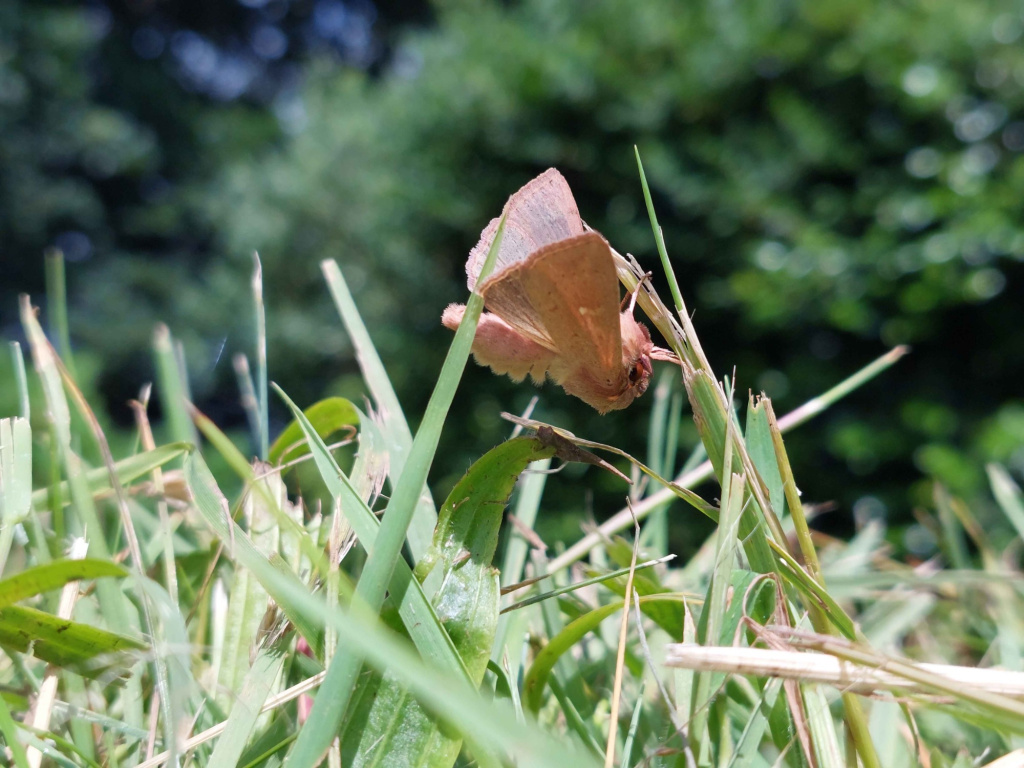
I observed a number of new moth species, most of which seemed to be attracted to the kitchen lights.  An exception was the Clay (Mythimna ferrago) that I spotted in our Uckfield garden.

Common Cardinal beetle, 29 May, Manor Park
A number of new species of beetle included the Common Cardinal beetle, which was in our garden (Pyrochroa serraticornis). It is a predator, which can be found on flowers, trunks and stumps. 

Grey-patched Mining Bee, 27 April, Manor Park
I found just one new species of bee, the Grey-patched Mining Bee, which can be found in open grassland.

Russet Toughshank, 26 Oct, Manor Park

One thing that did like the Autumn rains was fungi - I got several new species for my list including the Russet Toughshank (Gymnopus dryophilus) shown, which was growing near our Oak.

Western Conifer Seed Bug, 22 Aug, Manor Park

The Western Conifer Seed Bug is native to the USA but has become established in the UK since 2007.

So it was a real bumper year for new species, which was partly down to a boost from new technology.